
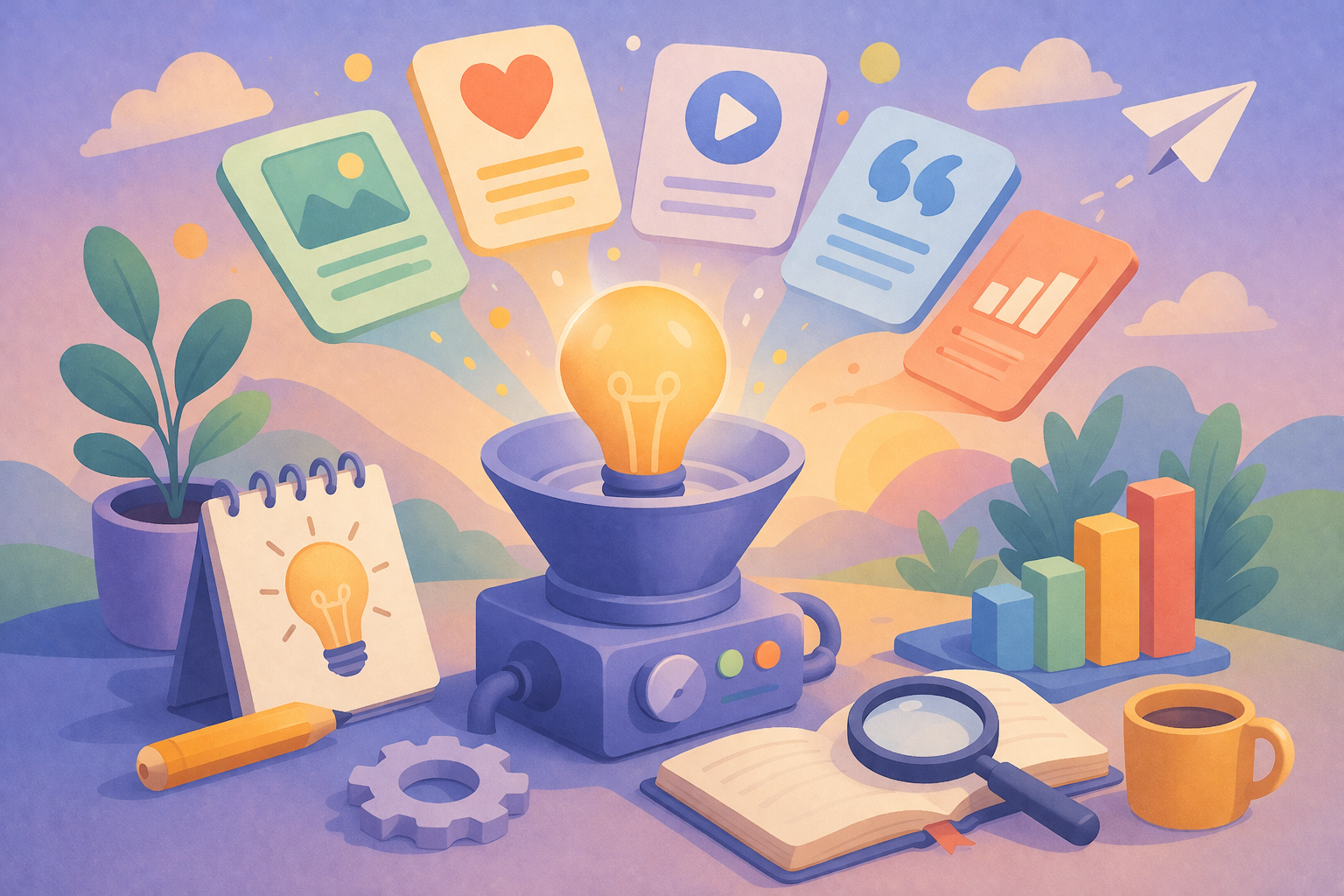
Best Content Idea Generators: Never Run Out of Topics
Use content idea generators to generate content ideas. Find unlimited blog topics and headlines using AI tools. Beat writer's block and never run out of ideas.


Every content creator knows the feeling. You sit down to write, coffee in hand, ready to produce something amazing. And then… nothing. The cursor blinks mockingly on a blank screen. Your mind is empty. You’ve covered every topic you can think of, and inspiration is nowhere to be found.
This is the dreaded content block, and it’s one of the biggest challenges facing marketers, bloggers, and business owners today. In a digital world that demands a constant stream of fresh, engaging material, running out of ideas isn’t just frustrating, it’s a threat to your growth.
But what if you could eliminate creative block forever? What if you had a tool that could generate hundreds of relevant, audience-focused content ideas in seconds, tailored specifically to your business and your goals? This is the promise of a Content idea generator, and it’s transforming how successful creators plan their strategies.
In this guide, we’ll explore everything you need to know about content idea generators. We’ll dive into how they work, why they’re essential for modern marketing, and, most importantly, how you can use them to build a sustainable, high-performing content engine that drives real results.
What Is a Content Idea Generator?
A Content idea generator is a tool designed to help you discover fresh topics for your content marketing efforts. It takes the guesswork and endless brainstorming out of the equation, providing you with a list of relevant, creative, and strategically valuable ideas at the click of a button.
This approach is especially useful for niche SaaS teams creating content around categories such as HR software, employee management, and workforce tools.
While early versions of these tools were simple, essentially random topic spinners, modern content idea generators are powered by artificial intelligence. They analyze your inputs, understand the context of your business and audience, and generate ideas that are not only unique but also strategically aligned with your marketing goals.
How Does a Content Idea Generator Work?
The best AI-powered content idea generators are sophisticated pieces of technology. They combine natural language processing, machine learning, and a deep understanding of content marketing best practices to produce high-quality suggestions. Here’s a simplified look at the process:
-
Input Analysis: You provide the tool with information about your business, your target audience, and the platforms you want to create content for. The more detailed and specific you are, the better the results.
-
Contextual Understanding: The AI analyzes your inputs to understand your industry, your unique value proposition, and the specific needs of your audience. It identifies patterns, key themes, and related concepts that will resonate with your readers.
-
Idea Generation: Using this understanding, the AI generates a list of content ideas. A powerful content idea generator will often structure these ideas according to different stages of the marketing funnel, ensuring you have topics for building awareness, generating interest, nurturing desire, and driving action.
-
Platform Optimization: The best tools also consider the platform you’re creating for. An idea for LinkedIn will look very different from one for TikTok or a blog post. The AI tailors its suggestions to match the format, audience behavior, and best practices of each channel.
The Strategic Benefits of Using a Content Idea Generator
Why should a content idea generator become a cornerstone of your content strategy? The benefits go far beyond just overcoming writer’s block.
-
Save Countless Hours of Brainstorming: The most obvious benefit is the time saved. What might take a marketing team hours of meetings, whiteboarding, and research can be accomplished in seconds. This efficiency allows you to focus your energy on what matters most: creating high-quality content and engaging with your audience.
-
Eliminate Creative Block for Good: Staring at a blank page is a thing of the past. With a content idea generator, you always have a starting point. You can generate ideas on-demand, whenever inspiration runs dry, ensuring a consistent flow of content.
-
Ensure Strategic Alignment: A good generator doesn’t just give you random topics. It provides ideas that are strategically aligned with your business goals. By categorizing ideas by funnel stage, it helps you build a content calendar that addresses your audience’s needs at every step of their journey, from first discovery to final conversion.
-
Generate Platform-Specific Ideas: The modern content creator must wear many hats. You need ideas for blog posts, LinkedIn articles, Instagram reels, TikTok videos, newsletters, and more. A robust content idea generator can create tailored suggestions for each platform, understanding the nuances of what works where.
-
Uncover Fresh Angles and Perspectives: Even when you’re familiar with your niche, it’s easy to fall into a rut, covering the same topics in the same way. A generator can introduce you to new angles, unique formats, and creative spins on familiar subjects that you might never have considered.
Choosing the Right Content Idea Generator for Your Needs
Now that you understand the power of these tools, the next step is to select the right one for your workflow. The market offers a range of content idea generator options, from simple free tools to comprehensive platforms. Finding the right fit involves understanding your needs and the features that will make the biggest difference for your team.
Key Features to Look For
When evaluating your options, certain features separate a truly valuable tool from a basic one.
-
Customization and Input Detail: The best tools allow you to provide rich, detailed inputs. Look for generators that ask for more than just a keyword. The ability to describe your business, define your target audience, and select your marketing channels leads to far more relevant and effective ideas.
-
Marketing Funnel Integration: This is a game-changer for strategic planning. A content idea generator that structures its suggestions by marketing funnel stages, such as Awareness, Interest, Desire, and Action, helps you build a balanced content calendar that guides your audience towards conversion, rather than just creating random top-of-funnel content.
-
Multi-Platform Support: If you create content for multiple channels, you need a tool that understands the differences between them. Look for a generator that lets you select the platforms you’re targeting (e.g., blog, Instagram, LinkedIn, TikTok) and tailors its ideas accordingly.
-
Language Support: For businesses targeting a global audience, multilingual support is essential. The ability to generate content ideas in the languages your audience speaks saves significant time and ensures cultural relevance.
-
Ease of Use and Integration: The tool should fit seamlessly into your existing workflow. A clean, user-friendly interface is a must. For advanced users, integration with other tools like your content management system or social media scheduling platform can streamline the process even further.
Free vs. Premium Tools
The landscape of content idea generators includes a healthy mix of free and premium options, each with its own advantages.
Free Tools: These are an excellent starting point. A free content idea generator allows you to experience the benefits without any financial commitment. They often provide a generous number of ideas per session and are perfect for solo bloggers, small business owners, and startups who are bootstrapping their marketing efforts. The key is to understand that free tools may have limitations on customization, output volume, or advanced features like funnel-stage categorization.
Premium Tools and Platforms: As your content needs scale, a premium solution may become a worthwhile investment. These are often part of larger marketing platforms that offer a suite of tools for content creation, SEO, and analytics. Premium tools typically offer unlimited generations, highly detailed customization, advanced AI models, and seamless integration with other software. For marketing teams and agencies managing content for multiple clients, the time saved and strategic depth provided by a premium tool can easily justify the cost.
For most users, the journey starts with a reliable free tool. It allows you to test the waters, understand the value, and develop a feel for how AI-generated ideas can enhance your creative process before scaling up.
How to Implement a Content Idea Generator in Your Workflow
Knowing what a content idea generator can do is one thing; integrating it effectively into your content creation workflow is where you’ll see the real return on your time. To truly benefit, you need a process that turns generated ideas into a full, strategic content plan.
This section provides a practical, step-by-step guide to making a content idea generator the engine of your content success. It’s designed to be actionable, allowing you to implement these steps immediately.
Step 1: Define Your Inputs with Precision
Before you generate a single idea, take the time to provide the most detailed inputs possible. This is the foundation of your entire process. Think of it as briefing a brilliant strategist.
-
Business Description: Don’t just say “I sell shoes.” Say, “I sell eco-friendly, handcrafted hiking boots designed for serious trail runners and outdoor enthusiasts who value sustainability and durability.”
-
Target Audience: Go beyond “women aged 25-40.” Describe their pain points, interests, and behaviors. “My audience is experienced trail runners who struggle to find durable, eco-conscious footwear that performs in rugged, wet conditions. They are active on Instagram and follow outdoor adventure accounts.”
-
Marketing Channels: Be specific. Are you creating a blog post, a LinkedIn article, an Instagram carousel, or a TikTok video? The format dictates the content.
Actionable Tip: Spend 10 minutes crafting a detailed brief. The quality of the ideas you receive will be directly proportional to the quality of the information you provide.
Step 2: Generate and Categorize Your Ideas
Now, input your detailed brief into your chosen content idea generator and generate your ideas. A powerful tool will present them to you in a structured way, often categorized by the marketing funnel stage (Awareness, Interest, Desire, Action).
Your goal here is not to just pick the first interesting idea. Your goal is to evaluate the list as a whole.
Actionable Tip: Create a spreadsheet and categorize the generated ideas. Note the funnel stage for each. A balanced content calendar will have a healthy mix of all four stages. If you have too many “Awareness” ideas and too few “Action” ideas, you know you need to adjust your inputs to generate more conversion-focused topics.
Step 3: Curate, Combine, and Add Your Human Touch
The AI has done its job of generating a broad range of ideas. Now it’s your turn to act as the editor and strategist.
-
Filter for Relevance: Remove any ideas that don’t feel quite right for your brand or your specific goals.
-
Combine the Best: Maybe you love the angle of one idea but the format of another. Combine them to create a hybrid concept that’s uniquely yours.
-
Add Your Expertise: Think about your own unique experiences, case studies, and insights. How can you add your personal touch to the AI-generated idea to make it truly authentic?
Actionable Tip: For each final idea you select, write a one-sentence “angle.” For example, if the generated idea is “10 Tips for Beginner Runners,” your angle might be “10 Tips for Beginner Runners from Someone Who Couldn’t Run a Mile a Year Ago.” This simple addition adds a layer of personal, compelling storytelling that AI alone can’t provide.
Step 4: Build a Strategic Content Calendar
With a curated list of ideas, it’s time to build your content calendar. This is where you transform a list of topics into a strategic plan.
-
Map to the Funnel: Place each idea on a timeline, ensuring you are consistently serving your audience at all stages of their journey. Start with Awareness topics to attract new visitors, then use Interest topics to engage them, Desire topics to showcase your solutions, and Action topics to drive conversions.
-
Consider Seasonality and Trends: Look at your calendar and see where you can incorporate seasonal topics, industry events, or current trends. A content idea generator can help with this by suggesting timely topics, but it’s your job to integrate them into the larger plan.
-
Plan for Different Formats: Decide which ideas will be long-form blog posts, which will be short videos, and which will be social media series. Your calendar should reflect a diverse content mix that caters to different audience preferences.
Actionable Tip: Use a visual tool like a Trello board, Asana, or a simple Google Calendar to map out your content. Color-code by funnel stage or content type to get a clear, at-a-glance view of your strategy.
Step 5: Execute, Measure, and Iterate
Your content plan is now ready. The final step is execution and continuous improvement.
-
Create Your Content: With a clear idea and angle, the writing or production process becomes much more focused and efficient.
-
Track Performance: After publishing, monitor the performance of your content. Which ideas resonated most with your audience? Which had the highest engagement, shares, or conversions?
-
Refine Your Inputs: Use this data to inform your next session with the content idea generator. If you notice that “list” posts consistently outperform “how-to” posts, adjust your future briefs to favor that format. If a particular audience segment responded well to a specific angle, note that for next time.
Actionable Tip: Create a feedback loop. Every quarter, review your content performance data. Use the insights you gain to refine the business and audience descriptions you use in your generator. This ensures that the tool becomes more effective over time, learning from your real-world results.
Conclusion: Turn Creative Block into Strategic Advantage
In the fast-paced world of digital marketing, consistency is key. A constant stream of fresh, engaging, and strategically relevant content is what builds audiences, establishes authority, and drives growth. But the pressure to constantly generate new ideas can be overwhelming.
A content idea generator is not a replacement for your creativity. It is a powerful tool that removes the friction from the ideation process, allowing you to focus on what you do best: creating content that connects. It transforms a time-consuming, often frustrating task into a streamlined, strategic operation.
By understanding how these tools work, choosing the right one for your needs, and implementing a structured workflow, you can turn creative block into a thing of the past. You can build a content engine that not only runs smoothly but also delivers consistent, measurable results.
Stop letting the blank page dictate your schedule. Start generating, curating, and planning. The perfect content idea for your next big piece is just a generation away. Take the insights from this guide, apply them to your own strategy, and experience the power of having an endless well of inspiration at your fingertips.
Thanks for reading! ❤️
Written by
JenishRead Next

Turn this into your AI Search strategy
LLaMaRush creates SEO, AEO, and GEO optimized content built to rank in Google and get cited by AI answer engines.
Start Ranking Everywhere