
Electrician SEO vs. Google Ads: Best for Leads in 2026?
SEO or Google Ads for electricians? Compare real costs, lead quality and ROI to find the best channel for growing your electrical business in 2026.


You need more service calls, but your marketing budget isn't infinite. Do you invest in the slow burn of SEO or the instant spark of Google Ads? Getting this decision wrong can cost you thousands in wasted spend or missed opportunities.
Let's be real. Most marketing advice is abstract and confusing. As a fellow business owner, you don't have time for theory, you need a clear path to more booked-out weeks. You're not choosing between two marketing tactics; you're choosing between two fundamentally different investments: one that gives you a short-term cash injection and one that builds long-term equity.
This founder-to-founder breakdown cuts through the hype. We'll compare electrician SEO and Google Ads head-to-head on cost, speed, lead quality, and long-term value, using real numbers and scenarios from the trades. By the end, you'll have a concrete framework to decide whether to invest in SEO, Google Ads, or a smart hybrid strategy based on your business's immediate needs and 5-year goals.
You'll understand the real timelines (no sugar-coating), the true costs (with examples), and the types of leads each generates. This isn't about what's "better", it's about what's right for your business right now, so you can build a predictable, sustainable pipeline of customers.
The Core Difference: Building an Asset vs. Renting a Billboard
Let's start with the most critical mental model. Understanding this will make every other decision clear.
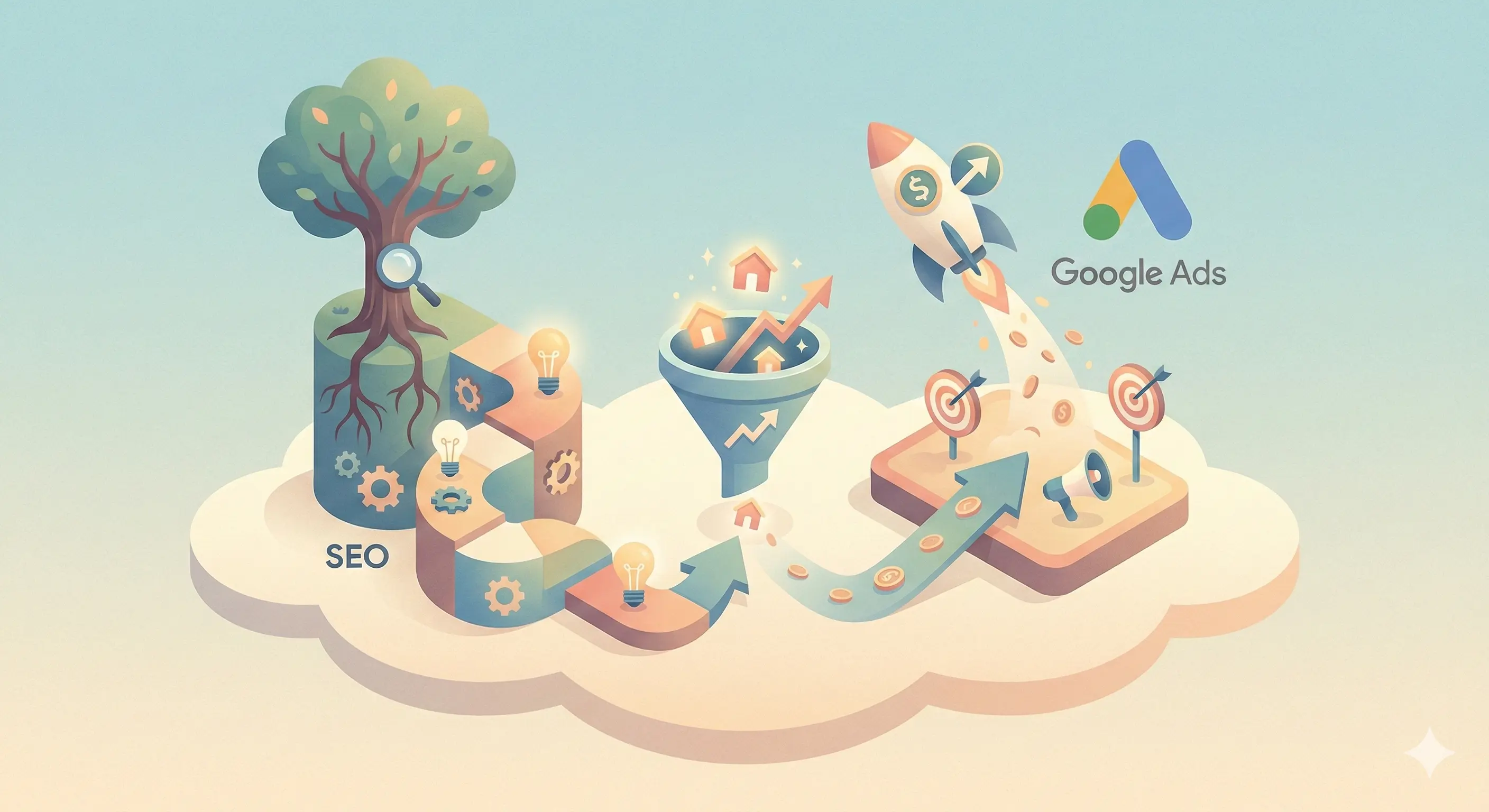
SEO (Search Engine Optimization) is building a permanent, valuable asset. Think of it like buying your commercial property. There's a significant upfront investment, getting the land, pouring the foundation, and constructing the building. It takes time. But once it's built, you own it. It generates revenue for years with relatively low ongoing maintenance. That's what ranking #1 organically for "electrician in [Your City]" is. It's a digital asset you own. It drives calls 24/7 without you paying for each one. If you sell your business, that ranking and the authority it represents have tangible value.
Google Ads (Pay-Per-Click) is renting a premium billboard on the busiest highway. The visibility is immediate and powerful. As soon as you sign the contract and pay, your ad is at the top of the page. But the moment you stop paying, your ad disappears. You own nothing. There's no equity. It's a pure expense for access. This is perfect when you need immediate attention, but it's not a long-term foundation.
The Fundamental Trade-Off: Speed vs. Sustainability.
Google Ads is fast. You can have leads calling within hours of turning on a campaign. SEO is slow. It typically takes 3-6 months of consistent work to see meaningful traction, and 12+ months to dominate. The trade-off is longevity. The leads from SEO keep coming for years. The leads from Ads stop the day your budget runs out.
The Trust Factor: The Organic Stamp of Approval.
Studies consistently show that users trust organic results more than paid ads. An organic listing is perceived as a recommendation from Google-"this is the most relevant, authoritative result for your query." A paid ad is perceived as a business paying to be there. This "organic bias" can lead to higher click-through rates on the #1 organic result than the #1 paid ad, and often attracts customers who are more committed to researching and hiring a quality professional, not just the first number they see.
Head-to-Head Comparison: Cost, Speed, and Lead Quality
Now, let's get into the nitty-gritty. Here’s exactly how these two strategies stack up across the metrics that matter.
Cost Structure: Monthly Expense vs. Capital Investment.
- Google Ads: You pay per click (CPC). In competitive urban markets for electricians, a click for "emergency electrician near me" can cost $25 to $60 or more. If you want 10 calls a month and have a 10% click-to-call conversion rate, you might need 100 clicks. At $40/click, that's $4,000 per month, and you pay that every month for visibility.
- SEO: You pay for expertise and labor (your time or an agency's). A typical investment might be $1,500 - $3,500 per month for a professional agency, or your own time valued at 10-20 hours a month. The key difference: You do NOT pay per lead. Once you rank, you can get 100 clicks for $0. Your cost per lead plummets over time.
Speed of Results: Instant vs. Gradual.
- Google Ads: You can be live in 24 hours. With proper setup, you can get your first call on day one. It's the ultimate short-term lever.
- SEO: This is a process. Here's a realistic timeline:
- Months 1-3: Foundation work (technical website fixes, Google Business Profile optimization, initial content). You may see a small, gradual increase in impressions.
- Months 4-6: Early rankings for less competitive terms (long-tail keywords like "flickering light repair [Town]"). Lead flow begins.
- Months 7-12+: Climbing rankings for core terms ("electrician [City]", "panel upgrade"). Lead volume becomes significant and stable.
Lead Quality & Customer Intent.
Both target high-intent users actively searching for solutions. The difference is in the stage of their journey.
- Google Ads excel at capturing urgent, transactional intent. The person searching "24 hour emergency electrician" is in panic mode and likely to call the first reputable option they see. These are great for immediate revenue but can be one-off jobs.
- SEO captures the full spectrum: from urgent searches to comparison and research intent. The person reading your "Ultimate Guide to Home Rewiring" is planning a major project. They are building trust with you over weeks. When they call, it's for a $8,000 rewire, not a $200 outlet repair. SEO builds relationships that lead to higher lifetime customer value.
Comparison Table: Electrician SEO vs. Google Ads at a Glance
| Factor | Google Ads (PPC) | SEO (Organic) |
|---|---|---|
| Investment Model | Ongoing rental fee (Cost-Per-Click). Pay to play, stops when you stop. | Upfront/investment in building an asset. Ongoing maintenance cost. |
| Time to First Leads | Hours to days. Instant visibility upon campaign launch. | 3-6 months minimum. Requires patience and consistent effort. |
| Long-Term Effect | None. Zero equity built. Pure expense. | Compounding. Rankings solidify, authority grows, asset value increases. |
| Best For | Immediate cash flow, testing services, covering gaps, hyper-competitive short-term plays. | Building a sustainable, sellable business, maximizing long-term ROI, establishing local authority. |
| Key Metric to Watch | Cost Per Lead (CPL) and Return on Ad Spend (ROAS). | Organic traffic growth and keyword ranking positions. |
| Primary Risk | Wasting budget on poor targeting, bad ad copy, or inefficient landing pages. | Algorithm changes, long time horizon, and inconsistent execution can delay or prevent results. |
| Customer Perception | "This company paid to be here." | "Google recommends this company as a top result." |
When to Choose Google Ads (The Fast Track)
Google Ads is your tool when speed is the primary objective. Here are the specific scenarios where it makes undeniable sense.
Launching a New Business or New Location.
You have the licenses, the truck, and the tools, but no customer base. You need immediate cash flow and, critically, social proof (reviews, testimonials, case studies). Running a targeted Google Ads campaign for your core services in your service area can get you those first 10-20 jobs quickly. This revenue and these customer stories become the fuel for your long-term SEO strategy.
Testing Service Demand or Market Viability.
Considering adding EV charger installation but not sure if there's demand in your area? Instead of investing in extensive content, run a focused ad campaign for "EV charger installation [City]" for 60 days. Track the clicks, calls, and estimates generated. The cost of the campaign is your market research fee. If it's profitable, you now have confidence to create SEO content around that service.
Covering Seasonal Gaps or Promoting Limited-Time Offers.
July is slow for indoor electrical work? Run a 4-week campaign promoting "Generator Tune-Up & Safety Inspection" before hurricane season. Running a "Free Electrical Safety Inspection for Seniors" promotion? Ads can get that message in front of the right audience immediately. Use Ads as a tactical tool to smooth out your revenue and fill specific schedule gaps.
Operating in a Hyper-Competitive Market Where Organic is Locked Up.
If you're a new electrician in a major city and the top 3 organic spots are held by decades-old companies with 500+ reviews, ranking organically may be a 2-year battle. Google Ads lets you "buy" your way onto page one today, giving you a fighting chance to compete while you simultaneously build your organic presence for the long haul.
Critical Warning: Success with Google Ads is not automatic. A poorly structured campaign with broad keywords, bad ad copy, or a slow website will burn cash with little return. You must track phone calls back to the ad and know your true cost per booked job.
When to Choose SEO (The Foundation Builder)
SEO is the strategic choice for building a business that lasts, reduces your stress, and maximizes your profit over a 5-10 year horizon.
Building a Sustainable, Long-Term (or Sellable) Business.
If you want a business that isn't reliant on you constantly feeding it advertising dollars, SEO is the answer. It builds a systemic lead generation engine. Imagine your website ranking #1 for your top 10 service keywords. That engine works while you sleep, on weekends, and during holidays. It also makes your business more valuable if you ever want to sell. A company with a dominant organic presence is worth far more than one dependent on paid ads.
Establishing Unshakeable Local Authority.
SEO, especially local SEO centered around your Google Business Profile, positions you as the expert in your area. When you consistently produce helpful content (blogs on electrical safety, project galleries, service pages), earn genuine reviews, and engage with your community online, you build a reputation that transcends any single ad. People start to recognize your brand as the leader. This authority protects you from competitors and price wars.
Maximizing Return on Investment (ROI).
The math is compelling over time. Let's say you invest $2,500/month in SEO for 12 months ($30,000 total). In year one, you break even. But in year two, you maintain those rankings for a lower maintenance cost ($1,500/month). The leads keep flowing. Your cumulative cost per lead becomes a fraction of what you'd pay for Ads. The lifetime value of an organically acquired customer who trusts you for multiple projects (panel upgrade now, backyard lighting later) is often higher.
Supporting a Stable, Mature Business.
If you have a solid base of recurring commercial clients or a steady stream of referrals, you have the runway to invest in SEO without desperate need for immediate leads. You can afford to play the long game, knowing that the asset you're building will future-proof your business against dry referral periods or economic dips.
Important Reality Check: SEO is not "set and forget." It requires patience, consistency, and adaptation to Google's constant algorithm updates. You are building a garden, not laying concrete.
The Winning Hybrid Strategy for 2026
The most successful, growth-oriented electricians don't see this as an either/or choice. They use both tools strategically, with each one supporting the other. This is the powerhouse approach for 2026.
The Dominant Page Effect: Combined Visibility.
When a potential customer searches for "electrician near me," what do they see? They see 3-4 paid ads at the top, then the local map pack (powered by local SEO), then organic results. If your business appears in the paid ads and the map pack, you dominate the screen. This dramatically increases brand recognition and trust. Studies show this dual presence can increase click-through rates by over 150%. The customer thinks, "This company must be legitimate, they're everywhere."
Use Ads to Fund and De-Risk Your SEO Investment.
This is a brilliant financial strategy. Start a moderate Google Ads campaign to ensure a baseline of leads and revenue now. Allocate a portion of that new revenue directly to funding a comprehensive SEO program. The ads pay for the SEO. Over 12-18 months, as your organic rankings climb and begin generating their own leads, you can gradually and strategically reduce your ad spend. You've used short-term capital (ads) to build a long-term asset (SEO) without straining your cash flow.
Use SEO Data to Supercharge Your Ads.
Your Google Search Console (which comes with SEO) shows you exactly what people are searching for when they find you organically. These are golden keywords for your Ads. For example, your SEO content might start ranking for "cost to install a 240v outlet for dryer." That's a high-intent, commercial keyword you can now add to your Google Ads campaign with high confidence. SEO becomes your free, ongoing keyword research tool for Ads.
A Practical Phased Hybrid Approach:
-
Month 1-3: Launch a foundational Google Ads campaign ($1,500-$2,500/month) targeting urgent/intent keywords. Simultaneously, begin Phase 1 SEO: perfect your Google Business Profile, ensure website technical health, and create 3-5 core service pages.
-
Month 4-9: Continue Ads. Begin Phase 2 SEO: launch a blog/content plan, build local citations, actively seek reviews. Start seeing early organic leads.
-
Month 10-18: As organic leads hit 30-50% of your total, begin reducing ad spend by 10-20% per quarter, re-investing those savings into advanced SEO (video content, link building). The goal is to shift the lead source mix from 80% ads/20% organic to 20% ads/80% organic.
Your Action Plan: How to Decide for Your Business
Stop overthinking. Answer these questions and follow the actionable steps.
Conduct a 5-Minute Self-Assessment:
-
Timeline: "Do I need consistent leads within the next 90 days to pay bills?"
-
Budget: "What is my true, dedicated monthly marketing budget (not including truck wraps or home show booths)?"
-
Competition: "If I search 'electrician [My City]' right now, are the top 3 organic results from giants with hundreds of reviews?"
-
Vision: "Do I want to build a business I could sell in 10 years, or am I focused on maximizing my personal income for the next 2-3 years?"
Budget Allocation Recommendations (Monthly):
- < $1,000: Focus 100% on SEO fundamentals. Do it yourself: perfect your GBP, get 20 reviews, write one great service page per month. Ads at this budget will be gone in 10 clicks.
- $1,500 - $3,000: Implement an 80/20 Hybrid. $2,400 on SEO (agency or dedicated time), $600 on a tightly focused Google Ads campaign for emergency services only.
- $3,000+: Implement a 50/50 or 60/40 Hybrid. You have the budget to compete on both fronts aggressively. Use Ads for immediate project leads and SEO to build your brand and capture high-value planning clients.
First Steps for Each Path:
- If choosing Google Ads First:
-
Set up Google Ads conversion tracking (phone calls, contact forms).
-
Start with a small daily budget ($30-$50) targeting 2-3 high-intent keywords like "[City] emergency electrician."
-
Create a simple, dedicated landing page with a clear phone number and a strong call-to-action ("Call Now for 24/7 Service").
-
- If choosing SEO First:
-
Conduct a full audit and optimization of your Google Business Profile (use our previous guide).
-
Fix NAP (Name, Address, Phone) consistency across the web.
-
Choose your most profitable service and create one comprehensive, 1,500-word "ultimate guide" page for it (e.g., "The Homeowner's Complete Guide to Electrical Panel Upgrades in [City]").
-
The Non-Negotiable Foundation:
Regardless of whether you choose Ads, SEO, or both, you must have a professional, mobile-friendly website and a systematic process for generating and responding to customer reviews. Traffic without trust converts poorly.
Conclusion
For immediate, measurable leads to fill your schedule this month, Google Ads is your tool. It's the fastest way to turn marketing dollars into phone calls. For building a business asset that generates high-quality calls for years with virtually no per-lead cost, SEO is your foundation. It's the smartest long-term investment you can make in your company's digital future.
The most successful electricians in 2026 won't choose one over the other based on dogma. They'll be strategic pragmatists. They'll use Google Ads as a tactical scalpel to address immediate needs and opportunities, while simultaneously investing in SEO as a strategic foundation to build an enduring, valuable, and less stressful business.
Key Takeaway: Don't think of this as a choice between marketing tactics. Think of it as a capital allocation decision. Allocate to Google Ads for short-term operational revenue. Allocate to SEO for long-term business equity. The best strategy uses both to cover the present and secure the future.
Frequently Asked Questions (FAQ)
Q1: What's a realistic monthly budget to start seeing results with Google Ads for an electrician?
A1: To be effective and gather enough data to optimize, you need a minimum budget of about $1,500 per month. This allows for 50-100 clicks in a competitive market, which can translate to 5-15 phone calls, depending on your ad and landing page quality. Starting with less than $1,000/month often means your ads stop showing by midday, and you can't gather enough data to improve them.
Q1: Can I do SEO myself, or do I need to hire an agency?
A1: You can absolutely handle the core fundamentals yourself: optimizing your Google Business Profile, asking for reviews, and creating basic service page content on your website. This "DIY SEO" can get you decent results, especially in smaller towns. However, to compete for top rankings in competitive markets, navigate technical issues, and execute a consistent content strategy, an experienced agency or consultant will almost always achieve better results faster. It's the difference between doing your own taxes and hiring a CPA.
Q3: How do I track if my SEO or Google Ads are actually working?
A3: For Google Ads, use their built-in conversion tracking to track phone calls and form submissions directly attributed to ad clicks. In your monthly reporting, look at "Cost per Conversion" (a booked job) not just "Cost per Click." For SEO, use Google Search Console. Track organic traffic growth, keyword ranking positions (use a tool like Semrush or Ahrefs), and most importantly, track phone calls that mention "Google" or "your website" when they call. The ultimate metric for both is revenue generated per month from each source.
Q4: What about Local Service Ads (the "Google Guaranteed" badges)? How do they fit in?
A4: Local Service Ads (LSAs) are a separate, lead-generation product from Google where you pay per lead (not per click). Google vets your license and insurance, and you get a "Google Guaranteed" badge. They appear above even paid ads. They are excellent for generating high-intent leads, but you have no control over your ad copy, and the cost-per-lead can be very high. Think of LSAs as a powerful supplement. If you have the budget, running LSAs for emergency services alongside a traditional Google Ads brand campaign and SEO is a "triple dominance" strategy. Start with core SEO and Google Ads first, then add LSAs once you have the systems to handle the lead volume.
Thanks for reading! ❤️
Written by
VirajRead Next


Turn this into your AI Search strategy
LLaMaRush creates SEO, AEO, and GEO optimized content built to rank in Google and get cited by AI answer engines.
Start Ranking Everywhere