
Find Competitor SEO Blind Spots: Content Gap Analysis Guide
Discover what your competitors are missing. This content gap analysis reveals untapped keywords and topics to dominate your niche in 2026.


You've done the keyword gap analysis. You know you're missing 'best CRM software' and 'email automation tools'. But your traffic still lags, and your conversion rates haven't budged. You're pouring resources into content that feels like shouting into a crowded room.
What if you're looking for gaps in the wrong places?
Traditional keyword gap analysis shows you what terms you're missing, but it's utterly blind to why that matters to a human being moving through a buying journey. It misses the strategic, intent-driven holes in your competitor's content strategy across the awareness, consideration, and decision stages. You end up fighting for the same high-volume, low-intent keywords as everyone else, while high-value buyers slip through unseen cracks in your competitor's funnel.
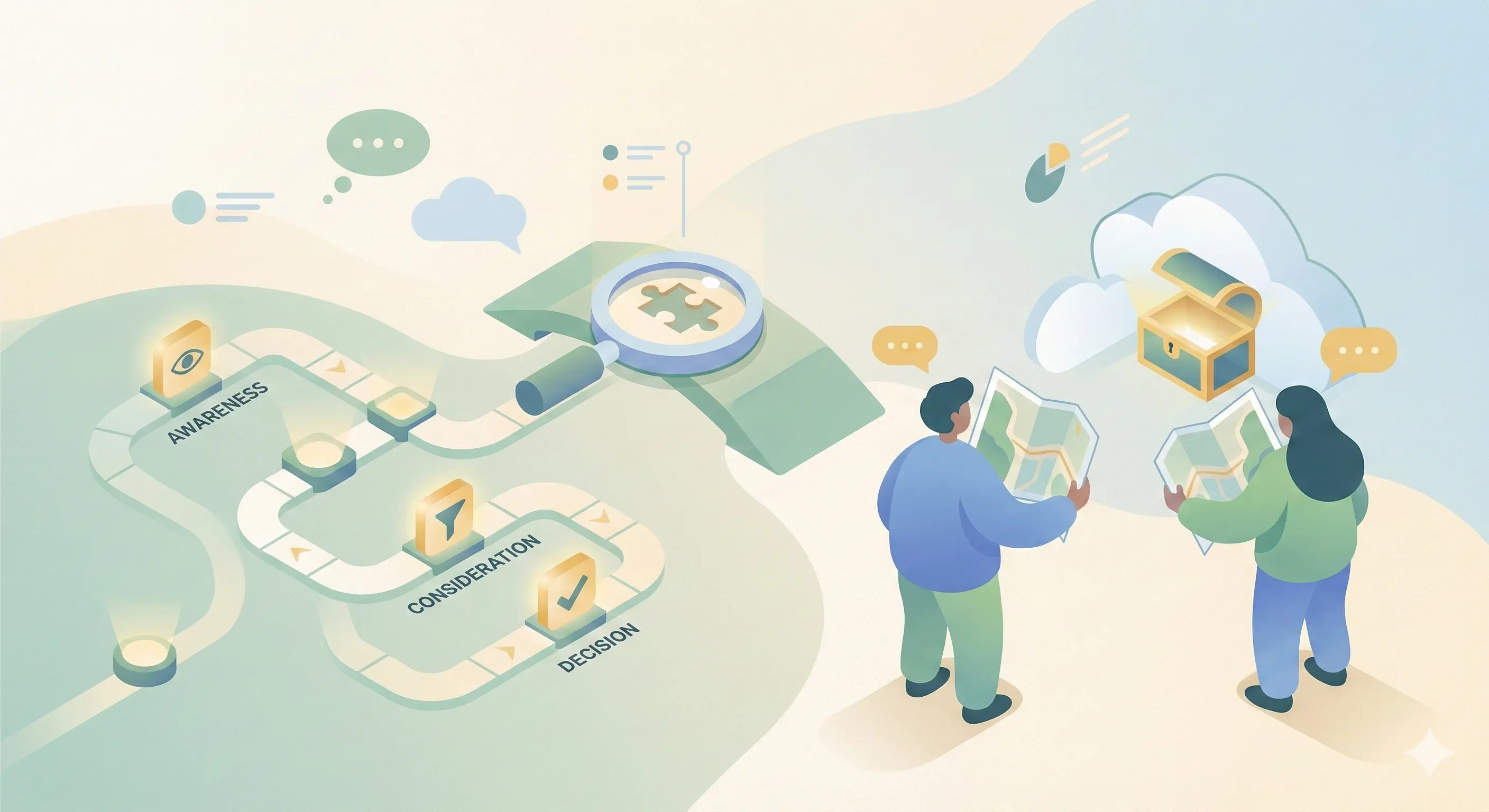
This guide is different. You'll learn a 5-step framework to map your content against competitors' through the lens of the buyer's journey. This reveals high-intent gaps they've missed, allowing you to capture ready-to-buy traffic by addressing questions and concerns they've ignored. Let's move beyond keywords and start analyzing intent.
Why Keyword Gap Analysis Alone Leaves Money on the Table
Keyword gap tools are fantastic for generating a list of terms your competitors rank for and you don't. But that list is just data, it lacks context. It tells you the "what," but completely obscures the "why" and the "when" in the customer's journey.
This leads to a critical mistake: prioritizing content by search volume alone. You might chase a keyword with 10,000 monthly searches about "what is marketing automation" (awareness stage) while ignoring a keyword with 1,000 searches for "marketo vs hubspot integration capabilities" (decision stage). The second keyword, though lower in volume, signals a user who is solution-aware, comparing options, and much, much closer to a purchase. The commercial intent is through the roof. A single conversion from that piece could be worth more than a thousand visitors from the top-funnel term.
This volume-focused approach funnels you into creating commoditized, top-of-funnel content that doesn't convert. You're stuck in an endless content arms race for educational pieces that, while they might drive traffic, do little to build authority for your specific solution or nurture a prospect toward a sale. Your content strategy becomes a leaky bucket.
We need to shift from analyzing keyword gaps to identifying intent gaps. A keyword gap is just a missing phrase. An intent gap is a missing answer to a critical question a potential buyer has at a specific stage of their journey. It's the difference between knowing you need a page about "CRM software" and knowing your competitors have failed to explain how a CRM handles a complex, industry-specific sales process during the consideration phase.
The Commoditization Trap of Top-Funnel Focus
Here’s what happens when everyone targets the same high-volume awareness terms: you create nearly identical content. Google "project management software," and you'll find dozens of articles with the same basic definitions, the same list of generic benefits, and the same superficial "top 10 tools" lists. This is the commoditization trap.
You're competing on minutiae, slightly better formatting, a few more examples but not on substance that changes a buyer's mind. The ROI diminishes because you're fighting for a crowded, ad-filled search results page where the user's intent is purely educational, not commercial.
Meanwhile, in the middle of the funnel, the consideration stage is often barren. This is where a buyer knows they have a problem ("my team's projects are always delayed") and is evaluating different solution categories ("should I use a Gantt chart tool, a Kanban board, or a full work OS?"). This stage is ripe for detailed, comparison-heavy, and deeply educational content that builds real authority. Yet, most competitors are too busy churning out more "what is" articles to build the definitive guide that helps a buyer navigate this complex decision. This is your blind spot, and your golden opportunity. By filling these mid-funnel intent gaps, you attract a more qualified audience and position your product as the informed, expert choice before the "best tools" list even comes into view.
The 5-Step Framework for Buyer Journey Gap Analysis
This framework moves you from a scattergun keyword list to a strategic content plan. It’s about working smarter, not harder, with your limited resources.
Step 1: Define Your Core Buyer Persona & Journey Stages
You can't map a journey if you don't know the traveler. Start by crisply defining your primary buyer persona. Then, map their journey in 3-4 key stages. A classic model is:
- Awareness: Problem-aware. They experience symptoms ("leads are falling through cracks") but may not know the solution category.
- Consideration: Solution-aware. They know possible solutions ("we need a CRM") and are evaluating categories, features, and approaches.
- Decision: Product-aware. They are comparing specific products/vendors and are ready to choose.
- Retention (Bonus): Customer-aware. They have bought and need onboarding, advanced use cases, and success content.
For each stage, document their key questions, pain points, and the content formats they likely consume.
Step 2: Map Your Own Content Assets to Each Stage
Audit your existing content. Take every key blog post, guide, video, and tool, and assign it to a journey stage. Does that "Ultimate Guide to SEO" belong in Awareness (problem: no traffic) or Consideration (solution: need an SEO tool)? Be honest. This creates your "as-is" map and often reveals you're over-indexed on one stage (usually Awareness) and weak in others.
Step 3: Identify & Map 3-5 Key Competitors' Content
Do the same for your competitors. Pick 3-5 true competitors (those going after the same budget with a similar solution). Use tools like Ahrefs or Semrush to export their top pages. Manually review their cornerstone content, resource hubs, and video channels. Categorize their top 50-100 pieces of content into your same journey stages.
Step 4: The Gap Analysis Matrix: Visualizing Overlap and White Space
This is where the insight happens. Create a simple matrix.
Step 5: Prioritize Gaps by Intent Strength & Resource Investment
Not all gaps are equal. A gap in the Decision stage is typically higher priority than one in Awareness because the intent is stronger. Prioritize based on: a) The stage of the journey (Decision > Consideration > Awareness), b) The estimated commercial intent of the topic, and c) The effort required to create a best-in-class asset for that gap.
Building Your Buyer Journey Map
Don't overcomplicate this. Use a simple table to get started.
| Journey Stage | User's Mindset | Sample Questions & Pain Points | Ideal Content Formats |
|---|---|---|---|
| Awareness | "I have a problem." | "Why are my sales reports inconsistent?" "Is there a better way to track customer emails?" | Blog posts, infographics, short-form social video, industry reports. |
| Consideration | "I'm exploring solutions." | "CRM vs. spreadsheets: which is better for a small team?" "Key features to look for in a CRM." | Comparison guides, webinars, case studies (problem/solution focused), feature checklists, ROI calculators. |
| Decision | "I'm ready to choose a vendor." | "[Your Product] vs. [Competitor]: integration comparison." "Can this CRM handle a complex sales cycle?" | Product comparisons, detailed case studies (with results), demo videos, free trials, pricing pages, integration docs. |
| Retention | "How do I succeed with this?" | "Advanced automation workflows for our new CRM." "How to train our sales team on the new system." | Tutorials, knowledge base, advanced webinars, customer community, success stories. |
Creating the Gap Analysis Matrix
You can do this in a spreadsheet. List journey stages as rows. As columns, have yourself and each competitor. In each cell, note the strength and type of content they have for that stage.
| Journey Stage | Your Company | Competitor A | Competitor B | Gap/Opportunity |
|---|---|---|---|---|
| Awareness | Strong: 10+ blog posts on core problems. | Very Strong: Active YouTube channel with problem-solution videos. | Weak: Only a few basic articles. | Format Gap: We lack video content for problem-awareness. |
| Consideration | Weak: Only one "features guide." | Moderate: Good comparison blogs. | Missing: No content comparing solution categories. | Major Gap: No one owns "CRM vs. Email Marketing Tool" deep dive. |
| Decision | Moderate: Case studies, but no direct comparisons. | Strong: Detailed "vs. Competitor" pages. | Weak: Pricing page only. | Intent Gap: We lack head-to-head comparison content that Competitor A has. |
| Retention | Missing: No advanced onboarding. | Missing: No post-sale content. | Missing: No help beyond support tickets. | Blue Ocean: No one is creating retention content. Could be a major advantage. |
This visual makes it obvious where competitors are weak or absent, and where you are over-investing in crowded spaces.
Interpreting the Gaps: Finding Competitor Blind Spots
The matrix doesn't just show gaps; it reveals your competitors' strategic blind spots, areas where they fundamentally misunderstand or undervalue the customer's journey. Here are the most common and valuable ones to look for.
Blind Spot 1: The 'Consideration Chasm' This is the most lucrative gap. Many companies jump straight from "what is" (Awareness) to "buy my product" (Decision). They skip the messy middle where buyers are actively educating themselves to make a smart choice. If your competitor has great introductory content and strong product pages, but no detailed guides comparing methodologies, frameworks, or solution architectures, they've left a chasm. You can build a bridge of authority right through it with comprehensive comparison content.
Blind Spot 2: Missing 'Post-Purchase' Content Almost everyone ignores the retention stage. They spend 95% of their content budget on acquisition. This is a massive blind spot. Creating onboarding checklists, advanced tutorial series, and community-building content does two things: it reduces churn for your existing customers, and it signals to prospects that you care about their long-term success, not just the sale. A competitor who lacks this is vulnerable.
Blind Spot 3: Over-indexing on One Format If all your competitors are blogging, the blind spot might be video or interactive content. If they all have webinars, maybe it's a detailed, evergreen ebook. A journey gap can be a format gap. A buyer in the consideration stage might prefer an interactive tool (e.g., "ROI calculator") over a long article. Spotting a format monopoly is a clear opportunity to differentiate.
Blind Spot 4: Ignoring Specific Micro-Moments Your competitors might cover broad topics but miss specific, high-intent niche questions. For a CRM, this could be "how to handle lead scoring for a B2B service business with long cycles." This is a micro-moment in the Consideration/Decision stage. It has lower search volume but extreme relevance and intent. Ranking for these "edge case" queries makes you the expert for that specific audience.
Validating a Blind Spot: How do you know it's a real opportunity and not just an irrelevant niche? Check for: 1) Existing forum questions (Reddit, industry communities) on the topic, 2) The presence of "people also ask" questions in SERPs around related broad terms, and 3) Use Google's Keyword Planner to see if related terms have any traffic, keeping in mind that for bottom-funnel terms, even 50-100 searches/month can be highly valuable.
Case Study: How We Found a $50k MRR Gap in a 'Saturated' Market
We worked with a B2B SaaS company in the crowded email marketing space. A standard keyword gap analysis showed them competing for all the usual terms. But when we mapped the buyer journey, we noticed a stark gap in the Decision stage. All major competitors had feature lists and pricing pages, but none had in-depth, technical documentation answering a critical question for their enterprise buyers: "How does this platform handle complex data synchronization with our legacy CRM via custom APIs?"
The search volume for the specific keyword was low. But the intent was unmistakable. We created a detailed, technical guide with code snippets, architecture diagrams, and a comparison of their flexible API vs. competitors' more rigid approaches. They promoted it through their sales engineers and targeted communities.
Within 90 days, that single piece of content was directly credited by the sales team with influencing over $50,000 in new monthly recurring revenue (MRR) from three enterprise deals. The prospects said they chose our client because this content proved the platform could handle their complex edge case, while the competitors' glossy marketing materials ignored it. This was a pure intent gap no keyword tool would have ever surfaced.
From Analysis to Action: Building Your Content Roadmap
Now, turn insight into execution. You have a list of gaps; you need a prioritized plan to fill them. If you want to move faster from analysis to topics, use a tool to turn competitor gaps into content ideas before you start building the roadmap.
First, prioritize your gaps. Use a modified ICE Score:
- Impact: What is the potential business value? (High for Decision stage, Medium for Consideration, Lower for Awareness).
- Confidence: How sure are you that addressing this gap will work? (Based on your validation).
- Ease: How difficult/expensive is it to create a best-in-class asset for this gap?
Score each from 1-10, average them, and work on the highest scores first.
Match content formats to the journey stage and gap type. A Consideration-stage gap about comparing methodologies is perfect for a webinar or a definitive guide. A Decision-stage gap about a specific feature is ideal for a detailed product page or a comparison tool.
Structure your content briefs differently. A brief for a "journey gap" piece isn't just about keywords; it's about intent and positioning.
Align with other teams. Share your gap analysis with Sales and Customer Success. Ask them: "Do prospects really ask this? What's the real question behind it?" This ensures your content addresses authentic, painful gaps.
Set stage-specific KPIs. Don't just measure traffic.
- Awareness Content: Measure traffic, branded search lift, social shares.
- Consideration Content: Measure time on page, newsletter sign-ups, content download rates.
- Decision Content: Measure lead quality (form submissions), demo requests, and, critically influenced pipeline revenue. Use your CRM to tag leads that come from these high-intent pages.
The Journey-Optimized Content Brief Template
Here’s how to brief a writer or creator to fill a strategic gap:
- Target Journey Stage: [e.g., Consideration]
- Competitor Gap Being Addressed: [e.g., "No detailed content comparing 'account-based marketing' vs. 'lead-based marketing' approaches for our industry."]
- Core User Question: [e.g., "We're investing in marketing automation. Should we structure our strategy around ABM or traditional lead gen?"]
- Primary Keyword & Intent: [e.g., "ABM vs lead generation" - Commercial Investigation]
- Competitor Content to Review/Analyze: [List 2-3 competitor URLs that are weak or missing on this topic]
- Our Unique Angle/Answer: [e.g., "Argue that hybrid is best for mid-market, introduce our 'Pipeline Orchestration' framework that bridges both."]
- Key Sections/Structure Must Include: [List, e.g., Definitions, Pro/Cons table for each, Hybrid approach explanation, Tooling requirements for each]
- Desired Action for Reader: [e.g., Download our "Hybrid Marketing Playbook" (gated) or Book a consultation to assess their tech stack.]
- Success Metrics: [e.g., 5+ minute average time on page, 3% conversion to playbook download.]
Tools & Templates to Operationalize Your Analysis
You don't need an enterprise budget to do this. A mix of manual analysis and affordable tools works perfectly for startups.
Manual vs. Tool-Assisted Analysis: For your first analysis, go manual. It builds crucial intuition about your market and competitors. After that, use tools to scale and update the process quarterly.
Recommended Stack:
- For Keyword & Content Discovery: Ahrefs, Semrush, or Moz. Use them to export competitor top pages and see keyword rankings by URL.
- For Organizing the Journey Matrix: Airtable (ideal for flexibility and linking records) or Google Sheets (simple and free). We've built a template for you (see below).
- For Intent Validation: conversion tracking tools (see what existing high-intent pages perform well), Reddit/industry forums, and direct interviews with your sales team.
Making It Sustainable: Don't let this become a quarterly nightmare. Block a 2-hour recurring meeting every quarter. One person pre-populates the tool data. In the meeting, the marketing (and sales) team reviews the matrix, scores 2-3 new potential gaps, and assigns one to be tackled next quarter. This keeps your strategy agile and focused on the biggest opportunities.
Conclusion
The most valuable content opportunities aren't found in the crowded, red-ocean keyword lists alone. They're hidden in the strategic holes in your competitor's understanding of the customer journey. These intent gaps, the unanswered questions in the consideration chasm, the ignored post-purchase needs, the overlooked micro-moments are where you can speak directly to a buyer when they are most ready to listen. You stop competing on generic keywords and start winning by addressing specific, high-intent needs better than anyone else.
Frequently Asked Questions (FAQ)
Q1: How often should I perform a buyer journey content gap analysis?
A1: For most B2B SaaS companies, a quarterly review is ideal. The market, your competitors, and customer concerns evolve. A quarterly check-in ensures your content roadmap stays aligned with real-time opportunities and doesn't become stale. You can do a "light" refresh monthly by simply checking if any new competitor content has emerged for your high-priority gap areas.
Q2: What if my product serves multiple buyer personas with different journeys?
A2: Start with your most important persona, the one driving the majority of revenue or your ideal customer profile. Run the full analysis for them first. Once that framework is built, you can create additional journey maps for secondary personas and overlay them to find gaps that might serve multiple audiences. Trying to do all personas at once from the start is a common way to get paralyzed. Prioritize and sequence.
Q3: How do I measure the ROI of content created to fill a journey gap vs. standard SEO content?
A3: Track different KPIs tied to the stage. For decision-stage gap content, track influenced pipeline value in your CRM by tagging leads from that page. For consideration-stage content, track lead quality (e.g., form submissions that turn into sales-qualified leads) and engagement metrics (time on page, scroll depth). Compare these metrics to your top-funnel awareness content. You'll often see a lower traffic volume but a significantly higher conversion rate and lead quality, proving the higher ROI of intent-focused content.
Thanks for reading! ❤️
Written by
JenishRead Next


Turn this into your AI Search strategy
LLaMaRush creates SEO, AEO, and GEO optimized content built to rank in Google and get cited by AI answer engines.
Start Ranking Everywhere