
SEO Content Automation: From GSC to WordPress
LLaMaRush automates your SEO content pipeline with GSC, AI, and WordPress, from keyword research and content planning to publishing.


To automate your SEO content pipeline, you connect real search data from Google Search Console to AI-driven keyword research, content gap analysis, brief generation, drafting, and WordPress publishing. This guide walks through the six core automation steps,from GSC keyword mining to performance tracking,so you can publish data-backed articles without manual research, spreadsheet juggling, or copy-paste publishing.
Who this is for: Founders, marketing leads, and content managers at startups and SMBs who are drowning in manual content tasks and need a scalable, data-driven system.
What you'll learn:
- How to mine Google Search Console for high-intent keywords automatically
- How to turn content gaps into a prioritized content roadmap
- How to generate SEO content briefs and full drafts with AI
- How to publish straight to WordPress via API and track ROI with GA4
Why now: 64% of content marketers already use AI tools in their strategies, and teams that adopt AI for content management report 45% more efficient workflows. The tools and APIs to automate the entire chain are mature. The only missing piece is the process,which this guide provides.
Introduction
Imagine publishing high-ranking, data-backed SEO articles on your WordPress site without touching your keyboard for research, drafting, or scheduling. That is not a distant fantasy,it is a workflow you can build today with Google Search Console, AI language models, and the WordPress REST API.
Traditional SEO content creation is fragmented and slow. Keyword research lives in spreadsheets, briefs sit in shared docs, drafts are written in a separate editor, and publishing is a manual copy-paste ritual. Each handoff introduces delay, context loss, and error. For a small team, producing one optimized article can consume most of a week. That is why so many content engines stall after a handful of posts.
By the end of this guide, you will know how to automate your SEO content pipeline from keyword research to WordPress publishing. You will learn where the human still matters, what Google actually thinks about AI-generated content, and how LLaMaRush fits into a modern content operations stack as the connective tissue between search data, AI drafting, and your CMS.
Why You Should Automate Your SEO Content Pipeline
An automated SEO content pipeline is a connected system where keyword data flows from Google Search Console into AI-powered research, briefing, drafting, and CMS publishing without manual handoffs. It replaces siloed spreadsheets and copy-paste workflows with API integrations, enabling consistent publishing at scale while keeping human review at the final quality gate.
The Cost of a Manual SEO Content Workflow
The manual approach to content operations is not just tedious; it is expensive in ways most teams underestimate. According to research on core content marketing task times, initial keyword research takes 8-16 hours for most small businesses. Planning and organizing a single month of content takes another 10-12 hours. Writing one blog post takes roughly 4-5 hours, and uploading it to your CMS takes 1-2 hours more.
Add those together and a single monthly content cycle, research, plan, write, publish, can easily consume 25 to 35 hours. For a lean team, that is nearly a full work week dedicated to producing just a handful of articles, before any optimization or performance analysis happens.
The deeper problem is fragmentation. Each stage uses a different tool: a spreadsheet for keywords, a document for briefs, an editor for drafting, and the WordPress admin panel for publishing. Every silo creates friction:
- Keywords lose their search-intent context when copied into a brief
- Briefs get ignored or misinterpreted by writers
- On-page SEO elements like meta descriptions and slugs are added inconsistently
- Nothing feeds performance data back into the next round of research
The result is a content operation that is slow, inconsistent, and nearly impossible to scale. Small teams publish less than they could, and the content they do publish is often not aligned with what their GSC data says users actually search for.
Here is my experience with manual SEO work: I purchased the SEMrush subscription for 6 months, did the competitor research and keyword research, made the different spreadsheets for keywords, blogs, competitors, SERP results and spent a lot of time figuring out what to write, how to write, and how to get mentioned and cited by AI. It was hectic, draining, and very tiring for me, and if you still don't get the result, it's sad. Then I thought of building LLaMaRush, which extracts the keywords on which my site is already ranking, makes keyword and topic clusters, and generates a brief on this blog topic. After editing and finalizing the brief, you can generate the blog, which is optimized according to SEO and your GSC data on which you are already ranking on the 2nd or 3rd page.
What an Automated Pipeline Looks Like
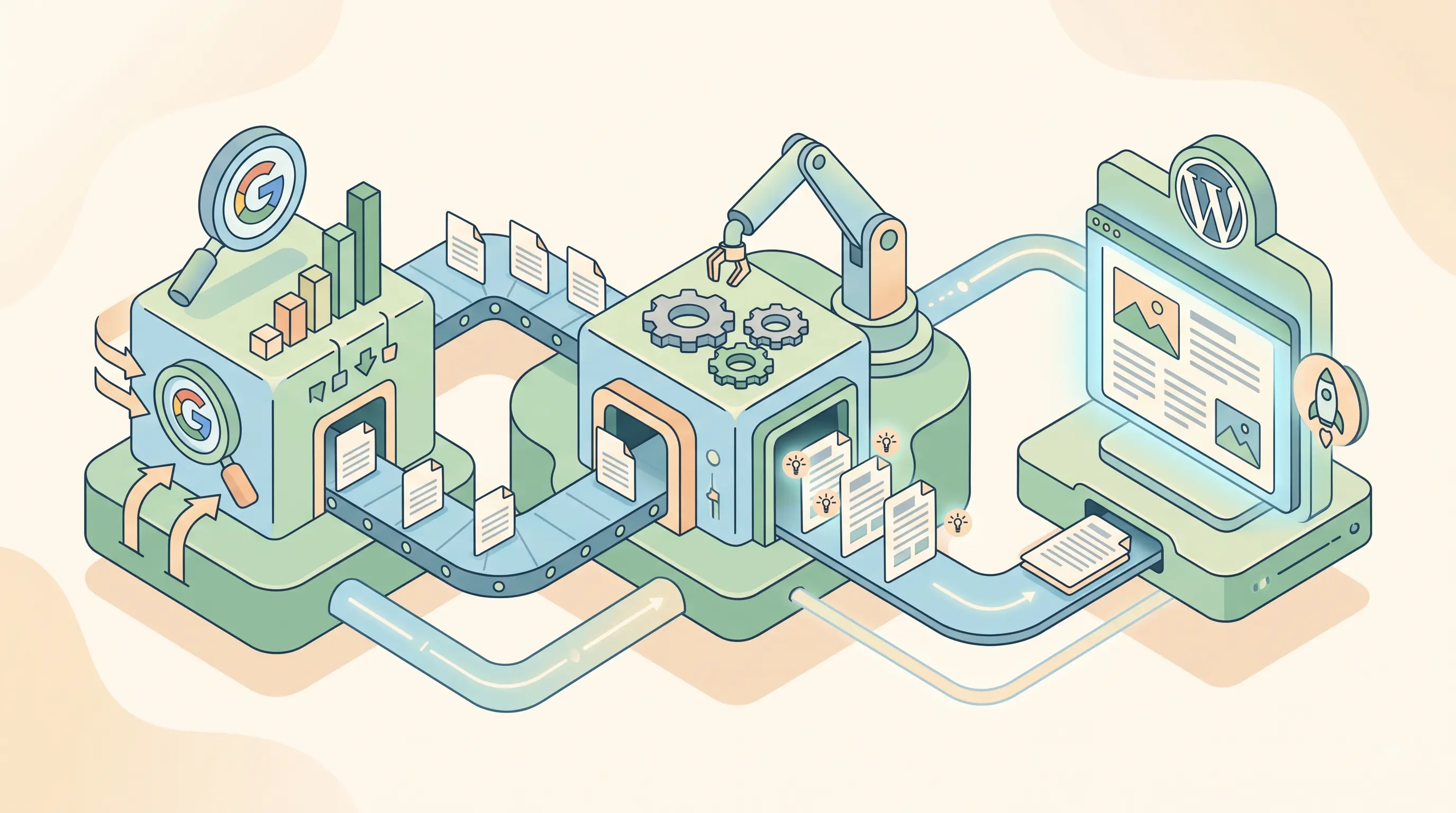
An automated pipeline removes the handoffs, not the judgment. The end-to-end flow looks like this:
- Keyword research: Google Search Console API exports real query data into an AI workflow that clusters keywords and generates long-tail variations.
- Content gap analysis: The system compares your existing rankings against competitor domains to surface missing topics.
- Brief generation: An AI model builds a complete SEO content brief, title, outline, target keywords, NLP terms, and internal links from the opportunity list.
- Drafting: An LLM writes a first draft following the brief, with on-page SEO elements like title tags and meta descriptions generated automatically.
- Publishing: The finished post is pushed to WordPress through the REST API, with categories, tags, and templates applied programmatically.
- Measurement: GSC and Google Analytics 4 data flow back into the system to identify winners, update underperformers, and inform the next content cycle.
This is not just about speed. Data-driven automation improves content relevance because every decision- which keywords to target, what to cover, how to structure it- comes from actual search performance data rather than opinion.
It is also aligned with Google's official position. Google's Search guidance about AI-generated content states that ranking systems reward original, high-quality content that demonstrates E-E-A-T (Experience, Expertise, Authoritativeness, and Trustworthiness), regardless of whether it is human or AI-generated. Google does not penalize AI content; it penalizes poor-quality content. The "Experience" component was added to the E-E-A-T framework in December 2022, meaning first-hand knowledge and demonstrated expertise matter more than ever. Automation is not a loophole,it is a way to produce more of the high-quality content Google rewards.
| Workflow Stage | Manual Approach | Automated Pipeline |
|---|---|---|
| Keyword research | 8–16 hours in spreadsheets | Minutes via GSC API and AI clustering |
| Content planning | 10–12 hours per month | Auto-generated opportunity list with priorities |
| Brief creation | Inconsistent, often skipped | Standardized AI briefs with SERP-backed structure |
| Drafting | 4–5 hours per post | AI first draft in under 15 minutes |
| Publishing | 1–2 hours of copy-paste | Instant via WordPress REST API |
| Performance tracking | Manual report pulling | Check page tracking |
Two common myths hold teams back. The first is that automation kills quality. In reality, 79% of teams using AI for content management report improved content quality, because AI handles the mechanical work while humans focus on expertise and editing. The second myth is that automation is only for large enterprises. That is false; 67% of small business owners and marketers now use AI for content marketing or SEO.
LLaMaRush fits into this stack as the orchestration layer. It connects to Google Search Console to analyze traffic, rankings, and content gaps, then carries that data through research, strategy, drafting, and direct CMS publishing. You still own the brand voice and final approval, LLaMaRush removes the busywork between data and published post.
Step 1: Automate Keyword Research with Google Search Console & AI
Automated keyword research replaces manual brainstorming and paid-tool guesswork with real query data from Google Search Console. By exporting performance metrics via the GSC API and letting AI cluster semantically related terms, you build a live keyword universe that reflects actual user intent for your domain.
Mining GSC Data for High-Intent Keywords
Google Search Console is the single most underused keyword research tool for most sites. Every query that earns impressions,even at position 10 or 15,is a proven demand signal from Google itself. The Google Search Console API provides programmatic access to search performance data such as clicks, impressions, and average position, with more flexibility than the user interface. It also allows you to retrieve up to 16 months of data and apply complex filters.
To mine that data automatically:
- Export your top 1,000-5,000 queries from GSC, including impressions, clicks, CTR, and average position.
- Filter out branded and navigational queries so you focus on topics that can attract new audiences.
- Apply position-based filters to find "cusp" keywords,queries sitting between positions 5 and 20. These are pages that already have traction and need only a content refresh or an internal link boost to break into the top 3.
- Filter for impression volume to separate high-potential topics from zero-impression noise.
| GSC Filter | Purpose | Recommended Threshold |
|---|---|---|
| Average position | Find cusp keywords | 5–20 |
| Impressions | Gauge demand | 100+ over 90 days |
| CTR | Detect title/meta issues | Below 3% = optimization opportunity |
| Query type | Remove brand noise | Exclude domain name variants |
One important caveat: GSC data is available with a 2-3 day delay. That is fine for content planning, because keyword demand shifts slowly. What matters is that the data is real, attributable to your domain, and refreshed regularly.
Using AI to Enrich and Cluster Keywords
Raw GSC exports are messy. A hundred queries might describe only ten distinct topics. This is where large language models shine. AI can group semantically related keywords into topic clusters, identify the searcher's underlying intent, and generate additional long-tail variations that GSC never surfaced because your site does not rank for them yet.
For example, GSC might show you ranking for "content gap analysis" at position 6. An AI clustering step can group that with "keyword gap tool," "content gap analysis tool," and "automated content strategy" into a single cluster. It can then generate variations like "how to do a content gap analysis for SEO" and "content gap analysis example" to expand the cluster into a complete topic.
LLaMaRush automates this process by converting GSC data into an always-fresh keyword universe. As you publish and rankings change, the keyword lists update automatically- no more rebuilding spreadsheets from scratch every quarter.
Step 2: Identify Content Gaps with Automated Analysis
Automated content gap analysis looks at the keywords your site already has visibility for and identifies opportunities where your content can gain more search visibility. The output is a prioritized set of content opportunities based on your actual search data, rather than a generic list of keywords.
Finding Opportunities from Your Existing Rankings
Keyword research tells you what people search for. Your own search data tells you where your site already has traction. Google Search Console shows the queries where your pages are getting impressions and clicks, including keywords where you have visibility but could rank higher.
A practical approach:
- Connect your Google Search Console to access your site's real search performance data.
- Analyze your ranking keywords to find queries where your site has existing visibility and potential to improve.
- Identify content gaps by looking for relevant topics and keyword opportunities that your existing content does not adequately cover.
- Group related opportunities into content clusters, so you can build on existing topical relevance instead of publishing disconnected articles.
These gaps become your content opportunities. Existing clusters can also be expanded with related topics, helping strengthen your coverage around areas where your site already has ranking potential.
Turning Gaps into Content Opportunities
Not every keyword opportunity deserves an article. The goal is to prioritize topics where your site has a realistic opportunity to gain visibility and where the subject is relevant to your business.
LLaMaRush analyzes your Search Console data and evaluates up to 1,000 keywords weekly to identify content opportunities across both existing and new clusters. It then uses those opportunities to build your SEO and AI Search content plan, turning raw search data into a practical publishing roadmap.
Step 3: Generate Optimized Content Briefs Automatically
An AI-generated content brief is a data-driven blueprint for an article that includes target keywords, search intent, suggested headings, NLP terms, entity recommendations, and FAQs. Generated automatically from your content gap list, it ensures every draft is built on SERP analysis rather than guesswork.
Components of an AI-Generated Content Brief
A brief is the contract between your keyword data and the final article. When generated by AI from real search data, it standardizes quality across every post. The essential components include:
| Brief Component | Purpose |
|---|---|
| Target keyword & secondary keywords | Defines the semantic focus and on-page optimization targets |
| Search intent | Determines whether the content should inform, compare, or convert |
| Working title & meta title | Provides the H1 and title tag direction |
| Suggested H2/H3 outline | Mirrors the structure of pages currently ranking in the top 10 |
| NLP terms & entities | Ensures topical depth and relevance for AI search engines |
| FAQs | Captures featured snippet and People Also Ask opportunities |
| Target word count & format | Matches the depth and format the SERP rewards |
The value of automation here is consistency. A human writer might produce excellent briefs once a week; an AI brief generator produces them for every opportunity in your backlog, instantly, in the same format. If you want to test the workflow manually first, you can auto-generate briefs for your pipeline before committing to a full autopilot setup. LLaMaRush does this at scale: it converts the content opportunity list from Step 2 directly into structured briefs, so your team never stares at a blank page.
How to Ensure Briefs Align with Search Intent
Search intent is the difference between an article that ranks and an article that bounces. The clearest signal of intent is the current SERP. When an LLM analyzes the top-ranking pages for a keyword, it can infer:
- Format: Are the winners listicles, long-form guides, or comparison tables?
- Tone: Are they technical, beginner-friendly, or commercial?
- Depth: Do the top results run 1,000 words or 5,000 words?
- Content type: Are these blog posts, product pages, or video transcripts?
LLaMaRush uses the tone you provided in setting, format, and depth so your article matches the pattern Google already rewards. The brief generation step also supports an approval workflow: the AI produces the brief, your content lead reviews and approves it in minutes, and only approved briefs move to drafting. This preserves editorial control without slowing the pipeline.
Step 4: Draft Articles with AI and Optimize for SEO
AI content creation drafts a complete, SEO-optimized article from your approved brief using a large language model, generating everything from headings and body copy to title tags and meta descriptions. The human-in-the-loop review remains essential for brand voice, factual accuracy, and subject-matter expertise.
Using AI to Write SEO-Friendly First Drafts
Once a brief is approved, the drafting stage turns it into a first draft. The quality of the output depends on two variables: the quality of the brief and the generation parameters you set.
- Prompt construction: The best prompts are full briefs,target keyword, outline, entities, FAQs, and tone guidance,not a single sentence like "write about SEO automation." LLaMaRush feeds the complete structured brief into the model, which is why its drafts arrive close to publish-ready.
- Temperature: Lower temperature settings (0.2–0.5) produce more factual, consistent output, which is what you want for SEO content.
- Model choice: Different LLMs have different strengths in topical depth and readability. Your pipeline should allow switching models without rebuilding the workflow.
The time savings are measurable. 36% of AI users spend less than one hour on long-form content that typically takes two to three hours without AI assistance. For a team producing ten articles a month, that is a full working week recovered.
On-Page SEO Optimization: Titles, Meta Descriptions, and Headings
The same automation that writes the body should handle the on-page elements. Keyword placement across the article should follow a consistent pattern:
- Title tag: Target keyword near the front, under 60 characters
- Meta description: A benefit-driven summary under 155 characters that includes the keyword naturally
- URL slug: Short, keyword-rich, and stripped of stop words
- H1: Mirrors the title but reads naturally
- H2/H3 tags: Include secondary keywords and reflect the outline from the brief
- Structured data: Automatically add schema markup appropriate to the content type, such as Article or FAQPage schema, to improve eligibility for rich results
LLaMaRush automates all of these during the drafting phase. The post arrives in WordPress with its meta fields, slug, and categories already populated, so no one has to remember whether the meta description convention is being followed.
Human Review: The Indispensable Step
Automation does not eliminate the need for human review, and pretending otherwise is a mistake. Google's E-E-A-T framework,with Experience added in December 2022,rewards demonstrated expertise. An LLM can draft, but it cannot know what your first-hand experience with your customers taught you.
Build a lightweight review workflow that does not become a bottleneck:
- Fact-check pass: Verify statistics, product claims, and anything time-sensitive.
- Brand voice pass: Adjust phrasing so the article sounds like your company, not like "a model."
- Experience pass: Add your own examples, screenshots, or lessons that no competitor can copy.
- Final publish approval: One click, straight from the review interface into WordPress.
The goal is a human review that takes 20–30 minutes per article, not days. That is the human-in-the-loop model that balances scale with quality.
Step 5: Automate Publishing to WordPress
WordPress publishing automation uses the WordPress REST API to create, update, and publish posts programmatically from your AI content tools. With an API connection, articles flow from draft approval directly into WordPress with categories, tags, featured images, and metadata already configured,no copy-paste required.
Integrating Your CMS with AI Content Tools
WordPress ships with a REST API that provides an interface for applications to send and receive data as JSON objects. This API allows programmatic management of site content, including creating, updating, or publishing posts. Every WordPress site, including self-hosted installs and WordPress.com business plans, exposes these endpoints.
To connect LLaMaRush to your WordPress site:
- Generate application credentials (API keys) in your WordPress dashboard under Users → Profile → Application Passwords.
- Enter the API credentials in LLaMaRush's CMS integration settings.
- Configure the default post template, default category, tag assignments, author attribution, and status (draft or published).
- Map your SEO fields (meta title, meta description, slug) to the corresponding WordPress fields or SEO plugin fields.
- Test with a draft post before enabling automatic publishing.
The integration is secure: the WordPress REST API requires authentication for creating, updating, or deleting content, so your credentials are validated on every request.
Scheduling and Publishing Best Practices
Automation gives you control, not chaos. Best practices keep the pipeline clean:
- Publish as drafts first: Allow the human review step to happen in WordPress itself, then schedule or publish from a single queue.
- Use an editorial calendar: LLaMaRush can schedule posts based on your calendar, spacing out publication to maintain a consistent cadence.
- Prevent duplicate content: Ensure your pipeline checks for existing posts with the same slug or title before creating a new one. Duplicate content is an SEO problem, and automation without guardrails can multiply it.
- Use webhooks for triggered publishing: Connect your drafting stage to WordPress via webhooks so an approved post automatically moves to "scheduled" while new data from GSC keeps the pipeline fed.
Manual publishing takes 1–2 hours per post. With API integration, that step becomes a background task measured in seconds.
Step 6: Track Performance and Iterate with Automations
SEO performance tracking closes the loop by connecting your published content to real search performance through Google Search Console and your existing analytics data. Reviewing performance regularly helps you see which content decisions are driving growth and which opportunities deserve another round of optimization, without manually rebuilding your strategy every week.
Using GSC to Measure Content Performance
Publishing is not the end of the pipeline; it is the midpoint. The final stage feeds performance data back into the system. Google Search Console shows the queries, pages, impressions, clicks, CTR, and average positions behind your organic search performance.
Connect that data to your content and you can answer questions like:
- Which articles are generating the most clicks and impressions?
- Which keywords moved from page 2 toward page 1 after publishing new content?
- Which topics are gaining traction and deserve additional content or internal links?
LLaMaRush uses your real Search Console data to continuously identify ranking opportunities, evaluate up to 1,000 keywords weekly, and build a content strategy around what your site is already showing potential for. Instead of publishing based on generic keyword lists, your content pipeline stays connected to actual search performance.
Automating Performance-Based Content Planning
Manual performance analysis-exporting reports, reviewing keyword changes, identifying opportunities, and rebuilding your editorial calendar is the kind of repetitive work automation exists to eliminate. LLaMaRush continuously analyzes your search data and turns those insights into an actionable content plan:
- Winners: Keywords and pages gaining clicks and visibility
- Opportunities: Keywords where your site has existing ranking potential
- Content gaps: Relevant topics your current content does not adequately cover
- New clusters: Related topics that can expand your existing topical coverage
The goal is not simply to publish more content. It is to keep feeding real search performance back into the content strategy, so every new article is informed by what your site has already achieved. LLaMaRush combines Search Console-powered planning with automated content generation and CMS publishing, creating a continuous loop from data to strategy to published content.
The final benefit of closing the loop is compounding. Ranking opportunities become new content. New content generates more search data. That data informs the next strategy. The pipeline improves based on actual search performance rather than gut feel, which is the difference between a content operation that grows and one that simply keeps producing.
FAQ
Q1: Is AI-generated content bad for SEO?
A1: No. Google's guidance about AI-generated content explicitly states that its ranking systems reward original, high-quality content that demonstrates E-E-A-T, regardless of whether it is human or AI-generated. Google penalizes poor-quality content, not AI content. The key is that AI-generated articles must be helpful, original, and backed by real expertise,which is why human review of AI drafts remains essential.
Q2: How long does it take to automate an SEO content pipeline?
A2: The initial setup, connecting Google Search Console, configuring LLaMaRush, and integrating WordPress via the REST API, can be completed in a few hours for a technically comfortable marketer or founder. Once configured, the time per article drops dramatically. Keyword research that took 8–16 hours manually runs in minutes, drafting takes under an hour, and publishing drops from 1–2 hours of copy-paste to a single approval click.
Q3: Do I still need human editors if I automate content creation?
A3: Yes. Automation handles the mechanical work, research, clustering, drafting, formatting, and publishing, but Google's E-E-A-T framework rewards demonstrated Experience and Expertise. A human reviewer should fact-check claims, adjust brand voice, and add first-hand experience to every article. A lightweight review pass of 20-30 minutes per post preserves quality without becoming a bottleneck.
Conclusion
Automating your SEO content pipeline is not just a time-saver; it is a competitive advantage that lets you publish more relevant content, faster, and with data backing every decision. The manual approach consumes 25–35 hours per monthly content cycle, spreads your work across disconnected tools, and leaves performance data unused. An automated pipeline powered by Google Search Console data, AI drafting, and the WordPress REST API compresses that cycle from weeks to days.
The steps are clear: connect GSC to uncover real keyword opportunities, identify content gaps from your existing search data, build a prioritized content strategy, generate and optimize articles with AI, publish directly to your CMS, and use performance data to continuously refine the pipeline. LLaMaRush turns this process into an automated workflow, connecting search insights, content planning, AI writing, and publishing so your SEO strategy keeps improving without the repetitive manual work.
Ready to build your automated content engine? Try LLaMaRush free and go from keyword discovery to WordPress publishing on autopilot.
Thanks for reading! ❤️
Written by
JenishRead Next

14 Best SEO Automation Tools for Bootstrapped SaaS Founders (2026)

8 SEO Automation Tools Honestly Compared

LLaMaRush vs Doing SEO Yourself: Time Cost, Results & the Real Trade-Off (2026)

Google E-E-A-T Explained: Build Trust & Rank Higher in 2026

12 Best AI Content Tools for Product-Led SaaS (2026)
Turn this into your AI Search strategy
LLaMaRush creates SEO, AEO, and GEO optimized content built to rank in Google and get cited by AI answer engines.
Start Ranking Everywhere