
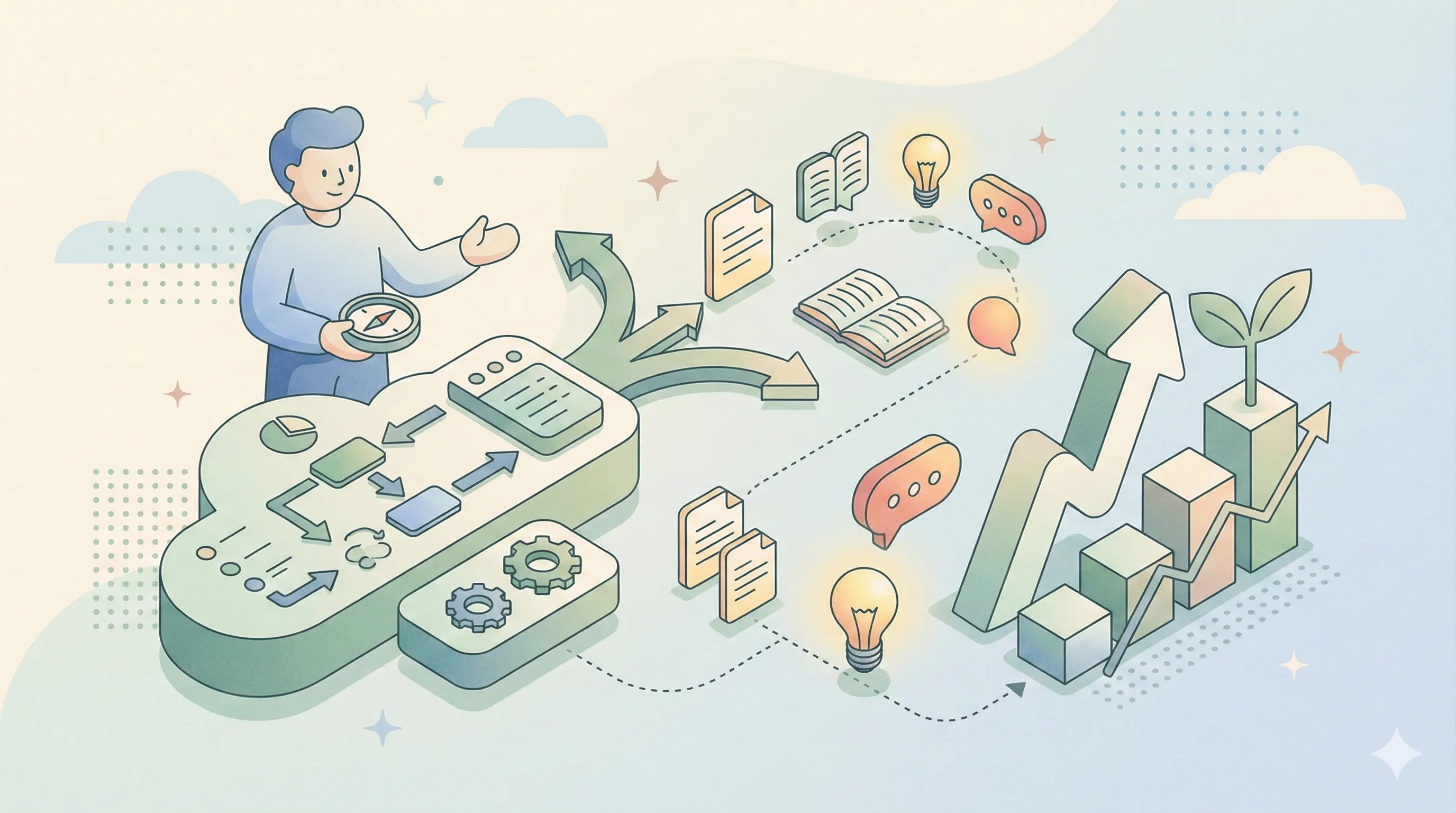
B2B SaaS Content Marketing: Grow MRR Without Paid Ads (2026)
Build a content engine that drives MRR growth. This blueprint shows SaaS founders how to create content that converts trials to customers.


You've built an incredible B2B SaaS product. The technology is sound, your early customers love it, but the sales pipeline feels like a rollercoaster; feast or famine. Your Customer Acquisition Cost (CAC) is creeping up month by month, and you’re watching a competitor with half your features consistently outrank you in search and win deals. Sound familiar? You know you need content marketing, but the usual advice “just start a blog!” feels hollow and hasn’t moved the needle.
The problem isn’t content; it’s strategy. Most B2B SaaS content marketing fails because it's treated as a blog-centric side project, an outlet for company news, not as a core, measurable growth engine integrated with sales and product. It becomes a cost center, not a revenue driver.
This guide is different. It’s a founder-to-founder framework to transform your content from an afterthought into your most predictable source of high-quality, sales-ready leads. We’ll move beyond theory into the operational playbook that connects what you publish directly to pipeline and revenue.
Why Generic Content Marketing Fails for B2B SaaS (And What Works)
The playbook for a DTC e-commerce brand is useless for a SaaS company selling a $25,000/year platform to a committee of enterprise buyers. The B2B SaaS buyer’s journey is complex, risk-averse, and stretches over months. Content that aims for vague “brand awareness” without a direct path to a Sales Qualified Lead (SQL) is a leaky bucket pouring out budget.
The critical failure point is a mismatch of intent. A B2C piece might aim for virality; a B2B SaaS piece must aim for clarity and conversion. Your content must speak to specific pains at specific stages, guiding a prospect from “I have a problem” to “Your solution is the best answer.”
This is where the concept of 'Content as a Product' becomes non-negotiable. You wouldn’t ship a software feature without understanding the user story, the pain it solves, and how you’ll measure its adoption. Apply the same rigor to your content. Treat each major asset, a pillar page, a benchmark report, a case study as a product feature designed to solve a specific information gap for your Ideal Customer Profile (ICP).
Consider two scenarios:
-
The Failed Blog-Centric Approach: A company blogs twice a week on broad industry trends. They get modest traffic, but the leads are low-quality, rarely converting. Content is created by marketing in a silo, with no input from sales or customer success.
-
The Successful Topic Cluster Strategy: A company identifies five core problem areas their software solves. For each, they create one definitive “pillar” guide (the product). Then, they create 8-10 “cluster” blog posts (supporting features) that answer specific, long-tail questions related to that pillar, all interlinked. This architecture signals authority to search engines and systematically captures prospects at different stages of research. A gated, interactive tool on the pillar page converts visitors into high-intent leads.
The difference is systematic intent versus random acts of content.
Mapping Content to the 5-Stage SaaS Customer Journey
Your content strategy must be a mirror of your customer’s journey. Every piece should have a designated home in this funnel.
-
Awareness: The prospect identifies a problem or opportunity. They’re searching for symptoms, not solutions.
- Content Types: Problem-focused blog posts (“Why is manual data reconciliation costing us 20 hours a week?”), industry benchmark reports, trend analysis webinars.
-
Consideration: They’ve defined their problem and are evaluating potential solutions or approaches.
- Content Types: “Vs. Competitor” comparison guides, solution briefs, expert webinars, methodology whitepapers.
-
Decision: They’re ready to buy and are choosing between a shortlist of vendors.
- Content Types: Detailed case studies with specific ROI, product demonstration videos, ROI calculators, security/compliance documentation, free trials or pilots.
-
Onboarding: They’ve purchased. Now, they need to achieve value fast to reduce time-to-first-value and prevent early churn.
- Content Types: Interactive onboarding checklists, “first 30 days” success guides, video tutorials for key workflows, dedicated onboarding webinar series.
-
Expansion & Advocacy: The customer is successfully using the product. The goal is now expansion (upsell/cross-sell) and turning them into a promoter.
- Content Types: Advanced workflow guides, templates for new use cases, customer spotlight interviews, invitation-only community forums.
By mapping content this way, you stop creating in a vacuum. You can audit your library and see, “We have 50 Awareness pieces but only 2 Decision-stage case studies,” and rebalance your efforts where it impacts revenue most.
The Unit Economics of Content: Calculating Your Content CAC
To get buy-in (from yourself or your board), frame content as an investment with measurable returns. You need to know your Content Customer Acquisition Cost (Content CAC).
Here’s a simplified formula:
(Total Content Marketing Costs) / (Number of Customers Acquired via Content) = Content CAC
Total Costs include: Salaries/freelancer fees for creation, editing, and promotion; software costs (SEO tools, design, email); advertising budget for content amplification. Customers Acquired via Content requires tracking. Use CRM deal attribution (e.g., “First Touch: Blog Download”) to identify which customers started their journey with your content.
Compare your Content CAC to your overall blended CAC. If content is more efficient, and it often becomes so over time as assets compound; you have a clear case to invest more. The goal is to see content not as an expense, but as an asset that builds equity (search rankings, email list, authority) and drives efficient growth.
The Founder's Content Engine: A 4-Pillar Framework
You can’t build a growth engine on sand. This framework provides the foundational pillars to make your content marketing systematic, scalable, and aligned with revenue.
- Pillar 1: Strategic Foundation (ICP, Messaging, Differentiation). This is your bedrock. Without it, everything wobbles.
- Pillar 2: SEO-Driven Topic Architecture. This is your blueprint moving beyond random keywords to intent-based content clusters.
- Pillar 3: Production Engine. This is your factory building a repeatable, quality-focused process for creation.
- Pillar 4: Distribution & Amplification. This is your logistics network ensuring your content reaches the right people.
- Pillar 5: Measurement & Iteration. This is your quality control and R&D using data to refine and double down on what works.
Pillar 1 Deep Dive: Building on Rock-Solid ICP & Messaging
Your content cannot be effective if it speaks to the wrong person or the wrong pain point. The founder’s unique role here is to be the source of truth on the customer.
Don’t just target a job title. Target a mindset, a set of responsibilities, and specific business pains. Conduct 5-7 customer interviews and win/loss analysis calls with this lens: What was the business pain that drove this purchase? What would have happened if they didn’t solve it?
The Critical Shift: Your content must speak to the economic buyer’s pains (revenue risk, cost overruns, compliance fines) as much as the end-user’s pains (frustration, inefficiency). A piece for a CFO might focus on “quantifying the financial risk of outdated systems,” while a piece for an IT manager might focus on “reducing security vulnerabilities.” Both are for the same ICP but address different stakeholders in the buying committee. Your messaging should be woven into content naturally, highlighting your unique differentiation (e.g., “the only platform with pre-built compliance workflows for healthcare”) without being overly salesy.
Pillar 2 Deep Dive: The SEO Blueprint for SaaS Authority
For B2B SaaS, SEO is your primary distribution channel for the Awareness and Consideration stages. The goal is not to rank for a million generic terms, but to own the topics that matter to your commercial success.
-
Research for Commercial Intent: Use tools like Ahrefs or Semrush. Beyond high-volume keywords, look for indicators of commercial investigation: terms like
“vs,” “alternative to,” “best practices for,” “how to choose,” and “tool for.”The keyword “project management software” is broad and competitive; “Asana vs ClickUp for agile teams 2024” has much stronger purchase intent. -
Build a Pillar-Cluster Model: Choose 3-5 core “pillar” topics that represent your key solution categories (e.g., “Workflow Automation Software”). Create a comprehensive, link-worthy guide for each (your pillar page). Then, create cluster content (blog posts, videos) that target long-tail questions related to that pillar (e.g., “How to automate document approvals,” “Benefits of automated invoicing”). Link all clusters to the pillar and the pillar to all clusters. This creates a content “neighborhood” that Google rewards with authority.
-
Target the Mid-Funnel Sweet Spot: While top-of-funnel content (broad questions) builds traffic, mid-funnel content (solution comparisons, best practice guides) captures prospects who are actively building a shortlist. This is where your highest-converting SEO traffic will come from.
The B2B SaaS Content Mix: From Top to Bottom of Funnel
A balanced content portfolio serves the entire journey. Here’s how to think about the mix.
| Funnel Stage | Goal | Content Format Examples | Key Metric |
|---|---|---|---|
| Top of Funnel (TOFU) | Capture attention, build list, educate on problem. | Blog posts, industry reports, infographics, trend newsletters, podcast interviews. | Website traffic, email subscribers, social shares. |
| Middle of Funnel (MOFU) | Nurture leads, showcase expertise, differentiate. | Webinars, comparison guides, solution briefs, whitepapers, template libraries. | Marketing Qualified Leads (MQLs), content engagement time, lead score increase. |
| Bottom of Funnel (BOFU) | Drive purchase decision, reduce perceived risk. | Case studies, ROI calculators, product tours, demo videos, security docs, pilot offers. | Sales Qualified Leads (SQLs), demo requests, pipeline generated. |
| Post-Sale | Drive adoption, reduce churn, enable expansion. | Onboarding kits, advanced tutorials, customer community content, new feature guides. | Product adoption rates, customer satisfaction (CSAT), expansion revenue. |
The High-Impact Lead Magnet: Beyond the Ebook
The traditional ebook is tired. It promises value but often delivers a repackaged blog post. To capture higher-intent leads, build interactive lead magnets and generate conversion-focused CTAs that match the reader's stage instead of using the same generic button on every page.
Instead of “The Ultimate Guide to CRM,” create a “CRM Health Assessment” tool. A visitor inputs 5-7 data points about their current process (number of sales reps, deal cycle length, etc.), and the tool generates a personalized score with customized recommendations. This provides immediate, tangible value, requires more investment from the prospect (signaling higher intent), and the data you collect is far more qualified for sales outreach.
Other ideas: A micro-SaaS calculator (“Calculate how much inefficient onboarding is costing you”), a configurator (“Build your ideal security stack”), or a diagnostic quiz (“What’s your organization’s automation maturity level?”). These tools become standout assets that competitors can’t easily replicate.
Leveraging Customer Stories as Your Ultimate Sales Asset
A case study is not a testimonial. It’s a proof-of-concept narrative structured around business outcomes. Here’s a simple template:
-
The Challenge: Describe the customer’s specific pain point in business terms. “Acme Corp was losing 15% of monthly revenue due to invoice reconciliation errors, requiring two full-time staff.”
-
Why Us/The Solution: Briefly explain why they chose your solution and what was implemented.
-
The Results (The Hero): Quantify the outcomes using the PCR Framework:
- Productivity: “Saved 60 person-hours per month.”
- Cost: “Reduced operational costs by $72,000 annually.”
- Revenue: “Recovered $250,000 in previously lost revenue.”
-
The Voices: Include quotes from multiple stakeholders: the end-user (“It’s so much easier now”), their manager (“My team is focused on strategic work”), and the economic buyer (“The ROI was clear within the first quarter”). This builds credibility for every member of the buying committee.
Operationalizing Your Strategy: Tools, Team, and Workflow
Strategy is useless without execution. Here’s how to build the machine.
The Founder’s Role: You are not the primary writer. You are the chief editor and the #1 source of ideas. Your job is to ensure content aligns with strategy, speaks with an authentic voice, and draws from real customer insights. Block one hour a week to review the content calendar and provide feedback on key pieces.
Building a Team: Start lean.
-
Internal/Founder: Sets strategy, interviews SMEs, provides outlines.
-
Freelance Writer(s): Executes on creation. Hire for industry expertise, not just writing skill. Use platforms like Contra or Crowd Content to find specialists.
-
Fractional Content Director (Early Hire): This is a force multiplier. A seasoned pro (10-20 hours/month) can manage the freelance network, enforce the editorial calendar, ensure SEO best practices, and own distribution freeing you up.
Essential Tech Stack:
-
SEO & Research: Ahrefs, Semrush, or Moz.
-
Content Planning: Llamarush, Airtable or Notion (for calendars), Google Docs (for creation).
-
Design: Canva (for social graphics), Figma (for interactive asset mockups).
-
Distribution & Email: ConvertKit or HubSpot, LinkedIn Scheduling tools.
-
Analytics: conversion tracking tools, CRM (HubSpot, Salesforce), Google Looker Studio for dashboards.
A Sample Quarterly Content Theme & Calendar
A theme-based approach focuses your efforts and creates a cohesive narrative. Let’s assume we’re “SaaSFlow,” a workflow automation platform.
Q3 Theme: The Automation Quarter – Conquer Repetitive Work.
| Week | Asset | Funnel Stage | Purpose | Distribution |
|---|---|---|---|---|
| 1 | Pillar Page Launch: "The 2024 Guide to Business Process Automation" | TOFU/MOFU | Ultimate SEO authority page. | Launch email, LinkedIn posts, outreach to influencers for quotes. |
| 2 | Cluster Blog 1: "5 Signs Your Team is Drowning in Manual Work" | TOFU | Drive traffic to pillar page. | Social media, newsletter. |
| 3 | Webinar: "The ROI of Automating Financial Approvals" (with a CFO guest) | MOFU | Generate high-quality MQLs. | Email series, LinkedIn Events, partner co-promotion. |
| 4 | Cluster Blog 2: "AP Automation vs. Traditional Processing: A Cost Analysis" | MOFU | Support pillar, target commercial intent. | SEO, syndication to finance blogs. |
| 5 | Case Study: "How FinTech Inc. Saved 200 Hours/Month with SaaSFlow" | BOFU | Drive sales conversations. | Sales team outreach, featured on homepage, targeted ads. |
| 6 | Interactive Lead Magnet: "Process Automation ROI Calculator" | MOFU/BOFU | Capture high-intent leads. | Gate on pillar page, promoted in webinar, social ads. |
| 7 | Cluster Blog 3: "Integrating Your Automation Tool with Salesforce: A Step-by-Step" | Post-Sale | Aid customer adoption. | Customer newsletter, knowledge base. |
| 8-9 | Q4 Planning & Repromotion | - | Amplify top performers. | Reshare top content, analyze performance. |
Measuring Success: The SaaS Content Metrics That Move the Needle
Forget vanity metrics. Your board doesn’t care about pageviews. They care about pipeline and revenue. You should too.
Vanity Metrics (Monitor, Don’t Optimize): Pageviews, Social Shares, Time on Page.
Value Metrics (Optimize and Report On):
-
Marketing Qualified Leads (MQLs): Leads that meet a minimum threshold (e.g., downloaded a key guide, attended a webinar) and are passed to sales.
-
Sales Qualified Leads (SQLs): MQLs that sales accepts as viable opportunities. This is the critical handoff metric.
-
Influenced Pipeline: The total value of opportunities where content was a touchpoint in the journey (using multi-touch attribution).
-
Content-Sourced Revenue: Closed-won revenue that can be attributed to a content-driven lead source. This is the ultimate KPI.
How to Track: Use UTM parameters on every content link you share. Integrate your website analytics with your CRM. Create a standardized naming convention (e.g., utm_source=linkedin&utm_medium=social&utm_campaign=q3_automation_guide). Train sales to ask, “How did you first hear about us?”
Building a Simple Content Dashboard (Google Looker Studio)
You need a single pane of glass. Connect your data sources (conversion tracking tools, CRM, email platform) to Looker Studio and create a dashboard with these key widgets:
-
Lead & Revenue Overview: A line chart showing MQLs and SQLs over time, with a key metric box for Content-Sourced Revenue (MTD).
-
Top Performing Assets: A table listing your top 10 content pieces (by title), with columns for: Pageviews, MQLs Generated, SQLs Generated, Influenced Pipeline Amount.
-
Funnel Conversion Metrics: A bar chart showing the conversion rate from Visitor → MQL (for key landing pages) and MQL → SQL.
-
Channel Performance: A breakdown of which channels (Organic Search, Email, Social, Paid) are driving the highest-quality (SQL) traffic.
This dashboard becomes your weekly pulse check, moving content from a creative black box to a measurable business function.
Conclusion
Effective B2B SaaS content marketing isn’t about publishing the most articles; it’s about building a systematic engine that aligns every piece of content with a stage in your customer’s journey, directly contributes to pipeline, and is relentlessly measured against revenue outcomes. It requires treating content with the same strategic rigor as your product roadmap defining the problems it solves, building it efficiently, and iterating based on data.
Stop chasing trends and start building equity. Focus on owning the topics that matter to your buyers, creating assets that serve as definitive resources, and wiring everything directly into your sales funnel. That’s how you turn content from a cost center into your most reliable growth lever.
Frequently Asked Questions
Q1: How can B2B SaaS companies use content marketing to grow MRR without paid ads?
A1: By treating content as a product, not a blog-centric side project. Build a systematic engine that maps content to each stage of the customer journey: Awareness (problem-focused blog posts, benchmark reports), Consideration (comparison guides, solution briefs), Decision (case studies with specific ROI, ROI calculators, demo videos), Onboarding (checklists, success guides), and Expansion (advanced workflows, customer spotlights). Use a pillar‑cluster SEO model to own commercial intent keywords (e.g., “Asana vs ClickUp for agile teams”). Track content‑sourced revenue, not vanity metrics. This approach turns content into a predictable, low‑CAC growth channel that compounds over time, no paid ads required.
Q2: What is the pillar‑cluster SEO model and why does it work for B2B SaaS?
A2: The pillar‑cluster model organizes your content around 3–5 core “pillar” topics that represent your key solution categories (e.g., “Workflow Automation Software”). For each pillar, create a comprehensive, link‑worthy guide. Then create 8–10 “cluster” blog posts that answer specific long‑tail questions related to that pillar (e.g., “How to automate document approvals”), all interlinked and linking back to the pillar. This structure signals deep topical authority to Google, helps you rank for mid‑funnel commercial investigation keywords (e.g., “best practices for,” “how to choose”), and systematically captures prospects at different research stages. It’s far more effective than random blog posts for generating qualified leads.
Q3: How do I measure the ROI of B2B SaaS content marketing beyond pageviews?
A3: Track value metrics instead of vanity metrics. Key KPIs include: Marketing Qualified Leads (MQLs) from content, Sales Qualified Leads (SQLs) accepted by sales, influenced pipeline (total opportunity value touched by content), and content‑sourced revenue (closed‑won deals attributed to content). Use UTM parameters on every content link, integrate your CRM with conversion tracking tools, and build a dashboard (e.g., Google Looker Studio) showing MQL/SQL trends, top‑performing assets by pipeline generated, and funnel conversion rates. Also calculate Content CAC = total content marketing costs ÷ number of customers acquired via content. Compare to your blended CAC to prove efficiency.
Q4: What types of lead magnets work best for B2B SaaS instead of generic ebooks?
A4: Traditional ebooks underperform. Instead, build interactive, high‑intent lead magnets that provide personalized value. Examples: a “CRM Health Assessment” tool where users input data and receive a customized score; a micro‑SaaS calculator (“Calculate how much inefficient onboarding is costing you”); a configurator (“Build your ideal security stack”); or a diagnostic quiz (“What’s your automation maturity level?”). These assets require more user investment, signaling higher intent, and generate far more qualified leads. Gate them on pillar pages or promote via webinars. The data collected is also more valuable for sales outreach. Competitors cannot easily replicate these interactive tools.
Q5: How do I structure a B2B SaaS case study that actually drives sales conversations?
A5: Use the PCR framework; Productivity, Cost, Revenue. Structure each case study as:
-
The Challenge – quantify the customer’s specific business pain (e.g., “Acme Corp was losing 15% of monthly revenue due to invoice errors”).
-
The Solution – briefly explain why they chose your product.
-
The Results – use PCR numbers: Productivity (“saved 60 person‑hours/month”), Cost (“reduced operational costs by $72,000 annually”), Revenue (“recovered $250,000 in lost revenue”).
-
The Voices – include quotes from three stakeholders: the end‑user, their manager, and the economic buyer (CFO/VP). This builds credibility for the entire buying committee.
End with a clear CTA (“See how we can achieve similar results for your team”). Case studies are your most powerful bottom‑of‑funnel sales asset.
Thanks for reading! ❤️
Written by
JenishRead Next



Turn this into your AI Search strategy
LLaMaRush creates SEO, AEO, and GEO optimized content built to rank in Google and get cited by AI answer engines.
Start Ranking Everywhere