

Best Outrank Alternatives in 2026: 7 Tools Compared
Compare the best Outrank alternatives in 2026 by real cost per article, backlinks, editing time, and AI-search readiness. Honest picks for solo founders.


TL;DR
Outrank (outrank.so) is an AI blog autopilot. It is a good fit if you want volume and links in one plan and you are happy to edit what it produces. People leave Outrank for five reasons: the flat price is too high for low volume, drafts need editing, the backlink exchange carries risk, there is little control over which topics get written, and there is no AI-citation tracking. Which alternative fits depends on which of those is your problem:
| Tool | Best for | Why it suits that reader |
|---|---|---|
| LLaMaRush | Solo founders | Topics chosen from your own Google Search Console data, and content built so ChatGPT, Perplexity and Google's AI Overviews can quote it. Plans the week, writes the posts, and publishes them, in about 15 minutes of your time. |
| SEObot | The cheapest true autopilot | Starts around $49/month and is run by a founder who built it for his own portfolio of sites. |
| RankYak | A topical-authority strategy | Clustered articles, internal linking, and a steady one-a-day publishing pace. |
| Arvow | A low annual price plus a wider toolbox | An SEO editor for old posts, a site-fixing agent, and AI-visibility tracking. |
| RightBlogger | Hands-on bloggers | Unlimited AI words, a big toolkit, and an agent that maintains published posts. |
| Byword | Bulk or programmatic articles | For teams that already own a keyword list and need volume. |
| Surfer SEO | Teams that already have writers | An on-page optimizer, not an autopilot. |
What is Outrank, and what does it cost?
Outrank is the reference point for every tool in this guide, so it helps to be exact about what it sells. It is an end-to-end pipeline that turns a website into a scheduled stream of SEO articles with very little manual work. It was built for people who would rather not run a content operation themselves.
How does Outrank work?
The workflow has four parts, and they run in sequence without much input from you.
- Keyword research: Outrank finds keywords for your site automatically, with search volume and difficulty data. Keyword research is unlimited on the plan, and you can keep generating new keyword sets.
- Article writing: It generates an SEO article for each chosen keyword, adds AI-generated images and relevant YouTube videos, and can write in more than 150 languages.
- Publishing: It posts to your site on a schedule. Supported destinations are WordPress, Webflow, Shopify, Framer, Wix, Notion, Ghost, and a custom webhook.
- Backlinks. It places links to your site inside relevant articles on other blogs and verifies each placement. You earn the credits that pay for this by hosting a relevant link inside your own articles.
Outrank also sells add-ons around the core plan, including a Free Tools Builder that creates and deploys one interactive SEO tool a week, and a Human Curated Service where professional editors review each article before it goes live.
What do independent reviewers say about Outrank?
Public feedback is mostly positive, with consistent caveats. One review roundup cites a 4.5 out of 5 rating on G2 for ease of use and automation. The recurring complaints are limited customization, occasional backlink-tracking errors that can cost credits, and a WordPress integration with little control over layout.
The most useful independent test we found is a 60-day review across three sites, published in July 2026 by Aboah Reviews. It scores Outrank 7.4 out of 10 and reaches a clear conclusion: treat it as a drafting system with human editing before publishing, not an autopilot you can walk away from. Its verdict on backlinks is balanced. The exchange is a genuine differentiator at this price, and it carries link-scheme exposure you should understand before switching it on.
Who is Outrank a good fit for?
Outrank is the right choice more often than the "alternatives" genre admits, so here is the honest split.
Outrank fits you if:
- You will actually publish close to 30 articles a month, so the flat price works out cheap per article.
- You want backlinks and content bought together, and you accept the risk that comes with a link exchange.
- You are comfortable reviewing and editing drafts, or you will pay for the Human Curated Service.
- You run several small sites and can use the multi-site discounts.
Outrank fits you less if:
- You only need 5 to 10 posts a month. One independent review estimates the effective cost then climbs toward $10 per article actually used.
- You want tight control over which topics are written. Arvow's review of Outrank notes that it picks topics from seed keywords, which gives less control than a brief-driven workflow. Arvow sells a competing product, so weigh that as a vendor view.
- You want to see whether ChatGPT or Perplexity cite your content. Independent reviewers report that Outrank does not track citation rate or AI mentions.
- You run a brand site that cannot risk a manual action from search engines.
Why look for an Outrank alternative?
Most people who search for an alternative have one specific frustration. Here are the real ones, with the evidence behind each.
Is $99/month too much if you only publish a few posts?
The price is flat, so a low-volume site pays for capacity it does not use. At 30 articles a month, $99 works out to $3.30 per article, which is competitive. At 8 articles a month it is about $12.38 per article. The cost-per-article section below runs this maths for every tool on the list.
Do autopilot articles need heavy editing?
Often they do. Reviewers report time spent fixing tone, factual errors, and brand-voice drift, especially on technical or opinion-led topics. Informational how-to content tends to come out cleaner. A cheap article that needs an hour of rewriting is not cheap, so the editing time belongs in your cost estimate.
Is Outrank's backlink exchange safe?
It is a real differentiator, because most tools in this guide do not build links at all. It also has a real risk. Google's spam policies list link exchanges made for ranking purposes as link spam, and a credit exchange in which you host links to earn links fits that pattern. Google has not, as far as we know, penalized Outrank users at scale, and links inside genuinely relevant articles are not automatically a problem. The point is to understand what you are opting into. Read Google's spam policies before you switch it on, and decide whether your site can absorb the risk.
Can you see whether AI assistants cite you?
Not inside Outrank, according to independent reviews. If part of your goal is being cited in ChatGPT, Perplexity or Google's AI Overviews, you need either a tool that tracks it or content built so those systems can extract it. We cover both later in this guide.
What does our own Search Console data say about autopilot SEO?
Most comparison guides never show their own numbers. Ours is more useful because we run LLaMaRush, and we have looked hard at what automated content does to a real site. Three findings shaped how we judge every tool here.
When we audited PhysioCarePMS, a physiotherapy practice-management platform, over a 28-day cycle, the largest problem was orphan pages: pages that exist on the site but have no internal links pointing to them. Search engines mostly find and evaluate pages through internal links, so those pages were effectively invisible. After we fixed the structure and the internal linking, impressions rose from 11,500 to 16,100 (up 40%) and clicks rose from 1,210 to 1,270 (up 5%). Average CTR fell from 10.5% to 7.9% and average position slipped from 12.7 to 13.1. That is a normal pattern when a site starts appearing for many more queries, because the new queries begin lower and click less. It also shows why you should read impressions, clicks, CTR and position together and not judge a tool on one number.
What this means for your choice: an autopilot tool that publishes 30 articles a month adds 30 new pages a month. If nothing links to them, and nobody checks them for relevance, you are building the same problem faster.
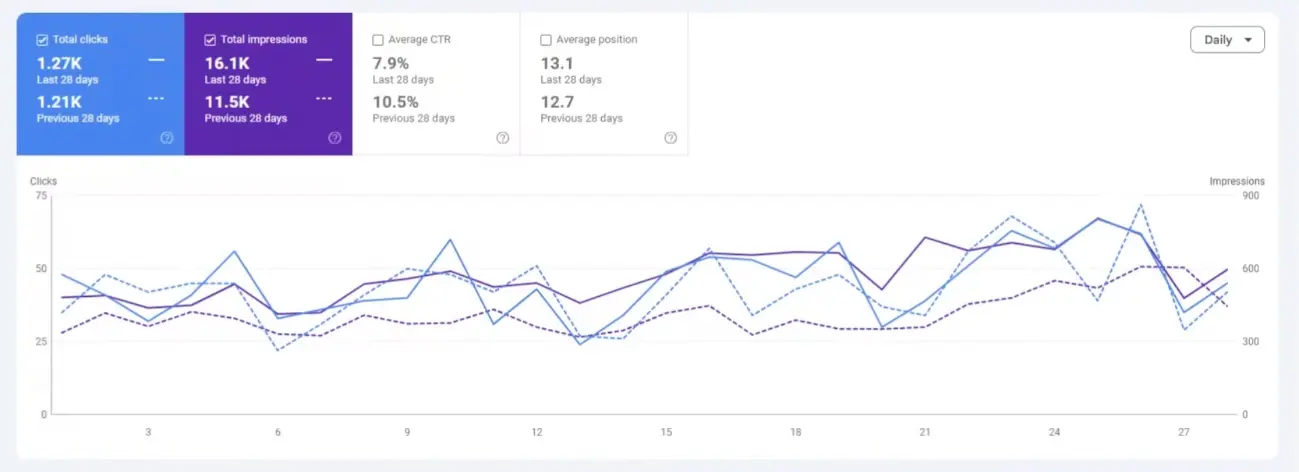 Chart of the PhysioCarePMS 28-day comparison: impressions, clicks, CTR, position
How do the best Outrank alternatives compare?
| Tool | Best for | Starting price | Articles per month | Publishing |
|---|---|---|---|---|
| Outrank | Volume + links in one plan | $99/mo | 30 | WordPress, Webflow, Shopify, Framer, Wix, Notion, Ghost, webhook |
| LLaMaRush | Solo founders, Search Console-driven planning | Free, $29, $79 | 3 lifetime (Free), 8 (Starter), 30 (Founder) | WordPress, Notion, GitHub, Ghost |
| SEObot | Cheapest autopilot | About $49/mo | Tiered | WordPress, Webflow, Shopify, Ghost, Wix, Framer, Notion, HubSpot, Next.js, webhooks, API |
| RankYak | Topical authority | $99/mo (own guide) | 30/month | WordPress, Shopify, Webflow, Wix, Ghost, Duda, Next.js and more |
| Arvow | Low annual price + AI tracking | $69/mo | Credit-based (about 100 text articles) | WordPress, Shopify, Wix, Ghost, Webflow, Framer, Blogger, Squarespace, Zapier, webhooks |
| RightBlogger | Hands-on bloggers | $49/mo annual, $59 monthly | Unlimited AI words | WordPress, Webflow, Ghost, Wix, Duda and more |
| Byword | Bulk / programmatic and articles | $99/mo | 25 (overflow priced per article) | WordPress, Webflow, Zapier, API |
| Surfer SEO | Teams with writers | Roughly $59–359/mo and enterprise | Editor documents, not articles | Not an autopilot |
Strategy, links and AI visibility
| Tool | Topic selection | Backlinks | AI-visibility features | Biggest trade-off vs Outrank |
|---|---|---|---|---|
| Outrank | Auto keyword research | Credit exchange, included | Not reported | Flat price; editing needed |
| LLaMaRush | Your Search Console data | No | Citation-first content structure, schema | Use the Google search console data of site and No link exchange |
| SEObot | Automated content plan | Advertised; mechanics unclear | Not a focus | Fewer articles at entry price |
| RankYak | Keyword discovery + clusters | Exchange network | Targets Google and ChatGPT | One-per-day cap |
| Arvow | Autoblog + keyword modes | Paid curated add-on; exchange page exists | AI visibility tracker (plan-dependent) | Credits pay for images too |
| RightBlogger | Keyword research + content planner | Network on plans | Positions for Google and ChatGPT | More of the workflow is yours |
| Byword | You supply the keywords | None | None | You are the strategist |
| Surfer SEO | SERP analysis, content planner | None | AI tracker on higher plans | Needs a writer |
The 7 best Outrank alternatives in 2026
1. LLaMaRush: best for solo founders who want a data-driven weekly plan
| Best for | Solo founders and small SaaS teams |
| Starting price | Free; $29/month Starter; $79/month Founder |
| Volume | 3 lifetime posts (Free), 8/month (Starter), 30/month (Founder) |
| Topic source | Your own Google Search Console data |
| Biggest limitation | No built-in backlink exchange |
What is LLaMaRush? It is an AI blog automation tool built for founders and solo builders. LLaMaRush's founder started it after running into the same wall repeatedly: pulling keywords out of Search Console, clustering them, choosing which to write, and then writing them, all by hand. The product does that loop for you. It reads about six months of your Search Console history, finds low-competition keywords with real search intent, groups them into clusters, and turns them into a weekly content plan. It then writes the posts and publishes them to your CMS. The intended time cost is about 15 minutes a week.
How is that different from a keyword database? Most autopilots pick keywords from a general index. LLaMaRush starts with the queries your site already earns impressions for, which shows where you are close to ranking and where you already have topical relevance. The idea is that a plan built from your own data is more likely to be realistic than one built from someone else's. This is also why we care so much about topic control: after our own experience with off-topic template posts, we would rather show you the plan than publish blindly.
What makes the content built for AI answers? We design posts as sets of independent passages. Each key section answers one full question and can stand alone as a quotable unit. Posts carry a TL;DR, a comparison or definition block where it fits, and an FAQ. They also carry Article, FAQ and Breadcrumb schema. Headers are written as the natural-language questions people put to AI assistants. Our March 2026 snapshot of two client sites, covered above, is early evidence that this structure helps, on niche queries and over short windows.
- Free ($0): 3 lifetime blog generations, manual publishing, Markdown export.
- Starter ($29/month): 8 blog generations and 8 AI header images a month, Search Console content selection, CMS publishing, and up to 2 autopilot posts a week.
- Founder ($79/month): 30 blog generations and 30 AI header images a month, daily autopilot publishing, and priority support.
How does it compare with Outrank? At the top tier, you get the same 30 posts a month for $20 less than Outrank's $99. The trade-off is what surrounds the posts. Outrank includes a backlink exchange, and LLaMaRush does not build backlinks for you. LLaMaRush puts its effort into choosing the right topics and structuring the content, then leaves link building to you. Its free tool pages, like the SEO title generator, give you extra ways to work on titles and metadata without an extra subscription.
Choose LLaMaRush over Outrank if you want topics tied to your own data, a lower price at 30 posts a month, and content structured for AI answers. Stay with Outrank if built-in backlinks matter most.
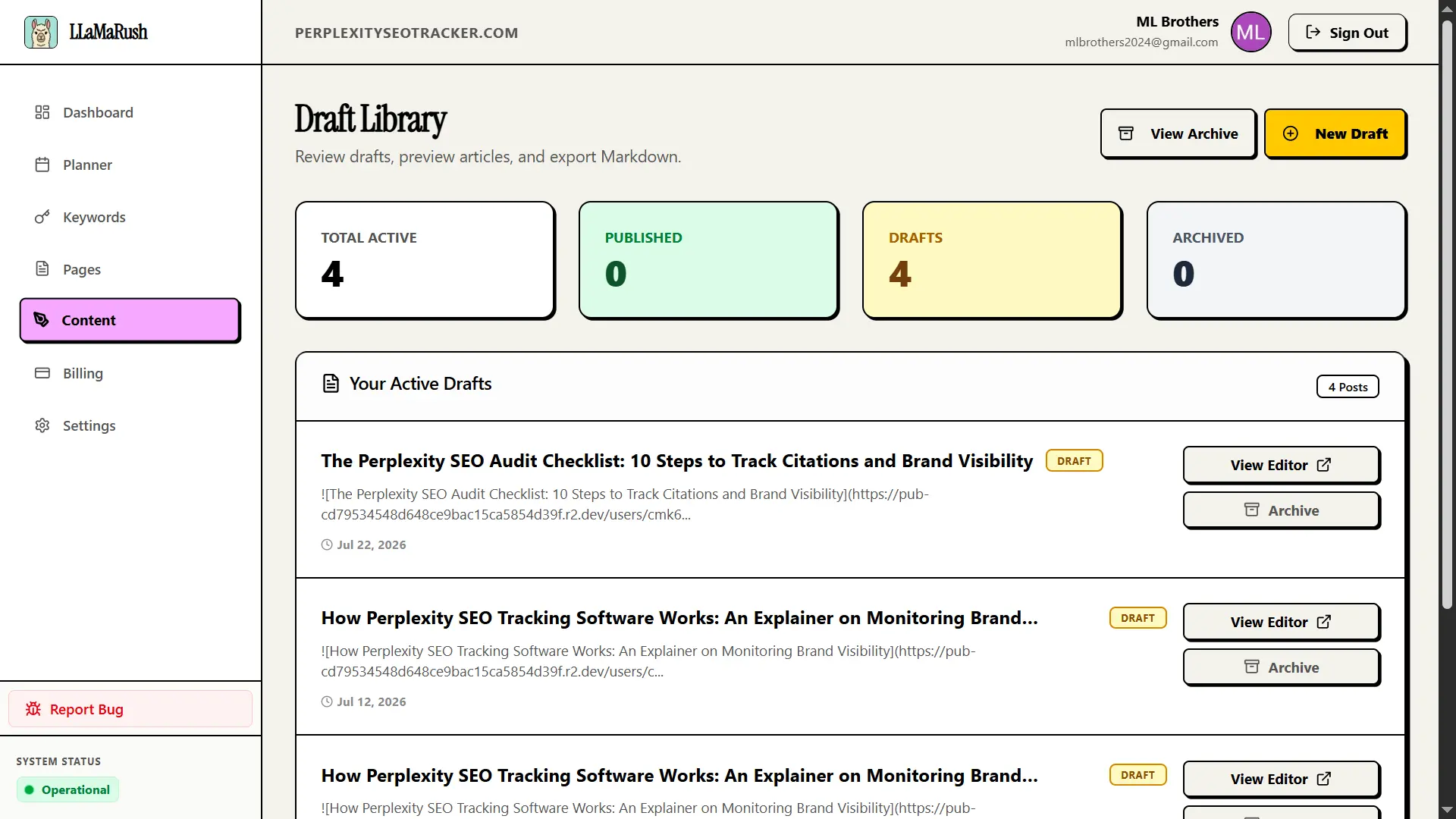 LLaMaRush dashboard screenshot showing Search Console opportunities and the weekly plan
2. SEObot: best for the cheapest hands-off autopilot
| Best for | Small sites and indie founders who want the lowest entry price |
| Starting price | About $49/month |
| Volume | Tiered. Outrank's comparison lists 9 articles at $49, 20 at $99, 50 at $199 and more |
| Publishing | WordPress, Webflow, Shopify, Ghost, Wix, Framer, Notion, HubSpot, Next.js, webhooks, REST API |
| Biggest limitation | Fewer articles per dollar at the $99 tier; link-building details are thin |
What is SEObot? It is an AI SEO agent built by John Rush, who says he made it because he needed it for his own portfolio of eleven SaaS projects and twenty directories. That founder-first origin is the point of the product. Onboarding is meant to be almost hands-off: you enter your URL, SEObot researches your site, audience and keywords, builds a content plan, and starts producing articles weekly.
What does it do well? According to SEObot's own site, you can approve, decline or moderate articles if you want to. It does internal linking for articles and your existing site pages, writes long-form posts (up to about 4,000 words), and inserts YouTube embeds, generated images, tables and lists. It runs a fact-checking step that cites sources, and it re-links older articles monthly. Newer features include a YouTube-video-to-article tool, programmatic SEO, a news mode, interactive SEO mini-tools, and backlinks to grow Domain Rating. It supports more than 50 languages, and it offers a refund on the $49 plan if you contact the team after the first article and are unhappy.
Where does it fall short? The entry tier is small, so you get fewer articles per dollar than Outrank at the $99 level. The backlink feature is advertised, but the public mechanics are less clear than Outrank's exchange.
Choose SEObot over Outrank if you run a small site and want the lowest-cost way to automate weekly publishing, with the option to moderate each article. Stay with Outrank if you want more articles per dollar at the $99 tier.
3. RankYak: best for a topical-authority strategy
| Best for | Businesses that want steady, cluster-based publishing |
| Starting price | $99/month after a 3-day trial |
| Volume | One article a day per site |
| Publishing | WordPress, Shopify, Webflow, Wix, Duda, Ghost, Next.js and more |
| Biggest limitation | Daily cap; same $99 price as Outrank |
What is RankYak? RankYak is an all-in-one SEO automation platform. It discovers keywords, builds a monthly content plan, writes articles, publishes them, and runs a backlink exchange. According to its own materials, it writes articles up to 5,000 words with internal linking, topic clusters, facts with citations, and Google Search Console integration.
What does it do well? Its pitch is topical authority over quick drafts: each article is supposed to sit inside a cluster, so the site builds depth on a subject over time. It adds an infographic per article, a Site Guard feature that finds and fixes pages losing clicks, a copilot, and an MCP server for developers. It also offers free tools such as a robots.txt tester, redirect checker and keyword clustering tool, which suggests a product built around the whole site, not just the writing.
Where does it fall short? You are capped at one article per day per site, which feels slow if you need a burst of content for a launch. RankYak's claims that its images look more natural and its content is less generic than Outrank's come from RankYak's own comparison, so read them as vendor claims. Its backlink exchange carries the same risk profile as Outrank's.
Choose RankYak over Outrank if you want a strategy-first approach and can wait for compounding results. Stay with Outrank if you want the option to buy 60 or 90 articles a month.
4. Arvow: best for a low annual price with a wider toolbox
| Best for | People who will prepay a year and want editing and visibility tools in one place |
| Starting price | $69/month. Outrank's comparison lists $99 monthly for the same Solo plan |
| Volume | Credit-based: 1,000 credits, roughly 100 text articles, with images and optimization drawing from the same pool |
| Publishing | WordPress, Shopify, Wix, Ghost, Webflow, Framer, Blogger, Squarespace, Zapier, webhooks |
| Biggest limitation | Credit arithmetic; a broader product is more to learn |
What is Arvow? Arvow is an AI SEO platform that started as an article writer and has grown into a wider suite. Per its own materials, it includes an autoblog, an SEO editor that rewrites existing pages, an SEO agent that adds schema markup, fixes meta titles and descriptions, sets canonical URLs, adds image alt text and improves internal linking, plus YouTube-to-blog conversion, a news writer, white-label reports for agencies, Google Business Profile tools, and visibility trackers for ChatGPT, Claude, Perplexity, Gemini, Grok and Google's AI Overviews. It also sells a done-for-you service from $2,000/month.
What does it do well? It is the only tool on this list, alongside Surfer, that lets you work on posts you have already published. Its pitch to Outrank users is straightforward: more articles per dollar, tracking of AI mentions, and the ability to edit your old content. Those are real gaps in an Outrank-only workflow. The Business plan, at $169/month adds the AI visibility and editing features.
Where does it fall short? The credit model is less predictable than a flat 30 articles. Images and optimization draw from the same credits, so "about 100 articles" is a ceiling for text-only posts. Arvow's comparison also criticizes Outrank's link exchange, yet Arvow's own menu lists a backlink exchange feature. Check what is included on each plan and what it does before assuming it avoids the risk. The breadth suits agencies well, but a solo founder who only wants weekly posts may find it more than needed.
Choose Arvow over Outrank if the annual price, the SEO editor and AI tracking matter most. Stay with Outrank if you want a flat, predictable article count and a simple pipeline.
5. RightBlogger: best for hands-on bloggers
| Best for | Bloggers and creators who want to steer, with a large toolkit |
| Starting price | Solo: $59/month monthly |
| Volume | Unlimited AI words and autoblogging on every paid plan |
| Publishing | WordPress, Webflow, Ghost, Wix, Duda, Blogmaker, HighLevel, Shopify, Notion, plus webhooks |
| Biggest limitation | More of the workflow is yours to run; capped SEO reports per plan |
What is RightBlogger? It is an all-in-one AI content and SEO toolkit built by Ryan Robinson and Andy Feliciotti, the team behind the annual State of Blogging survey. It bundles 80 to 90 AI tools with full blog automation, keyword research, SEO reports and direct CMS publishing.
What does it do well? Every paid plan includes unlimited AI words, brand voices and AI images, so you can run drafts and rewrites without watching a credit meter. Its Site Agent maintains published content: it fixes internal links, broken outbound links, weak meta descriptions and stale year references, with three approval modes (ask first, smart, or fully automatic) and one-click undo for 30 days. That is a direct answer to the "publish and forget" complaint. Plans scale by site: Pro is $89/month monthly or $69 annually for three sites and three seats, and Agency is $299 or $199 for ten sites.
Where does it fall short? It is a toolkit first and an autopilot second, so you make more decisions than you would with Outrank. SEO reports are capped per plan (30 on Solo). It is written for bloggers and creators, so it may feel less focused if you run a SaaS product. Its claim of a backlink network on its plans comes from its own materials, so check the terms before you count on it.
Choose RightBlogger over Outrank if you like to shape each piece and want post-publish maintenance built in. Stay with Outrank if you want the pipeline to run without you.
6. Byword: best for bulk and programmatic articles
| Best for | Teams that already know which keywords to target and need volume |
| Starting price | $99/month for 25 articles and 25 research reports; pay-as-you-go is about $5 per article |
| Higher tiers | Standard $299 (80 articles), Scale $999 (300 articles), an unlimited tier at custom or high pricing |
| Publishing | WordPress, Webflow, Zapier, API, Ghost, HubSpot, Medium, Airtable, Notion, Google Docs, Google Sheets |
| Biggest limitation | You supply the keywords; no backlinks |
What is Byword? It is a bulk AI article writer. You upload a list of keywords or titles, in some cases thousands, and it generates SEO-optimized articles from them. That makes it a natural fit for programmatic SEO, affiliate sites and agencies handling many client sites.
What does it do well? Volume and predictability. Overflow articles beyond your plan are cheaper on higher tiers, roughly $3.50 on Starter down to $2.50 on Scale, and credits accumulate without expiring. New accounts can test the tool with a handful of free article credits, and annual billing takes about 17% off. Standard adds whitelabeling, and Scale adds programmatic SEO features.
Where does it fall short? It does not tell you what to write. There is no Search Console-driven planning and no backlink feature, so you are the strategist. Public reviews are thin and polarized, with under twenty across major platforms in one tracker's count, so lean on the free test more than on ratings. And publishing large volumes of unreviewed pages is exactly the pattern Google's spam policies describe as scaled content abuse when the pages add little value, so review what you publish.
Choose Byword over Outrank if you already have a keyword list and want cheap overflow volume. Stay with Outrank if you want the tool to decide what to write.
7. Surfer SEO: best if you already have writers
| Best for | Teams with human writers who want an on-page optimizer |
| Starting price | Varies. Third-party trackers list entry plans between roughly $59 and $99/month and a $219/month tier |
| What you get | Content Editor scoring, SERP analysis, keyword research, content planner, Surfer AI writing, and AI-visibility tracking on higher plans |
| Biggest limitation | It is an optimizer, not an autopilot |
What is Surfer? It analyzes the top-ranking pages for a keyword and tells you how to structure your own article to compete. You paste a draft or write inside the Content Editor, and Surfer scores it against competitors in real time, flagging missing terms, heading structure and length gaps.
What does it do well? It is the best editor in this group if you already have writers. Higher plans add automated internal links, automatic optimization, and AI-search features such as mention-gap analysis, sentiment analysis and an AI tracker. It also has a 7-day money-back guarantee, according to one price tracker.
Where does it fall short? It does not write and publish for you. Surfer AI writing is a paid layer, there is no CMS auto-publishing according to Arvow's comparison, and it has no backlink features. Every document still needs a person, and plan structures have been shifting, so check the current tiers.
Choose Surfer over Outrank if you have writers and want them to write better. Stay with Outrank if you have no writers and want finished articles.
If you decide Surfer is the wrong category, our guide to Surfer SEO alternatives covers the options.
Which tools did we leave out, and why?
We left out volume autoblogging tools such as Koala Writer and Autoblogging.ai. They are designed to generate large amounts of text cheaply, and publishing unreviewed content at scale invites the SEO risk we described earlier. We also left out tools whose only pitch is agency-managed GEO or AEO services, because they solve a different problem. Our guide explains the same selection logic in more detail.
What does each tool really cost per published article?
Sticker prices hide the real number, because it depends on how many articles you actually publish. This table divides each plan's monthly price by the number of articles you would actually use, at two realistic volumes. It uses list prices and ignores your editing time and backlink value, which can change the answer.
| Tool | Plan used | At 8 posts/month | At 30 posts/month |
|---|---|---|---|
| Outrank | $99 All-in-One (30 included) | $12.38 | $3.30 |
| LLaMaRush | $29 Starter (8) / $79 Founder (30) | $3.63 | $2.63 |
| SEObot | $49 tier (9) / $199 tier (50) | $6.13 | $6.63 |
| RankYak | $99 (up to 1/day) | $12.38 | $3.30 |
| Arvow | $69 Solo (~100 text articles) | $8.62 | $2.3 |
| RightBlogger | $49 annual / $59 monthly (unlimited words) | $6.13 to $7.38 | $1.63 to $1.97 |
| Byword | $99 (25) plus overflow at about $3.50 | About $12.38, or about $40 if you buy at $5 each | About $3.88 |
| Surfer SEO | Editor, not a writer | Not comparable | Not comparable |
How to read this table:
- Low volume favours plans that match your pace. At 8 posts a month, a plan built for 8 is far cheaper per article than a flat 30-article plan.
- High volume favours flat and unlimited plans. Arvow and RightBlogger look cheapest at 30 posts, but credits, images and plan limits can change that, so read their fine print.
- Price is not the whole answer. Outrank's number includes backlinks and images. Arvow's assumes text-only articles. Cheap drafts that need an hour of editing each will cost you more than a pricier tool whose output needs less work.
Which Outrank alternative should you pick?
What is the best Outrank alternative for solo founders?
LLaMaRush. It plans from your own Search Console data, keeps the weekly effort small, and structures content for AI answers. It is built for founders without an SEO background. Pick it if topic quality and control matter more to you than built-in backlinks.
What is the cheapest Outrank alternative?
For a true autopilot, SEObot at around $49 a month. For bulk writing with cheap overflow, Byword. For low-volume sites, LLaMaRush's $29 Starter plan. In every case the lower price leaves something out, usually backlink building.
Which alternative builds topical authority best?
RankYak, because its whole approach is clustered content on a steady schedule. LLaMaRush also plans in clusters from your Search Console data.
Which Outrank alternative is best for AI-search visibility?
If you want to track citations, Arvow and Surfer both include tracking on certain plans. If you want to earn citations, structure matters most: independent passages, clear definitions, comparison blocks, an FAQ and schema. LLaMaRush is built around that structure. Tracking tells you whether you are cited, and it does not replace content that deserves to be cited.
What if you already have writers?
Surfer SEO. It improves drafts your team already writes, and it costs less than replacing them.
What if you want maintenance after publishing?
RightBlogger's Site Agent is the most explicit answer, with approval modes and undo. Arvow's SEO editor and agent also target existing pages. Ask any tool you consider exactly what it does to posts after they go live.
When should you stay on Outrank?
If you publish close to 30 articles a month, want automated backlinks in the same plan, and accept the exchange risk. It is a strong fit for that job, and none of the alternatives above match its bundle exactly.
How did we compare these tools?
We compared the seven tools using public information: each vendor's pricing page and documentation, Outrank's own comparison page, and independent reviews and price trackers published between January and September 2026. We looked at price per published article, editing needs, backlink support, CMS support, topic control, refresh and maintenance features, and AI-visibility features. For LLaMaRush, we also used our own Search Console audit and client results.
Two limits matter. First, several comparison pages we read are written by the vendors themselves, including Outrank, RankYak, Arvow and RightBlogger. We treated their claims as claims and said so. Second, this guide does not benchmark article quality across all seven tools, so it does not rank them on writing quality. Run each tool's free trial or test on one keyword before you commit. Prices and plans change often, and we will update this page when they do.
Outrank alternatives: frequently asked questions
Q1: What is the best alternative to Outrank?
A1: It depends on how you work. LLaMaRush suits solo founders who want a Search Console-based plan, SEObot suits the lowest entry price, RankYak suits topical authority, Arvow suits a low annual price and a wider toolbox, and Surfer SEO suits teams with writers. See the pick-by-situation section above.
Q2: What is the cheapest Outrank alternative?
A2: SEObot is the cheapest true autopilot, starting around $49 a month. Byword's overflow pricing is cheap for bulk writing, and LLaMaRush has a free plan and a $29 Starter plan. In each case the lower price usually excludes backlink building.
Q3: Is there a free Outrank alternative?
A3: Yes, with limits. LLaMaRush has a free plan with 3 lifetime blog generations, RightBlogger has a limited free plan, Arvow has a free plan, and Byword gives new accounts a few free article credits. Use free plans to judge quality before you pay.
Q4: Which Outrank alternatives include backlink building?
A4: Few do. Outrank, RankYak and RightBlogger describe link networks in their own materials. Arvow sells curated backlinks as an add-on and also lists an exchange feature. SEObot advertises backlinks, though the mechanics are less clear. Byword, Surfer and LLaMaRush do not build backlinks for you.
Q5: Is Outrank worth $99 a month?
A5: It can be if you publish close to 30 articles a month and want backlinks in the same plan. At 30 posts it works out to $3.30 per article. At 8 posts it is about $12.38, so a plan sized to your pace may fit better.
Q6: Does Outrank's content rank on Google?
A6: It can, but results depend on your topics, your editing and your site's authority. Reviewers report needing to fix tone and facts, and independent testing recommends treating drafts as first drafts. Use the workflow above before publishing.
Q7: Is Outrank's backlink exchange safe?
A7: It carries risk. Google's spam policies list link exchanges done for ranking as link spam, and a credit exchange fits that pattern. Reviewers describe link-scheme exposure. Understand what you are opting into before you switch it on, and audit the outbound links in your own articles.
Q8: Outrank vs Surfer SEO: which is better?
A8: They do different jobs. Outrank is an autopilot that researches, writes and publishes articles. Surfer is an optimizer for drafts that people write. Choose Outrank if you have no writers, and Surfer if you do.
Conclusion
Here's how the fit breaks down, in one table:
| Your situation | The natural fit | Why |
|---|---|---|
| You want weekly content planned from your own site's data, with almost no SEO background | LLaMaRush | It builds the plan from your Google Search Console history, writes the posts, and structures them so AI assistants can quote them |
| You want to automate a small site as cheaply as possible | SEObot | It's the lowest entry price for a true hands-off autopilot, around $49/month |
| You're building topical authority over time and can work at a steady rhythm | RankYak | Clustered articles and internal linking, published one a day |
| You want to fix and improve content you already published, without a big budget | Arvow | Its SEO editor and site-fixing agent come bundled with a low annual price |
| You're a hands-on blogger who wants a full toolkit, not just an autopilot | RightBlogger | Unlimited AI words, plus an agent that maintains posts already live |
| You already have a keyword list and need it turned into articles at scale | Byword | It's built for bulk and programmatic publishing, not strategy |
| You have writers, and you want their drafts to rank better | Surfer SEO | It's an on-page optimizer, not a writer or publisher |
| You want content and backlinks bought together, at real volume | Outrank | It's the only tool here with an automated link exchange built into the core plan |
Thanks for reading! ❤️
Written by
JenishRead Next

LLaMaRush vs Outrank: Which AI SEO Tool Is Better?

6 Best Blog Automation Tools for Technical Founders (2026)

Best SEObotAI Alternatives for Automated SEO Content in 2026

14 Best SEO Automation Tools for Bootstrapped SaaS Founders (2026)

8 SEO Automation Tools Honestly Compared
Turn this into your AI Search strategy
LLaMaRush creates SEO, AEO, and GEO optimized content built to rank in Google and get cited by AI answer engines.
Start Ranking Everywhere