
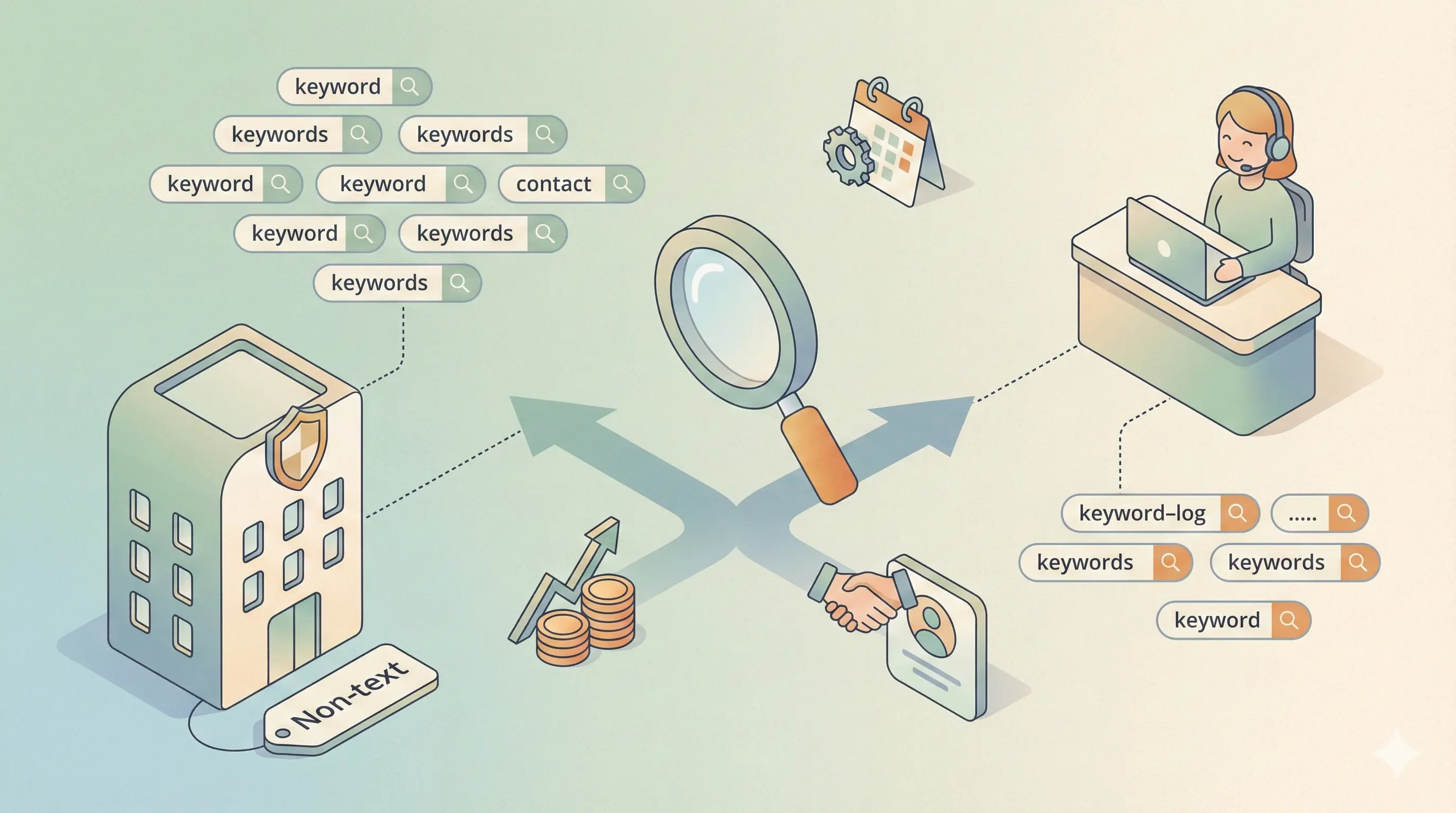
Insurance Broker vs Agent SEO: Which Keywords to Target (2026)
Insurance brokers vs agents: different audiences, different keywords. This guide shows the exact SEO strategy and keywords that work for each role in 2026.


If you're targeting "cheap auto insurance quotes" with the same intensity as "commercial liability insurance brokers," you're not just wasting budget, you're attracting the wrong clients entirely. I've seen agencies double their marketing spend while watching lead quality plummet, all because they chased volume over intent.
This guide solves the critical misunderstanding that all insurance professionals should chase the same keywords. I'll break down exactly how brokers and agents should approach keyword strategy differently based on client intent, business model, and competition. This isn't theory; it's what separates the agencies that get a steady stream of qualified leads from those that get endless price-shoppers who ghost after the first quote.
You'll learn how to identify and target the specific keyword categories that match your business model (agent vs broker), understand the search intent behind them, and build a content strategy that attracts your ideal clients, not just random searchers. Let's get into the nitty-gritty.
The Fundamental Difference: Why Your Business Model Dictates Your Keywords
The first mistake most insurance professionals make is treating SEO like a generic "get more traffic" button. They research "insurance keywords," find the highest volume terms, and create content around them. This is like a heart surgeon advertising for routine checkups because "more people need physicals." You attract the wrong audience and dilute your expertise.
Your business model, whether you're an agent or a broker fundamentally changes who your ideal client is, what they're searching for, and how they make decisions. Let's clarify the roles, because the industry often blurs them:
- The Insurance Agent's Role: Typically represents one specific carrier (captive agent like State Farm, Allstate) or a select few (independent agent with a limited panel). Their primary value proposition is often convenience, localized service, and carrier-specific program expertise. They excel at placing standard, "clean" risks efficiently. The client relationship is often with both the agent and the carrier brand.
- The Insurance Broker's Role: Acts as an advocate for the client, shopping among many (sometimes dozens) of carriers. Their primary value is choice, expertise in complex or niche risks, and advocacy during claims. They handle accounts where standard solutions don't fit, navigating harder-to-place risks. The client relationship is squarely with the broker.
These roles create entirely different client expectations. Someone searching for a "State Farm agent near me" wants efficiency and brand trust. Someone searching for "commercial insurance broker for manufacturing" wants a specialist who can navigate complex liability, product risk, and large property exposures.
I worked with an independent agent who spent 70% of his PPC budget on "cheap car insurance." He got hundreds of leads, but his close rate was abysmal. Why? He primarily served small business owners and affluent families' clients who valued advice and comprehensive coverage over the absolute lowest price. He was buying clicks from the wrong people. When we shifted his focus to keywords like "business auto insurance [his city]" and "personal umbrella insurance advice," his lead volume dropped by 60%, but his revenue from those campaigns tripled within six months. He stopped fighting the price war and started winning the advisory war.
The Agent's Focus: Carrier-Specific Solutions
Agents win by being the easiest, most trustworthy path to a well-known solution. Your keyword strategy should reflect that. If you're a captive agent, leverage your carrier's brand strength. People search for "Allstate agent" because they already have some brand affinity or recognition. Your content should answer questions about that carrier's specific programs, discounts, and local presence.
For independent agents, your keyword focus should be on localized solution keywords. You're not just selling "insurance"; you're selling the solution to "I need home insurance that meets my lender's requirements in Tampa" or "I need a quick auto quote before my policy lapses next week." Your keywords should include heavy geographic modifiers and emphasize speed, local service, and straightforward advice for common needs. Think of yourself as the helpful neighborhood expert for standard coverage.
The Broker's Advantage: Choice and Complexity
Brokers win on depth, not just speed. Your ideal client is often mid-way through their research, realizing their situation isn't standard. They've moved past "what is general liability insurance?" and are now asking "what is the minimum general liability coverage for a federal contractor?" or "errors and omissions insurance for IT consultants cost."
Your keyword universe is filled with industry-specific jargon, coverage-specific terms, and phrases that indicate complexity. You want to attract the searcher who knows enough to use precise terminology. A search for "D&O insurance for nonprofit board" screams for a broker. A search for "best price car insurance" does not. Your content must demonstrate nuanced expertise. You're not just providing quotes; you're providing market access and risk management strategy.
Keyword Intent Analysis: What Your Prospects Are Actually Thinking
You can't just look at a keyword; you have to diagnose the intent behind it. This is the single most important skill in insurance SEO. There are four main types of search intent, and they map directly to the agent/broker divide:
- Navigational Intent: The user wants to find a specific website. ("State Farm login," "XYZ Insurance Services website").
- Informational Intent: The user wants an answer to a question. ("What does business interruption insurance cover?").
- Commercial/Investigational Intent: The user is researching options and considering vendors. ("Best workers compensation insurance brokers," "comparing whole life insurance policies").
- Transactional Intent: The user is ready to take a commercial action. ("Buy commercial auto insurance online," "get a quick home insurance quote").
Intent varies dramatically between personal and commercial lines. A personal lines search is often shorter, more price-sensitive, and has a faster decision cycle. A commercial lines search is longer, more problem-focused, and involves a longer sales cycle with multiple stakeholders.
Transactional Intent (The Price Shopper)
This is the battleground for many agents, especially in personal lines. Keywords like "cheap car insurance quotes," "online auto insurance," and "instant homeowners insurance quote" are dominated by direct carriers (Geico, Progressive) and large aggregators. The searcher wants speed and price. If you're an agent competing here, you must differentiate on local service and bundling advice. Your content should acknowledge the price comparison but pivot to the value of local, personalized service, especially at claim time. However, for many brokers, these high-volume, low-intent keywords are a trap. The conversion value is low, and the client loyalty is fragile.
Commercial/Investigational Intent (The Problem Solver)
This is the broker's sweet spot. Keywords like "workers comp insurance for a restaurant with liquor liability," "cyber insurance for a small healthcare practice," or "insurance for a startup technology company" indicate a business owner who understands they have a specific, non-standard problem. They're not just price-shopping; they're solution-shopping. They need an expert who speaks their industry's language and knows which carriers have appetites for their risk. Your content for these keywords should be deeply educational, case-study driven (while respecting privacy), and should position you as a consultant who asks the right questions before giving a quote.
The Insurance Agent's Keyword Strategy: Local, Specific, Solution-Focused
For agents, your SEO strategy is a local volume play. You need to dominate your geographic service area for the specific types of insurance you sell. Cast a wide net within your zip codes and cities.
Primary Focus: [Insurance Type] + [Geographic Modifier] + [Service/Quote Modifier]
- Example: "auto insurance quotes Denver," "home insurance companies Tampa FL," "life insurance agent near me."
Leverage Your Carrier Strength (If Applicable): If you're a captive agent, this is your superpower. A significant portion of your traffic will come from branded searches. Optimize for "State Farm agent [your city]" or "Allstate insurance [your neighborhood]." Create content that explains your specific carrier's discounts, local claims process, and community involvement.
Personal Lines Focus: This is where most agents live. Your keyword clusters should revolve around:
- Auto: "SR-22 insurance [state]," "teen driver insurance discounts," "car insurance after a DUI [city]."
- Homeowners/Renters: "first-time homebuyer insurance guide," "does renters insurance cover theft," "flood insurance [city] requirements."
- Life/Health: "term life insurance rates for seniors," "Medicare supplement plans [state]."
The Power of 'Near Me' and Local Community Keywords: "Near me" searches are overwhelmingly mobile and have high purchase intent. Ensure your Google Business Profile is flawless and that your website clearly states your service areas. Go beyond generic insurance terms. Create content around local events or risks: "Preparing Your Home for [Local City] Storm Season," "[Local High School] Safe Driver Program," "Understanding [Your State]'s New Auto Insurance Laws."
Personal Lines Agent Keyword Examples
Think like your local client. They have immediate, practical needs. Your keywords should answer those needs directly.
- Targeted Phrase: "Affordable home insurance in Austin TX"
- Page/Content Idea: A page titled "Finding Affordable Homeowners Insurance in Austin: 2024 Tips & Discounts," discussing local construction costs, common Austin weather risks (hail), and carrier-specific discounts for homes with storm shutters or updated roofs.
- Targeted Phrase: "State Farm life insurance policies"
- Content Idea: As a State Farm agent, a detailed guide breaking down the differences between State Farm's term, whole, and universal life products, using plain language and scenarios (e.g., "If you're 30 and just had a baby, here's how we typically structure coverage...").
Commercial Agent Keyword Opportunities
Even as an agent, you can play in commercial lines, but your focus should be on mainstream small business needs. You're not going after the 100-employee manufacturing plant; you're targeting the local restaurant, retail store, or small contractor.
- Targeted Phrase: "Small business insurance package Chicago"
- Content Idea: "What's Included in a Chicago Small Business Owner's Policy (BOP)?" Explain the standard bundle, give local cost ranges for a cafe vs. a boutique, and include a checklist of documents needed for a quote.
- Targeted Phrase: "Commercial auto insurance for landscaping companies"
- Content Idea: A focused article on coverage must-haves for landscapers: liability for property damage, on-road and off-road vehicle coverage, and workers' comp considerations. Keep it practical and solution-oriented.
The Insurance Broker's Keyword Strategy: Expertise, Complexity, and Choice
For brokers, your SEO strategy is an authority and expertise play. You are not competing on geographic ubiquity for simple terms. You are competing on depth of knowledge for complex terms. Your goal is to be found when it matters most when a business or individual faces a risk they can't easily solve with a quick online quote.
Primary Focus: [Specific Risk/Coverage] + [Broker/Advisor/Specialist] + [Industry/Niche Modifier]
- Example: "product liability insurance broker for ecommerce," "high-risk auto insurance advisor," "directors and officers insurance for non-profits."
Commercial Lines Dominance: This is your natural habitat. Target industry-specific SIC/NAICS code language. Instead of "business insurance," target "insurance for artisan bakeries" or "malpractice insurance for mental health therapists." Your content should demonstrate you understand their operational risks, regulatory environment, and industry-specific policy endorsements.
The 'Expertise' and 'Advisor' Keywords: Don't shy away from terms that position you as a consultant. Keywords like "insurance advisor," "risk management consultant," or "insurance broker for" indicate a searcher seeking a trusted partner, not just a policy. Incorporate these into your page titles and meta descriptions.
Navigating Harder-to-Place Risks: Your most valuable keywords are those that signal standard markets might not work. Think: "hard to place commercial insurance," "insurance for startups with no revenue," "coastal property insurance high wind area," "insurance for cannabis-related businesses." By ranking for these, you attract clients who desperately need your specific skill set and are less price-sensitive.
Commercial Broker Keyword Examples
Your keywords should sound like industry talk. The more specific, the better.
- Targeted Phrase: "cyber liability insurance for small business"
- Page/Content Idea: "The Small Business Guide to Cyber Liability Insurance: What It Covers (& What It Doesn't)." Detail first-party vs. third-party coverage, discuss ransomware-specific endorsements, and provide a simple assessment quiz ("Does your business need cyber insurance? Answer these 5 questions").
- Targeted Phrase: "insurance broker for construction companies"
- Content Idea: A pillar page or resource hub titled "The Complete Insurance Checklist for Construction Contractors." Break it down by trade (general, electrical, plumbing), discuss wrap-up policies, subcontractor default insurance, and the importance of completed operations coverage. This becomes a definitive resource.
Specialty & Complex Risk Keywords
This is where you separate from the crowd. Own a niche.
- Targeted Phrase: "errors and omissions insurance for software developers"
- Content Idea: A highly technical comparison of E&O policy forms for tech. Discuss the difference between "negligence" and "breach of contract" coverage, the importance of prior acts coverage, and how intellectual property exclusions can be negotiated.
- Targeted Phrase: "high net worth personal insurance advisor"
- Content Idea: Content focused on the unique needs of affluent individuals: scheduled personal articles, excess liability (umbrella), collections insurance, domestic staff coverage, and the importance of agreed value vs. market value for unique assets. The tone should be discreet and highly professional.
Comparative Keyword Table: Agent vs. Broker Focus Areas
Here’s a side-by-side look at where agents and brokers should concentrate their efforts. This illustrates the strategic divergence clearly.
Personal Lines Keyword Comparison
| Keyword Example | Typical Searcher Intent | Better For | Competition Level | Recommended Content Approach |
|---|---|---|---|---|
| "cheap auto insurance quotes" | Transactional / Price Shopping | Agent (though competing with direct carriers) | Very High | Local landing page emphasizing local service & bundling discounts vs. online-only. |
| "what does full coverage auto insurance mean?" | Informational / Education | Agent | Medium | Simple, clear blog post or guide with local law references. |
| "high risk auto insurance after multiple DUIs" | Commercial / Problem-Solving | Broker | Medium-High | In-depth guide on SR-22s, non-standard markets, and steps to rebuild risk profile. |
| "home insurance companies in Dallas" | Commercial / Comparing Providers | Agent | High | Comparison page or article reviewing top carriers in Dallas, highlighting local agency benefits. |
| "coastal home insurance flood zone" | Commercial / Complex Need | Broker | Medium | Authoritative guide on NFIP vs. private flood, windpool coverage, and mitigation strategies. |
Commercial Lines Keyword Comparison
| Keyword Example | Risk Complexity | Better For | Sales Cycle | Conversion Strategy |
|---|---|---|---|---|
| "small business insurance quote online" | Low / Standard | Agent | Short (Days) | Quick online quote form, emphasis on speed & simplicity. |
| "general liability insurance for contractors" | Medium / Industry-Specific | Either | Medium (Weeks) | Detailed coverage explanation, checklist of needed info, offer a coverage review. |
| "workers compensation insurance for trucking company" | High / Niche-Risk | Broker | Long (Weeks/Months) | Offer a downloadable audit guide or a consultation to review class codes and experience mods. |
| "directors and officers liability insurance nonprofit" | High / Specialized | Broker | Long (Months) | Publish case studies (anonymized), offer a D&O policy comparison checklist as a lead magnet. |
| "product liability insurance for imported goods" | Very High / Complex | Broker | Long (Months) | Position as an expert with international market access. Content on import/export regulations and insurer requirements. |
Implementation Framework: Building Your Role-Specific SEO Plan
Knowledge is useless without action. Here’s your 5-step framework to build or correct your keyword strategy.
Step 1: Audit Your Current Keyword Targeting
Grab a spreadsheet. List the top 20-30 keywords you're currently trying to rank for (check your website content, meta tags, and any paid campaigns). Now, be brutally honest. For each one, label it: Agent-Friendly, Broker-Friendly, or Misfit. A misfit keyword is one that attracts clients you don't want or can't serve profitably (e.g., a commercial broker targeting "cheap car insurance"). This will be eye-opening.
Step 2: Identify 3-5 Primary Keyword Categories Matching Your Strengths
Don't try to be everything to everyone. Based on your audit and business model, choose 3-5 core categories. For an agent: maybe "Auto Insurance [Your County]," "First-Time Homebuyer Insurance [State]," and "Life Insurance for Families." For a broker: "Healthcare Practice Insurance," "Cyber Liability for SMEs," and "Professional Liability for Consultants." These are your content pillars.
Step 3: Create Pillar Content and Topic Clusters
For each primary category, build a cornerstone "pillar" page a comprehensive, ultimate guide. Then, create 5-10 supporting blog posts (cluster content) that dive into subtopics and link back to the pillar page. This tells Google you're an authority on the topic.
-
Agent Example: Pillar: "The Complete Guide to Auto Insurance in [Your City]." Clusters: "Understanding Uninsured Motorist Coverage in [State]," "How to Lower Teen Driver Insurance Costs," etc.
-
Broker Example: Pillar: "Cyber Insurance for Small & Medium Businesses: The 2024 Guide." Clusters: "Ransomware Coverage: What to Look For," "Does Cyber Insurance Cover Social Engineering Fraud?", etc.
Step 4: Develop Intent-Specific Conversion Paths
Your call-to-action must match the keyword's intent.
-
For transactional/intent keywords ("...quote"): Use a streamlined, multi-page quote form.
-
For commercial/investigational intent keywords ("...broker for..."): Use a "Schedule a Consultation" or "Request a Coverage Analysis" form. Offer a high-value lead magnet like a specialized checklist or whitepaper first.
Step 5: Measure What Matters: Lead Quality Over Quantity
Stop obsessing over "number of leads." Start tracking:
- Lead-to-Client Conversion Rate: Are your SEO leads closing?
- Average Policy Premium/Account Size: Is it going up?
- Client Retention Rate: Are these clients staying? A broker might get 10 leads a month with a 40% close rate and $10k average account size. An agent might get 100 leads with a 10% close rate and $2k average size. Which is better? It depends entirely on your model and capacity. Define your own "quality" metric.
For Agents: The Local Volume Play
Your implementation is about saturation and convenience. Double down on:
- Google Business Profile Excellence: Every detail updated, posts added weekly, Q&As monitored, photos of your team and office.
- Local Citation Building: Ensure your Name, Address, Phone (NAP) is consistent on every local directory.
- Hyper-Local Content: Write about community events, local risks, and area-specific insurance FAQs. Become the local news source for insurance.
For Brokers: The Authority & Expertise Play
Your implementation is about depth and trust. Focus on:
- In-Depth, Gated Content: Create sophisticated guides, whitepapers, and webinars that require an email to access. This qualifies your leads.
- Expert Positioning: Get quoted in trade publications, speak at industry association events, and publish bylined articles on professional platforms like LinkedIn.
- Niche-Specific Pages: Instead of a generic "Services" page, have dedicated pages for each niche you serve ("Insurance for Architects & Engineers," "Coverage for Biotechnology Startups").
Conclusion
Effective insurance SEO isn't about chasing the highest-volume keywords, it's about targeting the right keywords that match your specific business model, attract your ideal clients, and convert at the highest rate for your services. The agent's path is paved with local intent and solution-based queries. The broker's path is built on complex terminology and advisory-seeking searches. Walking the wrong path guarantees wasted budget and frustrated sales teams.
Your Key Takeaway: You are not a generic "insurance seller." You are either a local solution provider (agent) or a complex-risk problem solver (broker). Your entire digital presence, starting with your keywords, must scream that identity to the right audience.
Your Immediate Action: Audit your current keyword strategy today. Are you inadvertently targeting broker keywords as an agent, or vice versa? Pick one of your core categories from Step 2 and build out its pillar page this month.
Frequently Asked Questions (FAQ)
Q1: I'm an independent agent who also handles some complex commercial lines. How do I balance my keyword strategy?
A1: Create a clear website architecture that separates your personal lines and commercial lines services. Use distinct service area pages and blog categories. For SEO, you can absolutely target both, but be mindful of brand dilution. Your primary focus should still be on local, service-oriented keywords. For your complex commercial lines, create a dedicated "Commercial Risk Solutions" section and target specific niche keywords there, perhaps under a separate brand or team name to build specialized authority.
Q2: Are long-tail keywords really worth the effort for brokers, given their low search volume?
A2: Absolutely, and they are often your most valuable asset. While "business insurance" might get 50,000 searches a month, "insurance for drone photography business" might get 50. But that one searcher is a perfect-fit, high-intent prospect who is very likely to contact you. Long-tail keywords have lower competition, higher conversion rates, and directly signal expertise. For brokers, quality of traffic dramatically outweighs quantity.
Q3: How important is it to include my city name in every keyword as an agent?
A3: Critically important for primary service pages. Your main "Auto Insurance" page should be titled "Auto Insurance in [City, State] | Your Agency Name." This aligns with how people search locally. For blog content, you can mix it up, some with local modifiers, some without to capture broader informational intent that may still lead to local conversions.
Q4: As a broker, should I bother with Google Ads on high-volume, generic terms?
A4: Generally, no. It's usually a poor return on investment. Your budget is better spent on:
- Ads for your specific niche keywords (e.g., "D&O insurance for startups").
- Retargeting visitors who have read your deep educational content.
- LinkedIn ads targeting specific job titles (CFOs, CEOs) in industries you serve. Pay for attention from the right people, not just more people.
Q5: Can I rank for both "insurance agent" and "insurance broker" keywords?
A5: This is tricky and can confuse both users and search engines. It's better to pick one primary identity that matches your business model and licensing. If you are legally an agent but operate like a broker (shopping many markets), you might focus your content on broker-style educational topics but use "agent" in your local business listings and contact pages for clarity. Consistency in how you present your services is key to conversion.
Q6: How long does it take to see results from a refined, role-specific keyword strategy?
A6: SEO is a long game. You may see initial ranking movements for new pages in 3-6 months. Significant traffic and lead increases typically take 6-12 months of consistent, high-quality content publication and technical SEO work. The payoff, however, is a sustainable, inbound lead engine that operates 24/7 and attracts better-fit clients year after year. It's not a campaign; it's an asset you build.
Thanks for reading! ❤️
Written by
JenishRead Next


Turn this into your AI Search strategy
LLaMaRush creates SEO, AEO, and GEO optimized content built to rank in Google and get cited by AI answer engines.
Start Ranking Everywhere