

14 Best SEO Automation Tools for Bootstrapped SaaS Founders (2026)
Compare the best SEO automation tools for bootstrapped SaaS founders, from keyword research and content briefs to AI writing, audits, and rank tracking.


Running SEO as a solo founder usually looks the same: you know you should be publishing content, fixing technical issues, and building links, but the day gets eaten by product, support, and sales before you open a single dashboard. SEO automation tools exist to close that gap. Even starting with a free content idea generator can help you turn a vague topic into a sharper publishing queue before you commit to a full platform. The right stack can hand you keyword research, content briefs, drafts, technical audits, and rank tracking without you having to become a full-time SEO.
This guide breaks down 14 of the best SEO automation tools for 2026, organized by what they actually automate, so you can build a stack that fits a one-person or two-person team instead of an in-house marketing department.
TL;DR: The 14 Best SEO Automation Tools at a Glance
| Tool | Best For | Starting Price | Free Trial | AI Features | G2 Rating |
|---|---|---|---|---|---|
| Ahrefs | All-in-one keyword & backlink research | $29/mo | Limited free trial | AI tools and data to grow your brand’s traffic, visibility, and revenue. | 4.5/5 (710) |
| Semrush | All-in-one marketing suite | $139.95/mo | 7 days Free trial | SEO Copilot + AI Visibility Toolkit | 4.4/5 (4020) |
| LLaMaRush | Hands-off content pipeline for founders | $29/mo | 3 blog free | Keyword Research + Full content writing + publishing | No G2 Reviews yet but Reviews on Website |
| SEObot | Fully autonomous blog agent | $49/mo | No | AI agents for writing & linking | No G2 reviews but reviews in Website |
| Outrank | Automated Content writing and Backlinking Platform | $99/mo | 3-day trial for $1 | Daily AI article generation and backlink exchange | 4.6/5 (85) |
| Frase | SEO + AEO content workflow | $49/mo | 7 days Free trial | AI outlines + AI search tracking | 4.8/5 (309) |
| Scalenut | SEO + GEO content platform | $59/mo | 7 days Free trial | Cruise Mode AI drafting | 4.7/5 (316) |
| Surfer SEO | Real-time content optimization | $119/mo | 7 days Free trial | Surfer AI + AI Humanizer | 4.5/5 (545) |
| Screaming Frog | Technical site audits | Free / ~$279/year | Free tier (500 URLs) | Limited | 4.7/5 (187) |
| SE Ranking | Budget-friendly all-in-one | $103.20/mo | 14 days Free Trial | AI search visibility tracking and Page Audits | 4.7/5 (1578) |
| AccuRanker | Enterprise rank tracking | $249/mo | No | AccuLLM prompt tracking | 4.8/5 (232) |
| Pitchbox | Link building & outreach at scale | $300/mo | Free trial | AI email personalization | 4.7/5 (98) |
| GrowthBar | Budget AI writing + SEO data | $36/mo | 7 days Free Trial | ChatGPT-4 writer | 4.6/5 (350) |
| Ubersuggest | Cheapest entry-level SEO suite | ~$12/mo | 7 days Free Trial | Basic AI content and Prompt ideas | 4.2/5 (160) |
What is an SEO Automation Tool?
An SEO automation tool is software that takes over some (or most) of the repetitive work involved in ranking a website: finding keywords, building topic clusters, drafting content, checking technical health, tracking rankings, or reaching out for backlinks. Instead of manually pulling reports from five different places, you connect your site and the tool does the pulling, the analysis, and often the execution for you.
There's a real difference between "manual SEO with software help" and true automation. A tool like Google Search Console shows you data but leaves every decision to you. A tool like LLaMaRush goes further: it reads that same search data and turns it into a finished, published article without you writing a word. Most of the 15 tools in this guide sit somewhere on that spectrum, and knowing where each one sits matters more than any single feature list.
SEO automation tools are worth looking at if you're a solo founder, an indie hacker, a two-person marketing team, or an agency managing several clients with limited hours. If you've never done SEO before, this beginner's guide to SEO for founders is a useful primer before you start comparing software.
Manual SEO vs. automated SEO, side by side:
| Task | Doing it manually | With an automation tool |
|---|---|---|
| Keyword research | Hours in Search Console + spreadsheets | Minutes, with volume and intent scored automatically |
| Content briefs | Reading 5-10 competitor articles by hand | Auto-generated outline from live SERP data |
| First draft | 2-4 hours of writing | Minutes, with human review/editing |
| Internal linking | Re-reading old posts to find link spots | Suggested or auto-inserted based on a site crawl |
| Publishing | Copy, format, upload, schedule | One click, or fully automatic via CMS integration |
| Rank tracking | Manually checking Search Console per keyword | Dashboard updated daily or in real time |
Common examples of SEO automation tools include AI content platforms like LLaMaRush and SEObot, all-in-one research suites like Ahrefs and Semrush, content optimization editors like Surfer SEO, and specialist tools for a single job, like Screaming Frog for technical crawling or AccuRanker for rank tracking. Most founders don't end up using just one; they combine two or three that cover different stages of the pipeline.
Why Do Bootstrapped SaaS Founders Need SEO Automation?
Bootstrapped teams face a specific set of constraints that enterprise marketing departments don't:
- Small teams. There's often no dedicated marketer, let alone a content team, a technical SEO, and a link builder.
- Budget constraints. A $2,000-a-month agency retainer isn't realistic pre-revenue, and hiring a full-time content writer costs more than most tools combined.
- Time savings. Founders are already stretched across product, support, and sales; SEO has to fit into leftover hours, not replace them.
- Scaling without hiring. Automation lets a single founder maintain a publishing cadence that would otherwise require two or three employees.
If you're doing everything yourself right now, it's worth reading how solo founders can run SEO on around five hours a week before deciding how much of that time you actually want to hand off to software.
How SEO Automation Tools Save 10+ Hours Every Week?
A full manual SEO workflow touches eight distinct stages, and automation tools typically remove hours from each one:
- Keyword research - instead of manually digging through a keyword planner, tools surface volume, difficulty, and intent in seconds.
- Clustering - grouping hundreds of keywords into coherent topic groups by hand can take a full day; clustering tools do it in minutes.
- Briefs - AI-generated outlines replace the hour or two it takes to research competitor content manually.
- AI writing - first drafts appear in minutes rather than the 3-4 hours a founder might spend writing a single post.
- Optimization - real-time scoring tells you what to add or cut instead of guessing.
- Internal links - automated link suggestions replace manually re-reading old posts to find link opportunities.
- Publishing - one-click or fully automatic publishing removes the copy-paste-format cycle entirely.
- Tracking - dashboards replace manually checking rankings in Search Console one keyword at a time.
Stack a few of these stages with genuinely automated tools and it's realistic to cut 10+ hours a week down to under two. That's the core pitch behind LLaMaRush's comparison of doing SEO yourself versus automating it, which breaks down the actual time cost of each approach.
How We Evaluated These Tools
Each tool below was assessed against eight criteria, weighted according to what actually matters for a resource-constrained team:
| Criteria | Weight |
|---|---|
| Automation Features | 25% |
| AI Content Quality | 20% |
| SEO Features (keyword research, technical, links) | 20% |
| Ease of Use | 15% |
| Integrations | 10% |
| Pricing & Value | 10% |
We also looked at reporting depth and scalability as secondary factors within each category above. Automation was weighted the heaviest because "automation tool" that still requires four hours of manual work per article isn't really automating anything, it's just a faster editor. For background on what actually influences rankings once your content is live, see this plain-English breakdown of how Google's ranking algorithm works and this guide to Google's E-E-A-T signals.
The 15 Best SEO Automation Tools, Reviewed
1. Ahrefs
Ahrefs built its reputation on backlink data and near-real-time crawl updates. Ahrefs is the industry-standard research suite for keyword data, backlink analysis, and site audits. It's not an "automation" tool in the write-and-publish sense, but it automates the research and monitoring layer that every other tool in this list depends on. Ahrefs spans five tiers, Starter, Lite, Standard, Advanced, and Enterprise, with automated rank tracking, Content Explorer for link prospecting, and Site Audit for technical monitoring.
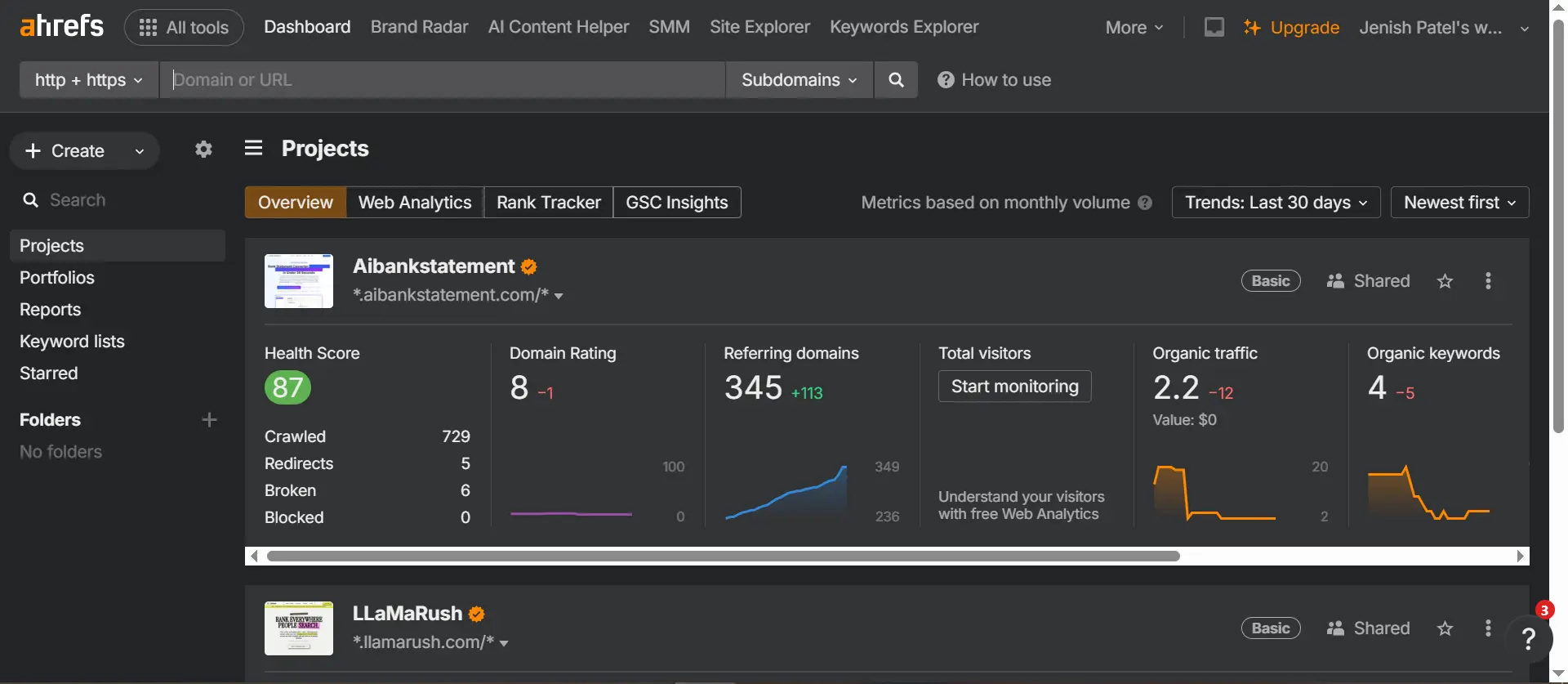 Ahrefs dashboard website SEO metrics, backlinks, and organic traffic.
Key Features:
- Site Explorer for competitor backlink and traffic analysis
- Keywords Explorer covering 12+ search engines, including YouTube and Amazon
- Automated Site Audit crawls that flag technical issues
- Content Explorer for finding link and content opportunities at scale
Pros:
- The most comprehensive backlink database in the category
- Frequent data refreshes (15–30 minutes) versus daily updates elsewhere
- Deep keyword and competitor research
Cons:
- No content writing or auto-publishing built in
- Entry-level Starter plan excludes Content Explorer, which many SEOs consider essential
- No free trial on the full platform but free trial on limited platform features.
Pricing:
| Plan | Monthly Price | Best For | Key Highlights |
|---|---|---|---|
| Free | $0 | Website owners | Limited access to Site Explorer, Site Audit, Web Analytics, AI Content Helper, and Social Media Manager for verified websites. |
| Starter | $29/month | Beginners & Bloggers | Competitor analysis, Keywords Explorer, Rank Tracker, Site Audit, and Site Explorer with usage credits. |
| Lite | $129/month | Freelancers & Small Businesses | 5 projects, 750 tracked keywords, 100,000 crawl credits, and 6 months of historical data. |
| Standard | $249/month | SEO Consultants & Growing Teams | 20 projects, 2,000 tracked keywords, unlimited credits per user, and 2 years of historical data. |
| Advanced | $449/month | In-house Marketing Teams | 50 projects, 5,000 tracked keywords, 1.5M crawl credits, advanced reporting, API access, and automation features. |
| Enterprise | Starts at $1,499/month | Large Enterprises | Unlimited API access, SSO, audit logs, unlimited historical data, custom limits, and enterprise support. |
Best For: Founders who need serious competitive and backlink research and are willing to pair it with a separate writing or publishing tool.
Verdict: Ahrefs is the research backbone many other tools on this list (including AI writers) lean on indirectly. It's rarely the only tool in a bootstrapped stack, but it's often the first one worth paying for once budget allows.
2. Semrush
Semrush is the broadest all-in-one marketing platform on this list, combining SEO, content, competitive research, and (via its newer AI Visibility Toolkit) answer-engine tracking in one subscription.
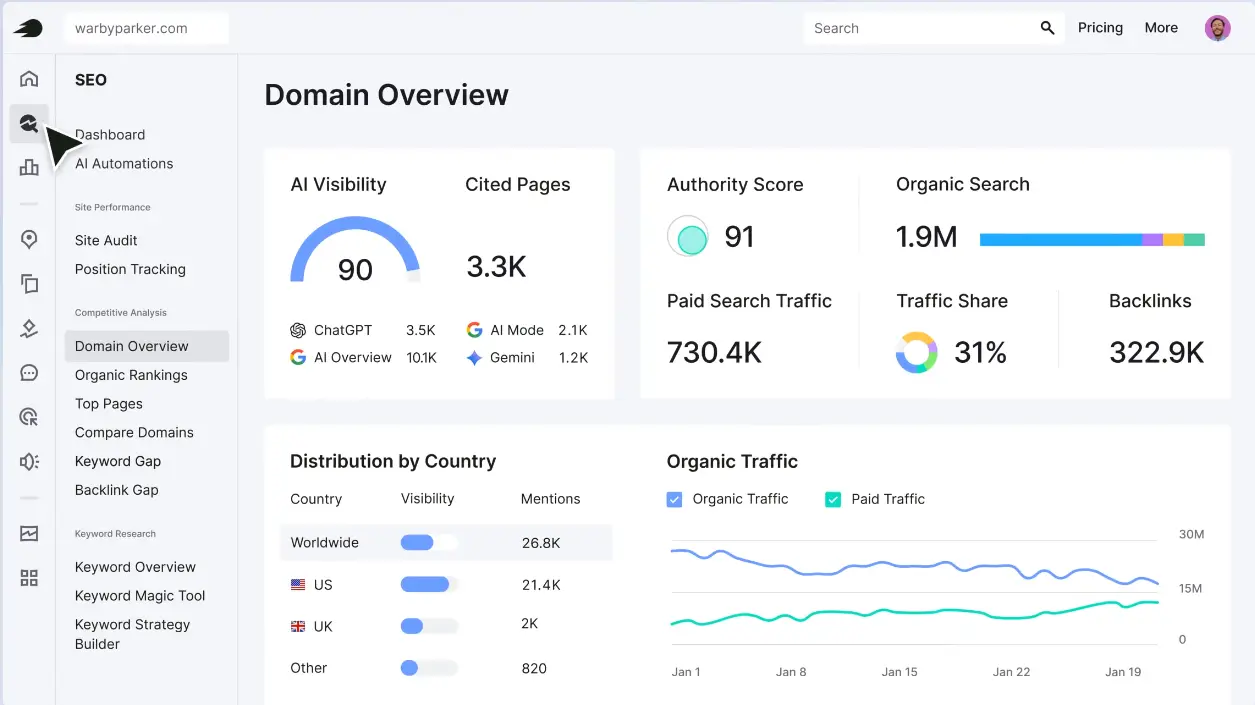 Semrush SEO dashboard with domain overview, keyword research, and AI visibility.
Key Features:
- Position tracking, site audits, and competitor keyword gap analysis
- Content Marketing Toolkit for briefs and content scoring
- AI Visibility Toolkit add-on for tracking brand mentions in AI answers
- Historical ranking and traffic data going back years
Pros
- Comprehensive all-in-one platform covering SEO, PPC, content marketing, and competitive research.
- Industry-leading keyword database with accurate search volume and keyword difficulty metrics.
- Powerful site audit tool that quickly identifies technical SEO issues and improvement opportunities.
- Robust competitor analysis for tracking rankings, backlinks, traffic, and marketing strategies.
- Frequent feature updates with AI-powered tools, local SEO, and content optimization capabilities.
Cons
- Higher pricing makes it less affordable for solo founders and early-stage startups.
- Usage limits on reports, projects, and tracked keywords can be restrictive on lower-tier plans.
- Large number of features creates a steep learning curve for beginners.
- Historical data and advanced capabilities are locked behind higher-priced plans.
- AI content generation features are less automated than dedicated AI SEO automation platforms like LLaMaRush or SEObot.
Pricing:
| Plan | Annual Price (per month) | Monthly Price | Best For | Key Highlights |
|---|---|---|---|---|
| SEO | $117.33/mo | $139/mo | Beginners & Individual Projects | 5 websites, 500 tracked keywords, keyword research, competitor analysis, Position Tracking, Site Audit, AI search performance tracking, AI visibility reports, custom prompt monitoring. |
| Starter | $165.17/mo | $199/mo | Founders & Small Businesses | Everything in SEO plan plus AI Visibility toolkit, 50 AI prompts/day, 1 AI brand domain, 300 AI visibility reports/day, AI-ready Site Audit, MCP access. |
| Pro+ | $248.17/mo | $299/mo | Growing SaaS & Marketing Teams | 15 websites, 1,500 tracked keywords, historical SEO data, content optimization, keyword cannibalization analysis, multi-location/device tracking, 100 AI prompts/day. |
| Advanced | $455.67/mo | $549/mo | Large Teams & Enterprises | 40 websites, 5,000 tracked keywords, SEO Share of Voice, expanded API & MCP access, advanced automation, 200 AI prompts/day. |
Best For: Growing teams and agencies that need one platform to cover research, content planning, and reporting for multiple sites or clients.
Verdict: Semrush is the safest "do everything reasonably well" choice once you've outgrown single-purpose tools, but it's overkill, and expensive, for a pre-revenue solo founder.
3. LLaMaRush
LLaMaRush is an AI SEO automation platform that connects to your Google Search Console data, then plans, writes, and auto-publishes blog content targeting the keyword gaps your site already has traction on, with minimal daily input from you. Positioned as an "AI SEO co-founder," LLaMaRush is built specifically for technical founders and indie hackers who don't want to run a content operation themselves. Rather than starting from a blank prompt, it reads your existing search and analytics data to decide what to write next, then handles the drafting, formatting, and publishing.
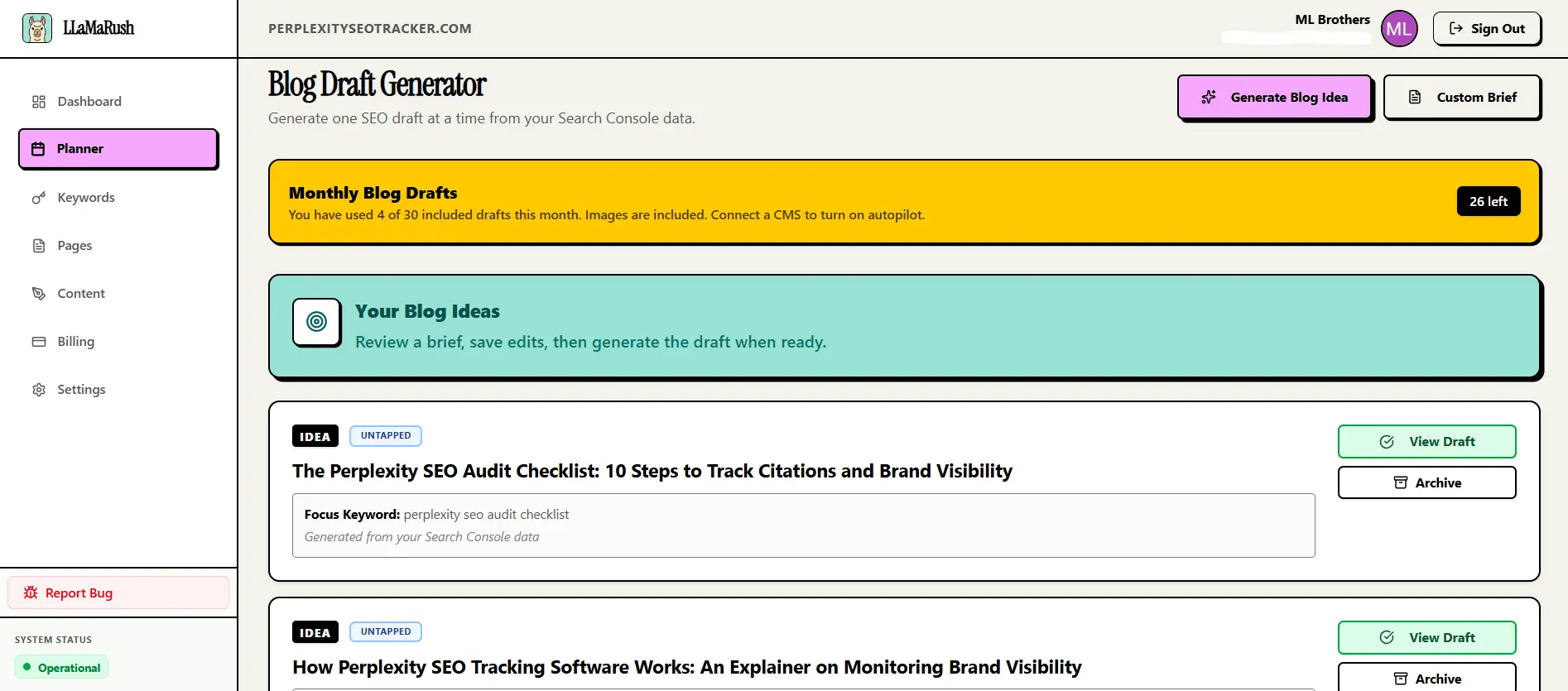 LLaMaRush SEO automation dashboard with AI blog planner and content workflow.
Key Features:
- Analyzes 6+ months of GSC and GA4 data to find keyword opportunities
- Weekly content plan with outlines, keywords, and opportunities
- One-click publishing to WordPress, Ghost, Notion and GitHub
- AI-written content that matches your tone and adds citations
Pros:
- Automatically creates an SEO strategy using your Google Search Console and GA4 data.
- Generates high-quality, long-form SEO content tailored to your website and brand voice.
- Fully automates the content workflow, from keyword discovery to CMS publishing.
- Identifies content gaps and prioritizes keywords with the highest traffic potential.
- Affordable and designed specifically for solo founders, startups, and small SaaS teams.
Cons:
- Focuses primarily on content automation rather than technical SEO or backlink analysis.
- Does not include a comprehensive keyword database like Semrush or Ahrefs.
- Best results require connecting Google Search Console and GA4 for personalized insights.
- Not ideal for agencies managing large numbers of client websites with advanced collaboration needs.
- Lacks built-in PPC research and advertising tools available in all-in-one marketing suites.
Pricing:
| Plan | Monthly Price | Best For | Key Highlights |
|---|---|---|---|
| Free | $0/month | Individuals exploring AI SEO | Access to core LLaMaRush features with limited monthly usage, ideal for evaluating the platform before upgrading. |
| Starter | $29/month | Solo founders & indie hackers | Automated keyword discovery, 8 AI SEO content generation, Google Search Console integration, WordPress publishing, and brand voice customization. |
| Founder | $79/month | Growing SaaS startups & small businesses | Everything in Starter, plus higher article limits with 30 articles monthly, GSC integration, advanced content planning, priority processing, and more automation. |
Best For: Solo founders, indie hackers, and small SaaS teams who want the entire SEO workflow, not just drafting, automated.
Verdict: LLaMaRush is an excellent choice for bootstrapped SaaS founders, solo entrepreneurs, and small teams that want to grow organic traffic without building a dedicated SEO team. Instead of requiring users to manually research keywords, create content briefs, write articles, optimize them, and publish them, LLaMaRush automates the entire workflow using your real Google Search Console and GA4 data. This makes it particularly valuable for founders with limited time and budgets who want to consistently publish high-quality, SEO-focused content. However, if your primary need is advanced backlink analysis, large-scale technical SEO audits, or PPC research, you'll still need complementary tools like Ahrefs or Semrush. For founders focused on content-led growth, LLaMaRush offers one of the best automation-first solutions available.
4. SEObot
SEObot bills itself as a fully autonomous "SEO Robot", AI agents handle keyword research, writing, internal linking. SEObot deploys specialized AI agents for different parts of the workflow. You provide a URL, and it plans a content strategy, writes SEO-friendly posts, and interlinks them automatically, with drafts available for approval before they go live.
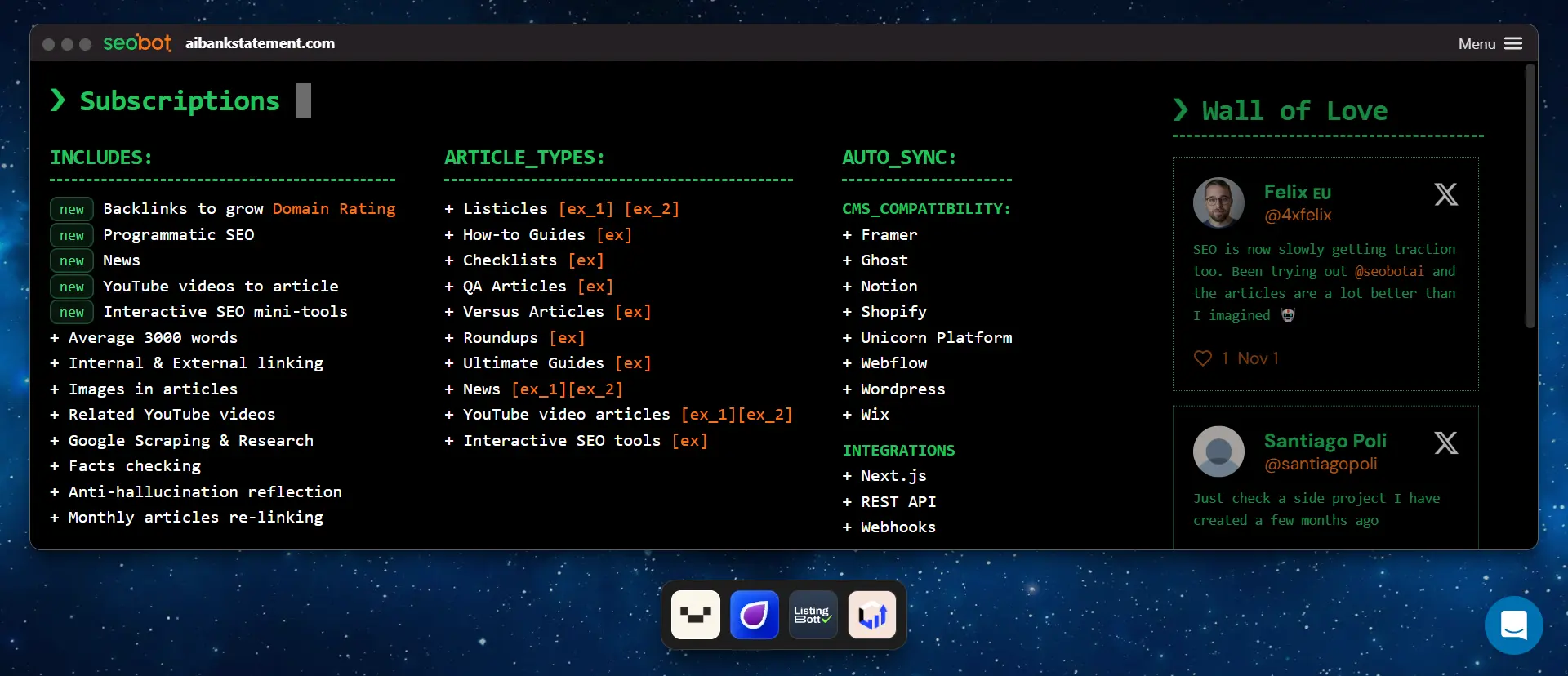 SEObot dashboard for automated SEO content generation and website publishing.
Key Features:
- AI agents for content creation, SEO analysis, and internal linking
- Supports 50+ languages
- Articles up to 4,000 words with images, tables, and FAQs included
- Auto-publishing across WordPress, Ghost, Shopify, and more
Pros:
- Fully automates keyword research, content planning, writing, internal linking, and publishing with minimal manual effort.
- Generates long-form SEO articles with images, tables, YouTube embeds, and source citations.
- Supports programmatic SEO, AI news generation, and interactive SEO mini-tools for scalable traffic growth.
- Integrates with popular CMS platforms like WordPress, Webflow, Ghost, Shopify, Wix, Notion, and HubSpot.
- Includes automated backlink building and continuous internal linking to improve site authority over time.
Cons:
- Primarily focused on content automation and lacks the comprehensive SEO research suite offered by Semrush or Ahrefs.
- No permanent free plan or free trial; users must start with a paid subscription.
- There is no Technical SEO auditing, rank tracking, and backlink analytics.
Pricing:
| Plan | Monthly Price | Best For | Key Highlights |
|---|---|---|---|
| Starter | Starts at $49/month | Solo founders, indie hackers, and SaaS startups | Fully automated onboarding, AI keyword research, content planning, long-form SEO article generation, internal linking, fact-checking, citations, AI images, YouTube embeds, and automatic CMS publishing. |
Best For: Founders comfortable letting AI run the majority of content production while they moderate output rather than write it themselves.
Verdict: SEObot is a capable choice for founders who want to automate SEO content production with minimal effort. If you're comparing multiple AI SEO platforms, reviewing side-by-side comparisons and alternative options can help you understand the trade-offs between automation, content quality, integrations, and overall workflow before making a decision.
5. Outrank
Outrank is a content assistant that automatically researches keywords and publishes SEO-optimized posts on a daily schedule, branded as "your behind-the-scenes content team." Outrank handles keyword research, writing, internal linking, and scheduling for WordPress, Feather, Framer, Notion etc sites specifically, aiming to grow a blog "on autopilot" once configured.
Key Features:
- Daily automated keyword research and article writing
- 150+ language support
- One-click WordPress plugin installation for auto-publishing
- Monthly 30-day publishing schedule generated automatically
Pros:
- Fully automates keyword research, content creation, publishing, and backlink building with minimal manual work.
- Generates and auto-publishes up to 30 SEO articles per month on supported CMS platforms.
- Includes a built-in backlink exchange network to help improve domain authority.
- Supports WordPress, Webflow, Shopify, Framer, and several other publishing platforms.
- Offers AI-generated images, unlimited AI rewrites, and support for 150+ languages.
Cons:
- Offers limited manual control compared to traditional SEO suites like Ahrefs or Semrush.
- Focuses primarily on content automation rather than technical SEO audits or backlink analysis.
- Only one public pricing plan is available, which may not suit users with lighter content needs.
- Requires a paid trial ($1 for 3 days) instead of providing a completely free plan.
- Not ideal for marketers who need deep keyword databases, rank tracking, or advanced competitive research.
Pricing:
| Plan | Monthly Price | Regular Price | Best For | Key Highlights |
|---|---|---|---|---|
| All in One | $99/month | Solo founders, SaaS startups, agencies, and content marketers | 30 AI-generated & auto-published articles/month, automated keyword research, high-DR backlink exchange, unlimited AI rewrites, AI-generated images, relevant YouTube embeds, unlimited users, CMS integrations (WordPress, Webflow, Shopify, Framer & more), support for 150+ languages, and custom feature requests. |
Multi-site Discounts
| Number of Sites | Discount |
|---|---|
| 2–4 sites | 10% OFF |
| 5–19 sites | 15% OFF |
| 20–25 sites | 20% OFF |
| 25+ sites | Contact Sales |
Best For: Outrank is best suited for bootstrapped SaaS founders, solo entrepreneurs, agencies, and content-focused businesses that want to automate their entire SEO content workflow with minimal manual effort.
Verdict: Outrank is a great choice for bootstrapped founders and small teams that want to automate SEO content from keyword research to publishing. It offers a hands-off workflow with AI content generation, auto-publishing, and backlink building. However, if you need advanced technical SEO, rank tracking, or detailed competitor analysis, you'll likely need a dedicated SEO platform alongside it. For how it stacks up against a GSC-driven alternative, see Outrank vs. LLaMaRush.
6. Frase
Frase combines SERP research, AI drafting, and real-time content scoring in one workflow, with an added focus on tracking how content performs in AI search engines like ChatGPT and Perplexity. Frase analyzes top-ranking pages for a target keyword, builds an outline from what's already ranking, then scores your draft against that research as you write, for both traditional Google rankings and newer AI/AEO visibility.
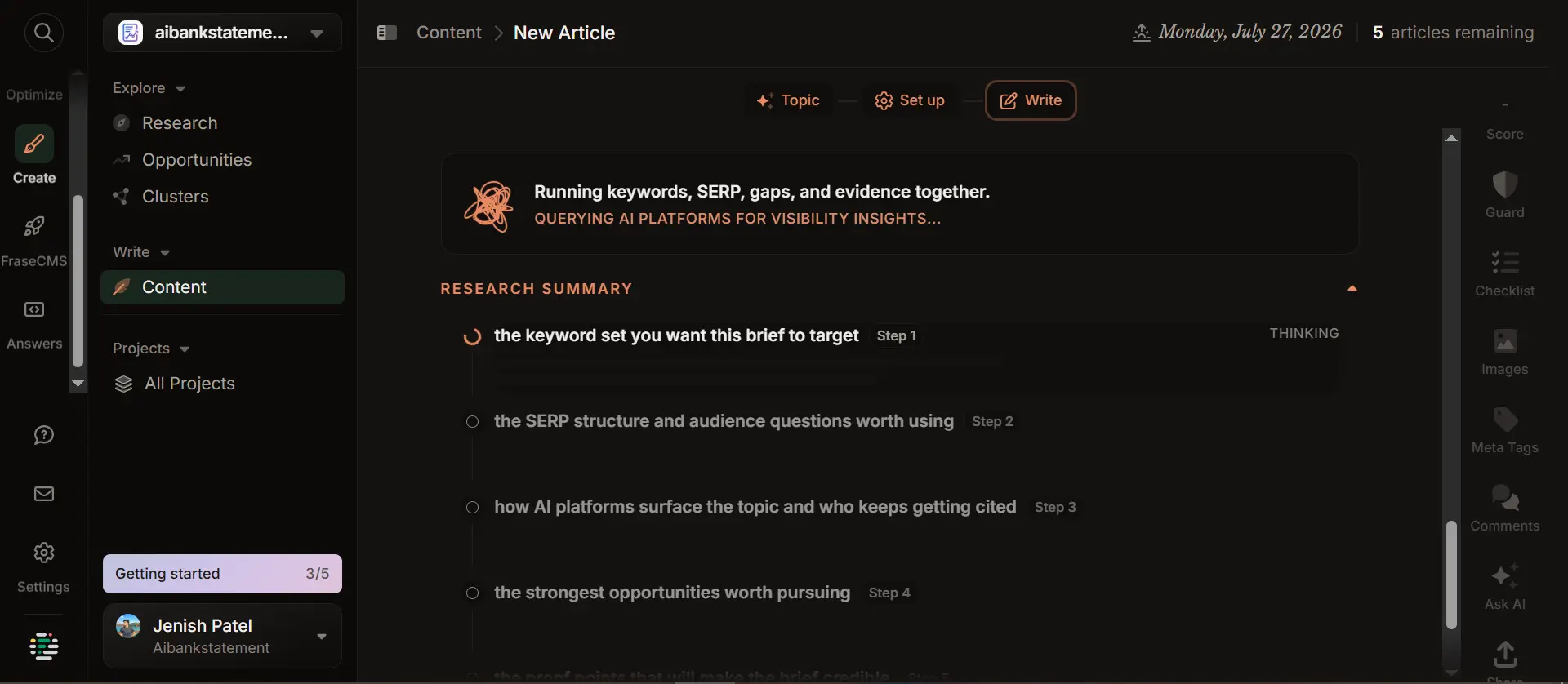 Frase AI content editor with SEO brief and content optimization workflow.
Key Features:
- SERP analysis that turns competitor content into outlines automatically
- Real-time SEO and GEO (AI search) scoring while you write
- Content Opportunities monitoring for pages that are losing traffic
- Optional AI Search Tracking add-on for ChatGPT/Perplexity visibility
Pros:
- Combines content research, AI writing, optimization, publishing, and AI visibility tracking in one platform.
- Generates SEO- and GEO-optimized content using live search data and AI-powered research.
- Monitors Google rankings and AI visibility, then suggests or drafts updates when content performance declines.
- Supports direct publishing to WordPress, Webflow, Wix, Sanity, and FraseCMS.
- Offers a 7-day free trial with no credit card required, making it easy to evaluate the platform.
Cons:
- Monthly article and audit limits can be restrictive on lower-tier plans.
- Advanced features like multi-site management and AI automation require higher-priced plans.
- Primarily focused on content optimization and lacks deep backlink analysis compared to Ahrefs or Semrush.
- Does not provide a comprehensive keyword database like dedicated SEO research platforms.
- Auto-publishing and autonomous content updates are unavailable during the free trial and are limited to paid plans.
Pricing:
| Plan | Annual Price (per month) | Monthly Price | Best For | Key Highlights |
|---|---|---|---|---|
| Starter | $39/month | $49/month | Solo founders, freelancers, and bloggers | 1 seat, 1 site, 10 AI articles/month, 50 audit pages/month, SEO & GEO scoring, AI Visibility, Content Guard for 3 pages, WordPress/Webflow/Wix/Sanity publishing. |
| Professional | $103/month | $129/month | Growing content teams & SMBs | 3 seats, 5 sites, 40 AI articles/month, 250 audit pages, content calendar, internal linking suggestions, AI Visibility (ChatGPT, Google AI & Perplexity), Content Guard for 15 pages. |
| Scale | $239/month | $299/month | Agencies & multi-site businesses | 5 seats, up to 10 domains, 100 AI articles/month, 1,000 audit pages, Claude & Gemini AI visibility, client-ready reports, automated publishing, content repurposing. |
| Enterprise | Custom | Custom | Large enterprises & agencies | Custom seats, custom domains, SSO/SAML, white-label reports, branded client portal, custom API access, SLA, dedicated account manager. |
Best For: best for content marketers, SEO professionals, bloggers, and growing SaaS teams that want to research, write, optimize, and refresh SEO content in one platform
Verdict: Frase is an excellent choice for content marketers, SEO professionals, and growing SaaS teams that want to streamline content research, writing, and optimization in one platform. It combines AI-powered writing with real-time SEO recommendations and content auditing, making it ideal for teams focused on creating and improving high-quality content. However, if you need comprehensive backlink analysis, advanced keyword research, or enterprise-level SEO reporting, you'll likely need a dedicated SEO platform alongside Frase.
7. Scalenut
Scalenut pairs fast AI drafting (Cruise Mode) with keyword clustering, content audits, and technical on-page fixes, aiming to be a complete "SEO + GEO" content platform in one dashboard. Scalenut lets you generate a 5-minute draft from a keyword and tone, then layers in keyword planning, content auditing, and an AI Humanizer to smooth out AI-written text.
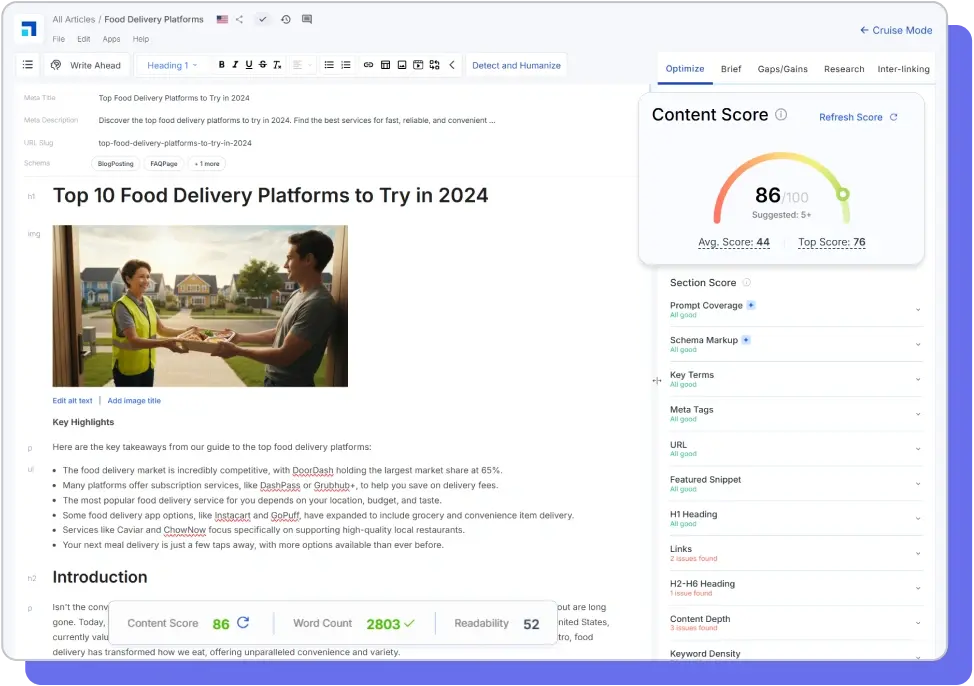 Scalenut AI content editor with SEO score and content optimization panel.
Key Features:
- Cruise Mode for fast, SEO-friendly draft generation
- Keyword Planner with topic clustering for content calendars
- Content Audit & Traffic Analyzer using your GSC data
- OnPage Pro for page-level technical fixes
Pros:
- Covers the entire SEO content workflow, from keyword planning to AI writing and optimization.
- Tracks AI visibility across ChatGPT, Google AI Overviews, and Perplexity.
- Includes content audits, internal linking, topic gap analysis, and auto-publishing tools.
- Supports team collaboration with multiple workspaces and user management on higher plans.
- Offers a 7-day free trial to explore all major features before subscribing
Cons:
- Lower-tier plans limit the number of articles, audits, and tracked prompts.
- Advanced collaboration and AI visibility features require higher-priced plans.
- Backlink analysis is less comprehensive than dedicated SEO tools like Ahrefs or Semrush.
- Primarily focused on content marketing rather than full technical SEO management.
- Can become expensive for growing teams that need higher content and tracking limits.
Pricing:
| Plan | Monthly Price | Annual Price (per month) | Best For | Key Highlights |
|---|---|---|---|---|
| Starter | $59/month | $24/month | Solo founders, bloggers & consultants | 5 GEO articles/month, 5 article optimizations, 10 AI visibility prompts, keyword clusters, 1 workspace, ChatGPT & Google AI Overview tracking. |
| Plus | $89/month | $36/month | Growing startups & small businesses | 30 GEO articles/month, 30 optimizations, 25 AI prompts, 200-page content audit, internal linking, topic gaps, WordPress & Shopify auto-publishing, up to 4 team members. |
| Professional | $199/month | $80/month | Agencies & marketing teams | 75 GEO articles/month, 75 optimizations, 100 AI prompts, 1,000-page audits, unlimited workspaces, unlimited team members, Perplexity tracking, cannibalization analysis, priority support. |
| Enterprise / Services | Custom | Custom | Large enterprises | Custom limits, dedicated support, advanced services, and tailored AI visibility strategy. |
Best For: Best for content marketers, SEO professionals, startups, and growing SaaS teams that want an all-in-one platform for planning, writing, optimizing, and monitoring SEO content.
Verdict: Scalenut is a strong choice for founders and marketing teams looking to manage their entire SEO content workflow from a single platform. It combines AI-powered content creation with optimization, AI search visibility tracking, and collaboration features, making it ideal for scaling content marketing. However, businesses that need advanced backlink intelligence or enterprise-level SEO research may still benefit from pairing it with a dedicated SEO suite like Ahrefs or Semrush.
8. Surfer SEO
Surfer SEO is the category leader for real-time, on-page content optimization, it doesn't do your keyword research or publish for you, but it tells you exactly what to add, cut, or restructure to match what's already ranking. Surfer SEO scores your draft against top-ranking pages for a target keyword in real time, using a "gamified" content score covering word count, headings, and semantic terms.
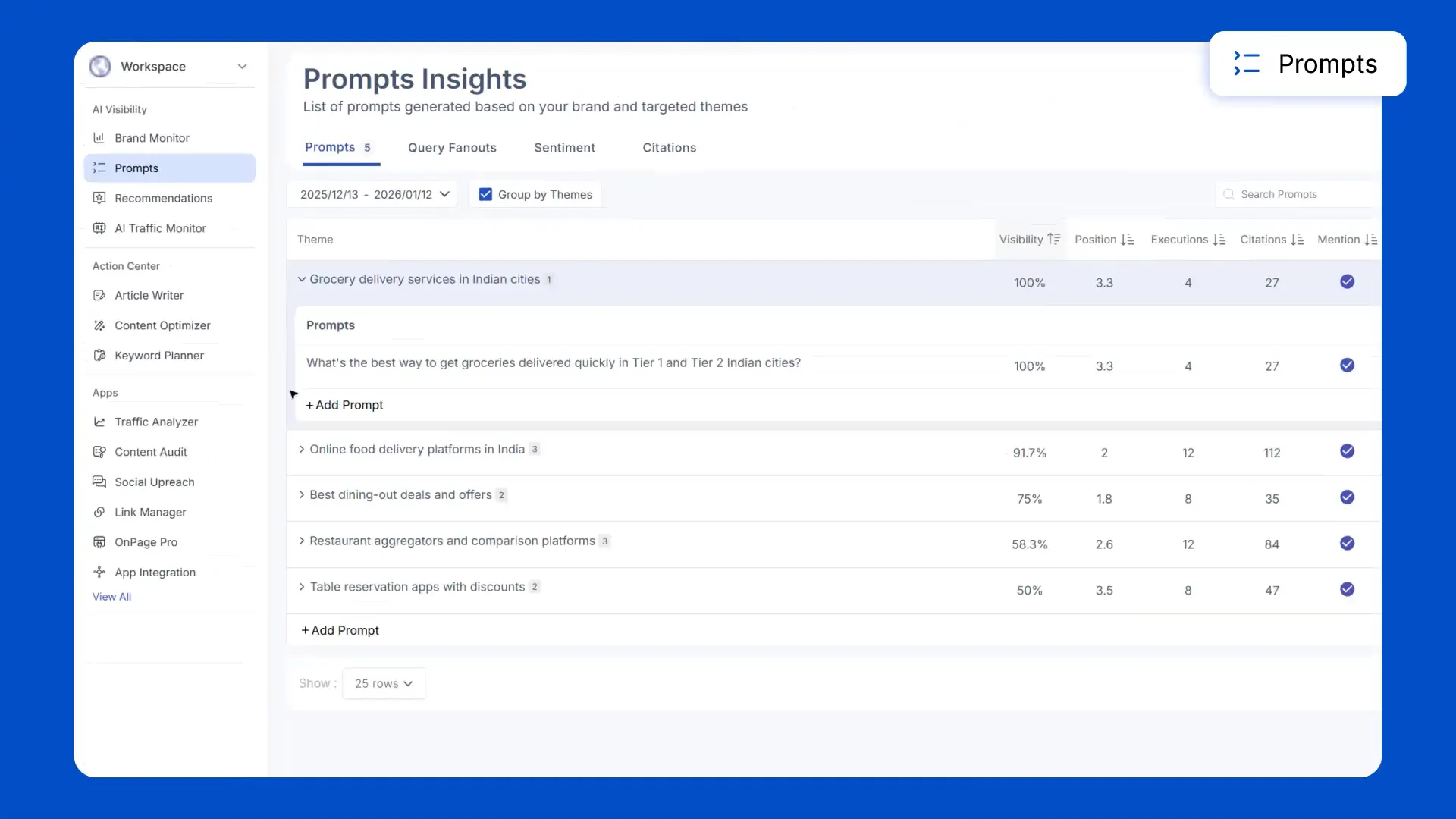 SurferSEO dashboard, prompt insights, brand monitoring tools, and content performance metrics.
Key Features:
- Content Editor with live SEO scoring against SERP data
- Auto internal-link suggestions across your site
- Surfer AI for generating full drafts, plus an AI Humanizer
- AI Search Tracking on higher tiers for ChatGPT/Perplexity visibility
Pros:
- Provides real-time content optimization recommendations based on top-ranking pages.
- Combines AI writing, content scoring, auditing, and keyword optimization in one platform.
- Includes AI Visibility tracking for Google AI Overviews and other AI search experiences.
- Integrates with WordPress, Google Docs, Jasper, and other popular content tools.
- Easy to use for beginners while offering advanced optimization features for SEO professionals.
Cons:
- Focuses mainly on on-page SEO and lacks comprehensive backlink analysis.
- Keyword research capabilities are less extensive than dedicated SEO suites like Ahrefs or Semrush.
- Document and tracking limits on lower-tier plans may restrict heavy content publishers.
- Pricing can become expensive as content production and team size grow.
- Does not include advanced technical SEO auditing or competitor research found in all-in-one SEO platforms.
Pricing:
| Plan | Annual Price (per month) | Monthly Price | Best For | Key Highlights |
|---|---|---|---|---|
| Discovery | $49/month | $59/month | Bloggers, freelancers & beginners | 10 content documents/month, AI SEO Optimization, Content Score, AI Writing Assistant (Surfy), Humanizer, 10 tracked pages. |
| Standard | $99/month | $119/month | Content marketers & small businesses | 30 documents/month, 50 tracked pages, AI SEO Optimization, Content Audit, AI Tracking, team collaboration. |
| Pro | $182/month | $219/month | Growing teams & agencies | 30 documents/month, 200 tracked pages, 5 seats, advanced AI tracking, multiple workspaces, priority collaboration features. |
| Peace of Mind | $299/month | $359/month | Large marketing teams | Unlimited documents, 500 tracked pages, 10 seats, unlimited workspaces, highest AI tracking limits, premium support. |
| Enterprise | Custom | Starts at $999/month | Enterprises | Custom limits, SSO, enterprise security, API access, dedicated onboarding, white-label options, priority support. |
Best For: Surfer SEO is best for content marketers, SEO professionals, agencies, and SaaS teams that want to create and optimize content based on real-time ranking factors.
Verdict: Surfer SEO is an excellent choice for businesses and content teams focused on improving on-page SEO with AI-powered optimization. It helps streamline content creation and optimization, making it easier to publish articles that align with search intent. If you're comparing different approaches to SEO automation, it can also be helpful to review a detailed comparison between Surfer SEO and fully automated platforms, as well as explore other alternatives before making a decision.
9. Screaming Frog SEO Spider
Screaming Frog is the desktop crawler technical SEOs reach for first, it surfaces broken links, duplicate content, redirect chains, and metadata issues by crawling your site the way a search engine would. Screaming Frog SEO Spider runs locally rather than in the cloud, giving you a detailed, exportable audit of exactly how your site is structured, invaluable before or after any content push.
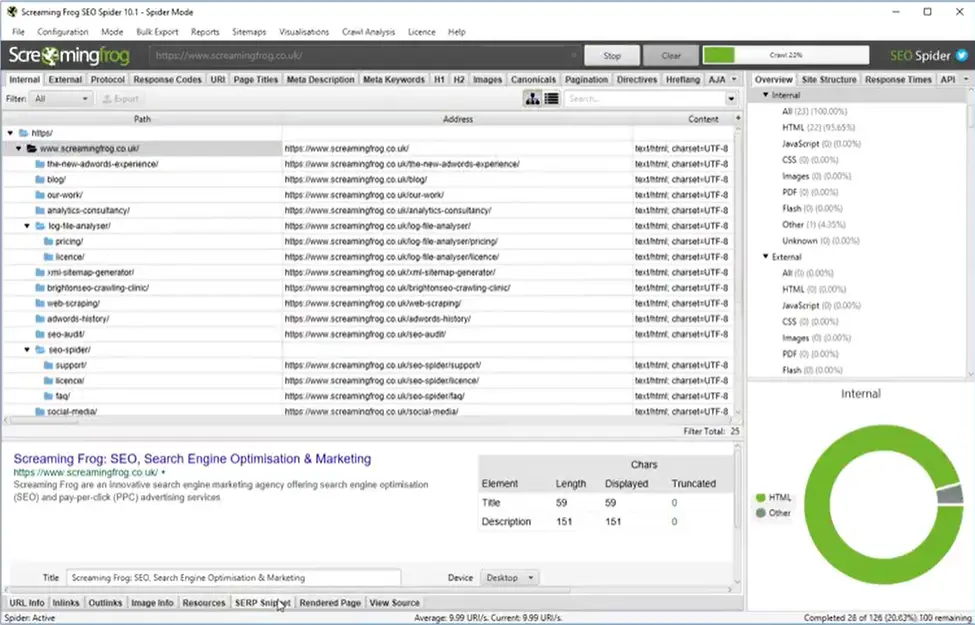 Screaming Frog SEO Spider dashboard for website crawling and technical SEO audits.
Key Features:
- Full-site crawling for broken links, redirects, and duplicate content
- Title, meta description, and heading analysis at scale
- XML sitemap generation and site visualizations
- Google Analytics and Search Console integration
Pros:
- Industry-leading website crawler for identifying technical SEO issues at scale.
- Free version supports crawling up to 500 URLs, making it useful for small websites.
- Integrates with Google Search Console, Google Analytics, PageSpeed Insights, and OpenAI.
- Provides in-depth audits for broken links, redirects, duplicate content, structured data, and Core Web Vitals.
- Highly customizable with JavaScript rendering, custom extraction, scheduling, and crawl configuration.
Cons:
- Desktop-based software with a steeper learning curve than most cloud SEO tools.
- Focuses on technical SEO and does not include keyword research or AI content generation.
- User interface can feel overwhelming for beginners due to its spreadsheet-style layout.
- Each user requires a separate annual license, which can increase costs for larger teams.
- Does not provide built-in rank tracking, backlink database, or competitor research like Semrush or Ahrefs.
Pricing:
| Plan | Price | Best For | Key Highlights |
|---|---|---|---|
| Free | $0 | Individuals, bloggers & small websites | Crawl up to 500 URLs, detect broken links, analyze metadata, generate XML sitemaps, JavaScript rendering, Google Search Console & Analytics integration, structured data validation, PageSpeed Insights integration, and technical SEO audits. |
| Paid License | $279/year | SEO professionals, agencies & enterprises | Unlimited URL crawling, crawl scheduling, crawl comparison, save/open crawls, advanced configuration, custom extraction, Looker Studio reporting, OpenAI & Gemini integration, technical support, and all premium SEO Spider features. |
Best For: Screaming Frog is best for technical SEO professionals, agencies, developers, and in-house SEO teams that need to audit website architecture and uncover technical issues.
Verdict: Screaming Frog is one of the best technical SEO crawlers available for auditing websites of any size. It provides deep insights into site structure, indexing, and technical issues that many cloud-based SEO tools miss. However, it is designed for technical analysis rather than keyword research or content automation, so many teams pair it with platforms like Semrush, Ahrefs, or AI-powered content tools for a complete SEO workflow.
10. SE Ranking
SE Ranking is a genuinely all-in-one platform, rank tracking, site audits, keyword research, and backlink analysis, priced meaningfully lower than Ahrefs or Semrush, with AI search visibility included rather than sold as an add-on. SE Ranking restructured its pricing in late 2025 down to two self-serve tiers, Core and Growth, both of which include AI visibility tracking across ChatGPT, Perplexity, and Google AI Overviews at no extra cost.
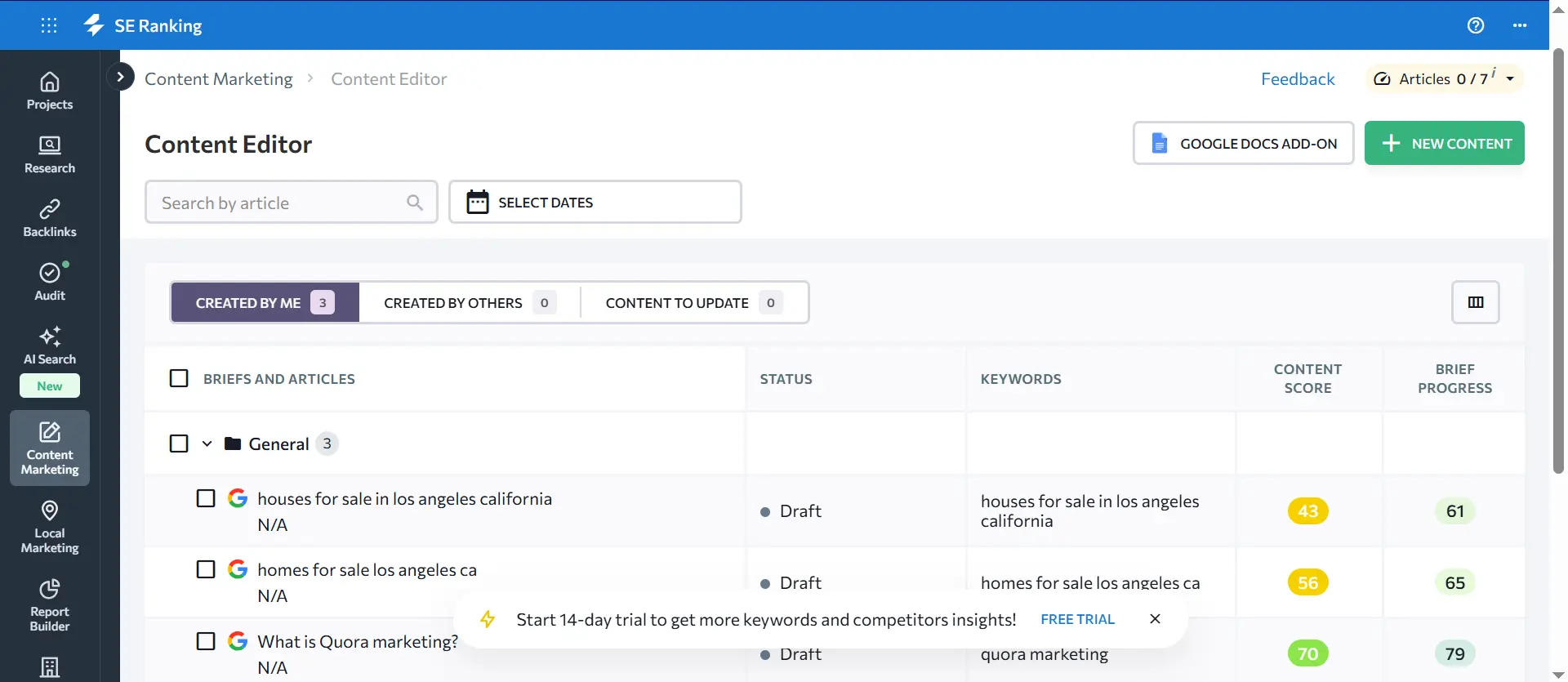 SE Ranking content editor dashboard with SEO content scores and keyword tracking.
Key Features:
- Keyword research and rank tracking for up to 2,000 keywords (Core)
- Site audits covering up to 250,000 pages
- Backlink monitoring and white-label reporting
- Built-in AI search visibility ("GEO prompt") tracking
Pros:
- Offers a complete SEO toolkit including keyword research, rank tracking, site audits, backlink analysis, and competitor research in one platform.
- Provides excellent value for money compared to premium tools like Semrush and Ahrefs.
- Includes AI-powered search visibility tracking and monitoring for modern search experiences.
- Supports white-label reporting, API access, and collaboration features for agencies and growing teams.
- Easy-to-use interface makes it suitable for beginners while still offering advanced SEO capabilities.
Cons:
- Backlink database is smaller and less comprehensive than Ahrefs.
- AI content generation and automation are not as advanced as dedicated AI SEO platforms.
- Higher plans are required for historical data, API access, and advanced collaboration features.
- Local marketing and AI search features may require additional add-ons depending on your subscription.
- Less suitable for enterprises that require the largest keyword and backlink databases.
Pricing:
| Plan | Annual Price (per month) | Monthly Price | Best For | Key Highlights |
|---|---|---|---|---|
| Core | $103.20/month | $129/month | Freelancers, bloggers & small businesses | 10 projects, 1 user, 2,000 tracked keywords, rank tracking, keyword research, competitor analysis, backlink checker, website audit, AI search tracking. |
| Growth | $223.20/month | $279/month | Growing businesses & agencies | 30 projects, 3 users, 5,000 tracked keywords, historical data, guest collaboration, page change monitoring, expanded AI search tracking, API access. |
| Enterprise | Custom | Custom | Large agencies & enterprises | Custom projects, custom keyword limits, advanced API, dedicated support, enterprise security, custom integrations, flexible scaling. |
Best For: SE Ranking is best for freelancers, agencies, small businesses, and SaaS teams that need a complete SEO platform without paying enterprise-level prices.
Verdict: SE Ranking is an excellent all-in-one SEO platform for businesses that want powerful SEO features at a competitive price. It delivers a well-balanced mix of keyword research, technical SEO, rank tracking, and competitor analysis, making it ideal for freelancers, startups, and agencies. If you're comparing SEO platforms, it's worth reviewing how SE Ranking stacks up against similar tools and exploring a few alternatives to find the best fit for your workflow and budget
11. AccuRanker
AccuRanker is a premium, dedicated rank tracker built for speed and accuracy at scale, daily keyword position updates across devices, locations, and now AI-powered search surfaces via its AccuLLM add-on. AccuRanker is priced by number of tracked keywords rather than by seat or site, which makes it particularly efficient for agencies managing rankings across many client domains under one subscription.
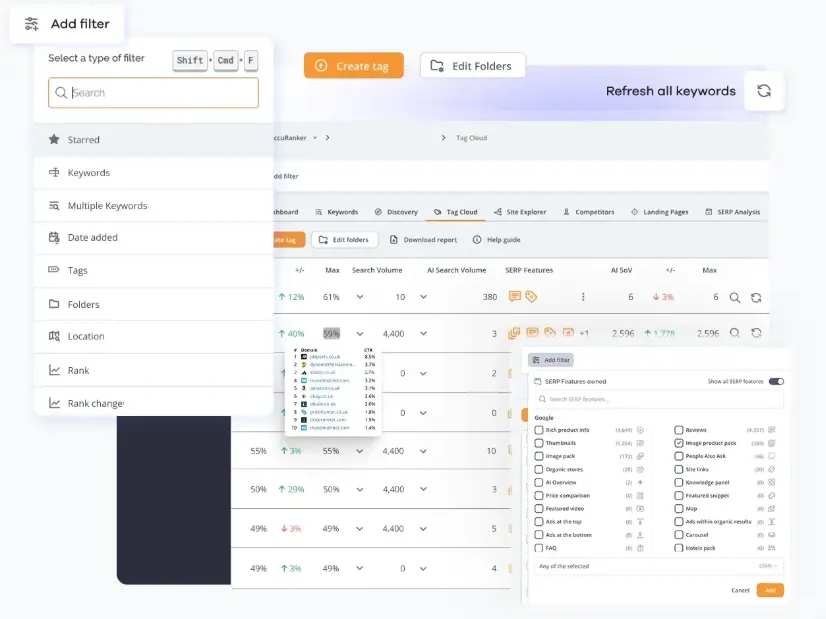 AccuRanker keyword rank tracking dashboard with SERP analysis and filters.
Key Features:
- Real-time keyword rank tracking across search engines, devices, and locations
- Unlimited domains and users on every tier
- AccuLLM for tracking brand visibility inside ChatGPT, Perplexity, and AI Overviews
- Looker Studio and BigQuery integrations for custom reporting
Pros:
- Delivers highly accurate daily keyword rank tracking with on-demand refreshes for instant updates.
- Built specifically for rank tracking, making it one of the fastest tools for monitoring keyword performance.
- Includes AI search visibility tracking across ChatGPT, Google AI Overviews, Perplexity, and other LLMs.
- Offers powerful filtering, tagging, reporting, and Google Search Console & GA4 integrations.
- Supports unlimited users, domains, and API access on higher plans, making it ideal for agencies and enterprises.
Cons:
- Focuses on rank tracking and does not provide AI content generation or SEO writing tools.
- Lacks comprehensive technical SEO auditing compared to platforms like Semrush or Screaming Frog.
- Does not include a large backlink database for link analysis.
- Pricing is significantly higher than many all-in-one SEO tools, especially for agencies tracking thousands of keywords.
- Better suited for tracking rankings than managing a complete SEO workflow.
Pricing:
| Plan | Monthly Price | Best For | Key Highlights |
|---|---|---|---|
| Professional | Starts at $249/month | Freelancers, consultants & small agencies | Daily rank tracking, keyword research, search intent, advanced filtering, tagging, Google Search Console & GA4 integrations, reporting and exports. |
| Expert | Starts at $849/month | Growing agencies & in-house SEO teams | Everything in Professional, plus Dynamic Tagging, Tag Cloud, AI CTR, AI Search Volume, Looker Studio integration, and Unlimited Read API. |
| Enterprise | Custom Pricing | Large enterprises | Everything in Expert, plus Google BigQuery integration, Unlimited Write API, raw SERP HTML access, enhanced processing speed, unlimited users & domains, and a dedicated Customer Success Manager. |
Best For: AccuRanker is best for SEO agencies, enterprise marketing teams, and businesses that rely heavily on accurate keyword rank tracking and reporting.
Verdict: AccuRanker is one of the best dedicated rank tracking tools for agencies and enterprise SEO teams that need fast, accurate keyword monitoring. Its daily updates, AI search visibility tracking, and powerful reporting make it ideal for performance-focused SEO workflows. However, if you're looking for content creation, technical SEO audits, or backlink research, you'll need to pair it with a broader SEO platform to cover the entire SEO process.
12. Pitchbox
Pitchbox is a purpose-built link building and digital PR outreach platform, prospecting, personalized email sequences, and a pipeline view for managing the entire backlink acquisition process. Pitchbox automates the parts of link building that eat the most time: finding relevant sites, finding the right contact, personalizing outreach, and tracking replies through a dedicated pipeline.
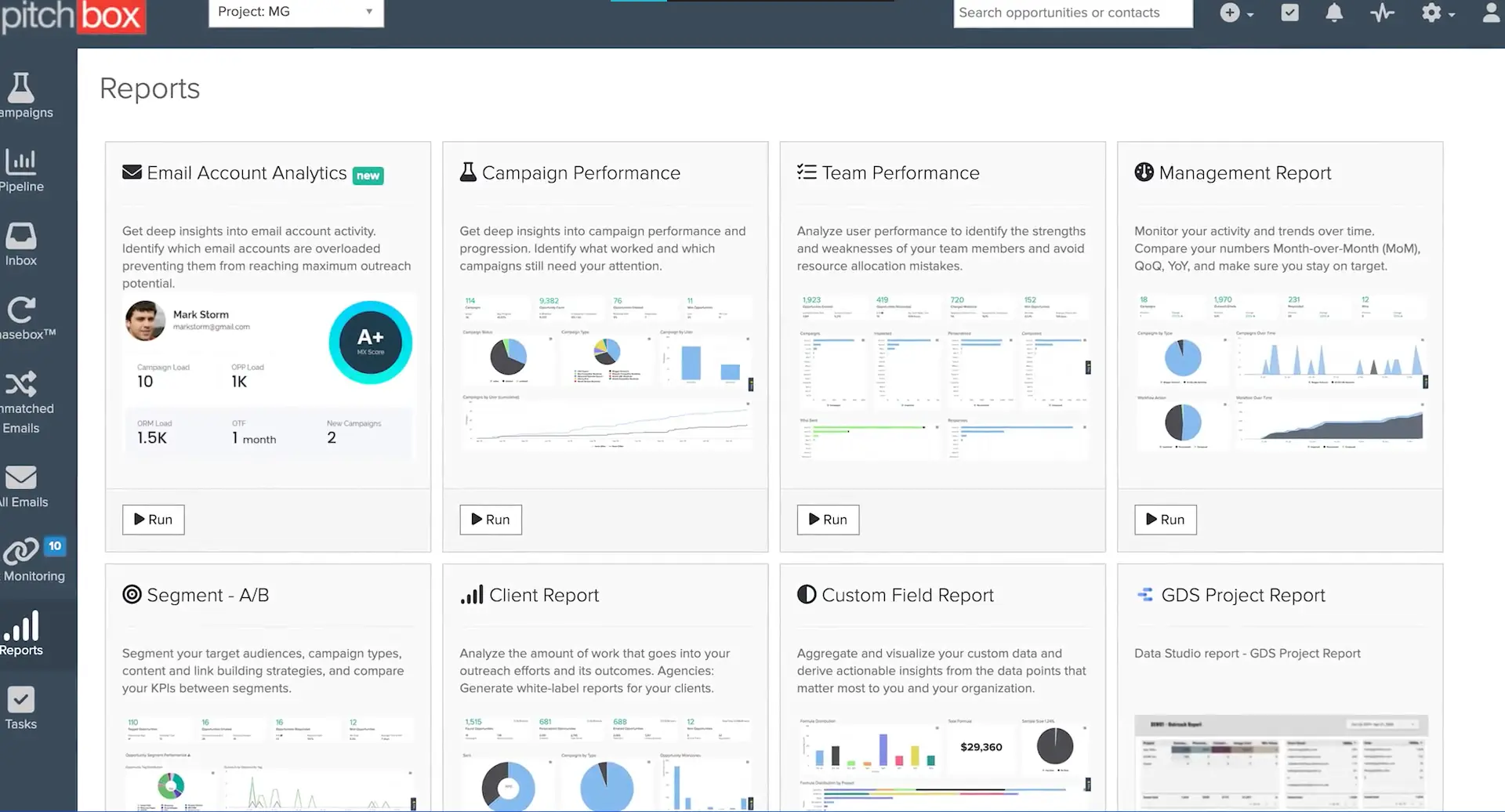 Pitchbox dashboard for link building campaigns and outreach reporting.
Key Features:
- Automated prospecting and contact discovery
- AI-assisted email personalization and subject line suggestions
- Deliverability tooling (SPF/DKIM/DMARC setup help)
- SEO metrics (DR, DA, traffic) built directly into the outreach inbox
Pros:
- Automates the entire link building workflow from prospect discovery to outreach and follow-ups.
- Includes AI-powered email personalization and AI reply generation to improve outreach efficiency.
- Integrates with Ahrefs, Semrush, Moz, Majestic, Slack, Zapier, and popular email providers.
- Built-in CRM helps manage prospects, conversations, campaigns, and backlink relationships in one place.
- Offers advanced reporting, link monitoring, and white-label reports for agencies and large teams.
Cons:
- Significantly more expensive than most outreach tools, making it difficult for bootstrapped founders.
- Primarily designed for link building rather than keyword research or content optimization.
- Rich feature set creates a steeper learning curve for beginners.
- Lower-tier plans limit users, email accounts, outreach volume, and workspaces.
- Delivers the most value for agencies and large outreach campaigns rather than small websites.
Pricing:
| Plan | Annual Price (per month) | Monthly Price | Best For | Key Highlights |
|---|---|---|---|---|
| Pro | $210/month | $300/month | Freelancers & single-site link builders | 2 users, 2 email accounts, 2,000 outreach emails/month, 25 campaigns, 1 workspace, AI personalization, AI reply, CRM, link monitoring, 1,000 prospecting searches/month. |
| Advanced | $420/month | $600/month | Growing agencies | Unlimited users, 6 email accounts, 5,000 outreach emails/month, 25 workspaces, 1,000 campaigns/month, unlimited data credits, email rotation, white-label reports, API, Slack integration. |
| Scale | $825/month | $1,200/month | Large agencies & enterprise outreach teams | Unlimited users, 20 email accounts, 25,000 outreach emails/month, unlimited campaigns, unlimited prospecting, advanced automations, Looker Studio integration, approval workflows, dedicated deliverability features. |
| Enterprise | Custom | Custom | Large enterprises | SSO, SLA, dedicated support, vendor security review, custom agreements, enterprise onboarding, private training, and compliance features. |
Best For: Pitchbox is best for SEO agencies, digital PR teams, enterprise marketing teams, and businesses that run large-scale link building and outreach campaigns.
Verdict: Pitchbox is one of the best outreach platforms for agencies and businesses running large-scale link-building campaigns. Its automation, prospecting, CRM, and reporting features can save hours of manual work and help teams scale outreach efficiently. However, if you're a solo founder or small SaaS team building links occasionally, the cost and feature set may be more than you need. Before investing, it's worth understanding which backlinks actually move the needle and exploring lower-cost, manual link-building strategies, especially if you're just getting started.
13. GrowthBar
GrowthBar bundles keyword research, competitor analysis, and a ChatGPT-4-powered writer into an affordable package aimed at marketers and small teams who want speed without a steep learning curve. GrowthBar scans Google SERPs to build an outline (headings, keywords, word counts) automatically, then lets you generate a draft with its "2-Minute Blog Builder."
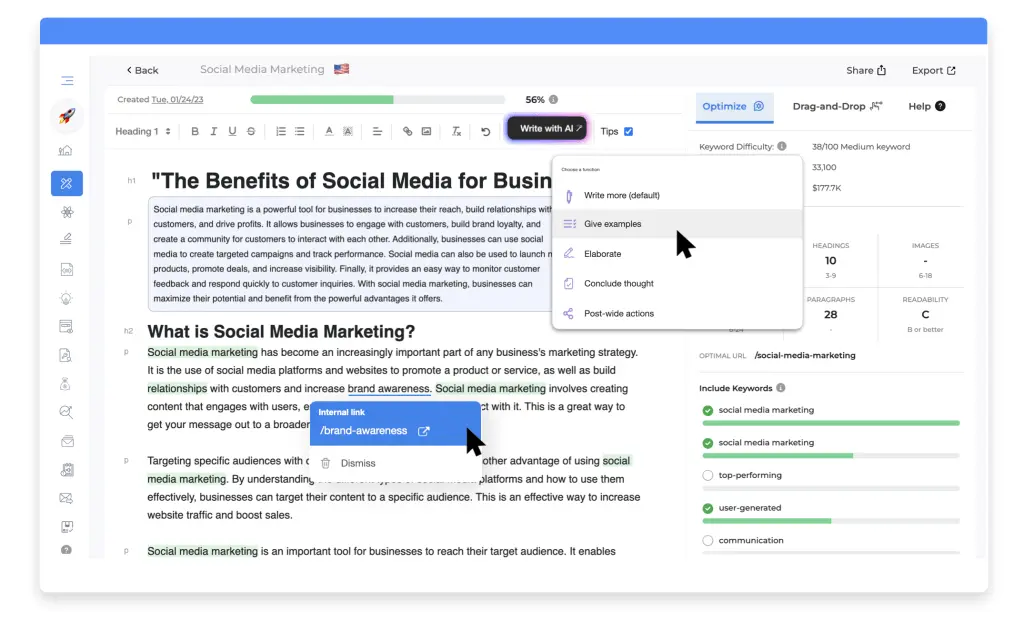 GrowthBar AI writing editor with SEO optimization and content scoring tools.
Key Features:
- One-click outline builder pulled from live SERP analysis
- ChatGPT-4-based AI writer for full drafts
- Keyword and competitor research with a Chrome extension
- Google SERPs for outline (heading, keywords, and optimized word counts)
Pros:
- Combines AI writing, keyword research, competitor analysis, and SEO optimization in one platform.
- Generates complete SEO-optimized blog posts and outlines in minutes using AI.
- Includes keyword research, backlink insights, competitor analysis, and rank tracking.
- Offers a Chrome extension for SEO research directly inside Google Search results.
- Supports team collaboration, custom AI writing styles, and direct publishing workflows.
Cons:
- Article generation and keyword tracking limits are relatively low on the Starter plan.
- Technical SEO auditing is less comprehensive than tools like Screaming Frog or Semrush.
- Backlink database is smaller than dedicated backlink analysis platforms such as Ahrefs.
- Primarily built for content marketing rather than enterprise-level SEO management.
- Multi-site management and higher usage limits require more expensive plans.
Pricing:
| Plan | Annual Price (per month) | Monthly Price | Best For | Key Highlights |
|---|---|---|---|---|
| Standard | $20.30/month | $36/month | Bloggers & solo founders | 25 AI articles/audits per month, 500 AI paragraphs, unlimited keyword research, track 25 keywords, 1 website, Chrome extension, competitor keywords, backlinks & Google Ads research. |
| Pro | $55.30/month | $74.25/month | Content marketers & growing businesses | 100 AI articles, 2,000 AI paragraphs, track 1,000 keywords across 3 sites, GSC integration, 5 user accounts, writer collaboration, advanced competitor research. |
| Agency | $90.30/month | $149.25/month | Agencies & content teams | 300 AI articles, 5,000 AI paragraphs, track 5,000 keywords across 25 sites, 10 user accounts, expanded competitor research, agency collaboration tools. |
Best For: GrowthBar is best for bloggers, content marketers, solo founders, and small SaaS teams that want to research keywords, generate long-form SEO content, and optimize articles from a single AI-powered platform.
Verdict: GrowthBar is a great choice for founders and content teams that want to simplify SEO content creation without sacrificing optimization. It combines AI writing, keyword research, competitor insights, and content optimization into a beginner-friendly workflow. However, if your strategy relies on advanced technical SEO audits, enterprise-level backlink analysis, or fully automated publishing workflows, you may need additional specialized SEO tools.
14. Ubersuggest
Ubersuggest is Neil Patel's budget-friendly entry point into SEO software, keyword research, a basic site audit, rank tracking, and AI content ideas for less than the cost of most other tools' cheapest add-on. Ubersuggest has grown from a simple keyword suggestion tool into a lightweight full SEO platform, with Individual, Business, and Enterprise tiers.
Key Features:
- Keyword research with daily search allowances
- Basic site audit and rank tracking for a single domain (Individual tier)
- AI Writer for content ideas and outlines
- Competitor keyword and backlink overview
Pros:
- Offers keyword research, site audits, rank tracking, competitor analysis, and backlink data in one affordable platform.
- One of the few SEO tools that offers both monthly and lifetime pricing options.
- Beginner-friendly interface with SEO training, templates, and educational resources included.
- Includes AI Search Visibility tracking for ChatGPT, Google Gemini, and other AI search experiences.
- Free version lets users perform basic keyword research before upgrading.
Cons:
- Keyword and backlink databases are smaller than those of Ahrefs or Semrush.
- Lower-tier plans have daily search, project, and tracking limits.
- Advanced technical SEO and enterprise reporting features are limited.
- Some SEO professionals question the freshness and accuracy of certain keyword metrics.
- Better suited for small businesses than large agencies managing many clients.
Pricing:
| Plan | Monthly Price | Lifetime Price | Best For | Key Highlights |
|---|---|---|---|---|
| Individual | $29/month | $290 | Bloggers, freelancers & solo founders | 1 project, 150 reports/day, keyword research, competitor analysis, site audit, backlink checker, AI Search Visibility, 125 tracked keywords, Chrome extension. |
| Business | $49/month | $490 | Small businesses & growing startups | 7 projects, 300 reports/day, 150 tracked keywords/project, 5,000-page site audits, AI Search Visibility, unlimited locations, 2 users. |
| Enterprise / Agency | $99/month | $990 | Agencies & enterprises | 15 projects, 900 reports/day, 300 tracked keywords/project, 10,000-page audits, advanced AI Search Visibility, 5 users, higher usage limits. |
Best For: Ubersuggest is best for bloggers, freelancers, solo founders, and small businesses looking for an affordable all-in-one SEO tool.
Verdict: Ubersuggest is one of the best budget-friendly SEO platforms for beginners and small businesses that want an all-in-one SEO solution. It offers a strong mix of keyword research, site audits, rank tracking, and competitor analysis at a fraction of the cost of premium tools. However, if you need the largest keyword databases, advanced backlink intelligence, or enterprise-grade SEO capabilities, you'll likely outgrow Ubersuggest and eventually need a more comprehensive platform.
Feature Comparison Table
Use this table to scan capabilities side by side before you read any individual review in full. It's the fastest way to rule tools out: if you need GSC integration and auto-publishing together, for instance, the list narrows to just a handful of rows immediately.
| Tool | Keyword Research | AI Writing | Content Strategy | Auto-Publish | GSC | GA4 | Internal Links | CMS Support | Rank Tracking | Technical SEO | AEO Support | API | Team Collab | Entry Price |
|---|---|---|---|---|---|---|---|---|---|---|---|---|---|---|
| LLaMaRush | ✔ | ✔ | ✔ | ✔ | ✔ | - | - | ✔ | ~ | - | ✔ | ~ | - | $29/mo |
| Ahrefs | ✔ | - | ~ | - | ~ | - | ~ | - | ✔ | ✔ | ~ | ✔ | ✔ | $29/mo |
| Semrush | ✔ | ~ | ✔ | - | ~ | ~ | ~ | - | ✔ | ✔ | ✔ | ✔ | ✔ | $139.95/mo |
| SEObot | ✔ | ✔ | ✔ | ✔ | - | - | ✔ | ✔ | - | - | ~ | ✔ | ~ | $49/mo |
| Outrank | ✔ | ✔ | ✔ | ✔ | - | - | ✔ | ✔ | - | - | ~ | ~ | ✔ | $99/mo |
| Frase | ✔ | ✔ | ✔ | - | ✔ | ✔ | - | ✔ | - | - | ✔ | - | ✔ | $45/mo |
| Outranking | ✔ | ✔ | ✔ | - | ✔ | - | ✔ | ~ | - | ~ | - | - | ✔ | $19/mo |
| Scalenut | ✔ | ✔ | ✔ | ✔ | ✔ | ~ | ✔ | ✔ | - | ✔ | ✔ | - | ✔ | $49/mo |
| Surfer SEO | ~ | ✔ | ~ | - | - | - | ✔ | ✔ | - | - | ✔ | - | ✔ | $99/mo |
| Screaming Frog | - | - | - | - | ✔ | ✔ | ~ | - | - | ✔ | - | ~ | - | Free/~$23/mo |
| SE Ranking | ✔ | ~ | ~ | - | ~ | ~ | ~ | - | ✔ | ✔ | ✔ | ✔ | ✔ | $103.20/mo |
| AccuRanker | - | - | - | - | ✔ | ✔ | - | - | ✔ | - | ✔ | ✔ | ✔ | $109/mo |
| Pitchbox | - | ~ | - | - | - | - | - | - | - | - | - | ~ | ✔ | $165/mo |
| GrowthBar | ✔ | ✔ | ~ | - | ✔ | - | ✔ | - | ✔ | - | - | ~ | ✔ | $36/mo |
| Ubersuggest | ✔ | ✔ | ~ | - | ~ | - | - | - | ✔ | ✔ | - | - | - | ~$12/mo |
✔ = fully supported · ~ = partial/add-on · - = not offered
Which Tool Is Right for You?
-
Solo Founder: LLaMaRush or Ubersuggest, depending on whether you want content automated or just cheap research. Start with solo founder SEO if you're unsure how much to automate versus do yourself.
-
Indie Hacker: LLaMaRush or SEObot for hands-off publishing; GrowthBar if you'd rather write yourself but want SEO data alongside you.
-
Bootstrapped SaaS: LLaMaRush paired with Screaming Frog for an occasional technical check covers most of what a pre-seed to seed-stage SaaS needs. See the full SaaS SEO roadmap for the nine-step version of this.
-
Startup Team (funded, small marketing hire): Surfer SEO or Scalenut for content, paired with SE Ranking for tracking and audits.
-
Agency: Ahrefs or Semrush for research and reporting, SE Ranking for white-labeled client dashboards, Pitchbox for outreach at volume. If you're outsourcing instead of buying tools, read how to choose a SaaS SEO agency without getting burned first.
-
Enterprise: Semrush Business or Ahrefs Enterprise, plus AccuRanker for large-scale rank tracking across many domains.
How to Integrate SaaS SEO Tools Into Your Workflow
Automation tools work best when they're plugged into a consistent pipeline rather than used ad hoc. A practical version of that pipeline looks like this:
Idea → Research → Clustering → Brief → Writing → Optimization → Publishing → Tracking → Updating
- Idea generation - pull from Search Console gaps, competitor content, or a content idea generator.
- Research - validate volume and intent with Ahrefs, Semrush, or Ubersuggest.
- Clustering - group related keywords so you're not writing five posts competing against each other (see keyword cannibalization).
- Brief - generate a structured outline with a content brief generator or Outranking.
- Writing - draft with LLaMaRush, SEObot, Scalenut, or GrowthBar depending on how hands-off you want to be.
- Optimization - score the draft in Surfer or Frase, and tighten titles and meta descriptions
- Publishing - auto-publish via CMS integration (WordPress, Ghost, Webflow) rather than copy-pasting.
- Tracking - monitor rankings and clicks weekly in Search Console, SE Ranking, or AccuRanker.
- Updating - revisit underperforming posts using a competitor content gap analysis every few months.
Common Mistakes to Avoid
Most of the regret founders report after buying an SEO tool traces back to one of five avoidable mistakes:
- Buying enterprise tools too early. Semrush Business or Ahrefs Advanced solve problems most solo founders don't have yet. Start at the lowest tier that covers your actual workflow.
- Ignoring integrations. A tool that doesn't connect to your CMS or Search Console adds a manual export/import step to every single post, the opposite of automation.
- Paying for unused features. Most all-in-one suites are bought for 20% of what they offer. Map your actual weekly tasks to features before upgrading tiers.
- Using AI without a strategy. Publishing AI-written posts with no keyword research or clustering behind them tends to produce content that ranks nowhere. Automation should execute a strategy, not replace having one.
- Ignoring Google Search Console. Even with a fully automated tool, GSC is still the only place you'll see exactly how Google sees your site, skipping it means flying blind on what's actually working. If you're weighing the real cost of skipping automation entirely, see how much SEO actually costs a small business.
Frequently Asked Questions
Q1. What's the best SEO automation tool for a solo SaaS founder?
A1: For founders who want the entire pipeline handled, LLaMaRush is built specifically for that use case, connecting to GSC/GA4 and auto-publishing content. If you'd rather just speed up research and writing yourself, GrowthBar or Ubersuggest are cheaper entry points.
Q2. Are AI-written blog posts penalized by Google?
A2: Google has repeatedly said it doesn't penalize content for being AI-assisted; it penalizes low-quality, unhelpful content regardless of how it was produced. The risk isn't the AI, it's publishing unedited, un-researched drafts at volume.
Q3. How much should a bootstrapped SaaS spend on SEO tools per month?
A3: Most solo founders can run a functional stack for $75-150/month: one automation or writing tool plus occasional use of a free-tier research tool like Screaming Frog or Ahrefs Starter.
Q4. Can SEO automation tools fully replace an SEO agency?
A4: For content production, often yes. For complex technical migrations, enterprise link building, or multi-market strategy, a human strategist still adds value automation tools don't replace.
Q5. Do I need coding skills to use these tools?
A5: No. Every tool covered here is designed for marketers and founders, not developers. CMS integrations (WordPress, Ghost, Webflow) are typically one-click connections.
Q6. What's the difference between an SEO automation tool and a plain AI writing tool?
A6: A plain AI writer (like general-purpose ChatGPT usage) drafts text from a prompt with no site-specific data behind it. SEO automation tools like LLaMaRush base decisions on your actual Search Console data, keyword difficulty, and competitor content, the automation is in the decision-making, not just the drafting.
Q7. How long before SEO automation tools show results?
A7: Most new or improved content takes 3-6 months to gain meaningful rankings, regardless of the tool used. Automation speeds up production and consistency; it doesn't speed up how quickly Google indexes and trusts new pages.
Q8. Can I use multiple SEO automation tools together?
A8: Yes, and most serious stacks do, for example, Ahrefs for research, LLaMaRush or Surfer for content, and Screaming Frog for periodic technical audits.
Q9. What is AEO/GEO, and do I need a tool that supports it?
A9: Answer/Generative Engine Optimization means optimizing content to be cited inside AI answers (ChatGPT, Perplexity, Google AI Overviews), not just ranked in blue links. Tools like Frase, Scalenut, SE Ranking, and Semrush's AI Visibility Toolkit now track this directly.
Q10. Which tool has the best free trial or free tier?
A10: Screaming Frog's free tier (500 URLs) is usable indefinitely, not just a time-limited trial. SE Ranking and AccuRanker both offer 14-day trials, longer than most competitors' standard 7 days.
Q11. Do these tools work for e-commerce sites, not just SaaS blogs?
A11: Most do, though tools like SurferSEO, SEObot, and Outrank are optimized specifically for blog content rather than product pages. Ahrefs, Semrush, and SE Ranking are more content-type agnostic.
Q12. What CMS platforms are most widely supported?
A12: WordPress has the broadest support across this list. Ghost, Webflow, Shopify, and Notion are also commonly supported, particularly by SEObot, Outrank, and Scalenut.
Q13. Is Google Search Console integration actually necessary?
A13: It's not strictly required, but tools that use it (LLaMaRush, Frase, Outranking, Scalenut, GrowthBar) can target keywords your site already has partial ranking traction on, generally an easier win than starting from zero.
Q14. What's the biggest mistake founders make when adopting SEO automation?
A14: Treating the tool as a strategy rather than an execution layer, publishing whatever the AI suggests without checking it against real search intent or your product positioning.
Q15. Should I start with a free tool before paying for automation?
A15: Yes. Google Search Console and Screaming Frog's free tier cost nothing and will tell you more about your current SEO health than any paid tool will in week one.
Q16. How many articles per month do I actually need to see growth?
A16: There's no universal number, but consistency matters more than volume. Two or three well-researched posts a week, published on a predictable schedule, generally outperform a burst of ten posts followed by months of silence.
Q17. Do SEO automation tools replace the need for backlinks?
A17: No. Content automation covers on-page work, but authority still comes largely from other sites linking to yours. Pair a content tool with either manual outreach or a dedicated platform like Pitchbox once your content library is established.
Final Verdict
- Best Overall: Ahrefs - the deepest research data in the category, even without built-in writing or publishing.
- Best Budget: Ubersuggest - usable SEO fundamentals for a fraction of what most competitors charge.
- Best AI-Powered: SEObot - the most autonomous, agent-driven content operation on this list.
- Best Enterprise: Semrush - the broadest all-in-one platform for teams managing multiple sites or clients.
- Best for Founders: LLaMaRush - purpose-built around a founder's actual constraint, which is time, keyword research, and automated content.
- Best for Agencies: SE Ranking - Ahrefs/Semrush-level breadth with white-label reporting at a lower price point.
Thanks for reading! ❤️
Written by
JenishRead Next




Turn this into your AI Search strategy
LLaMaRush creates SEO, AEO, and GEO optimized content built to rank in Google and get cited by AI answer engines.
Start Ranking Everywhere